
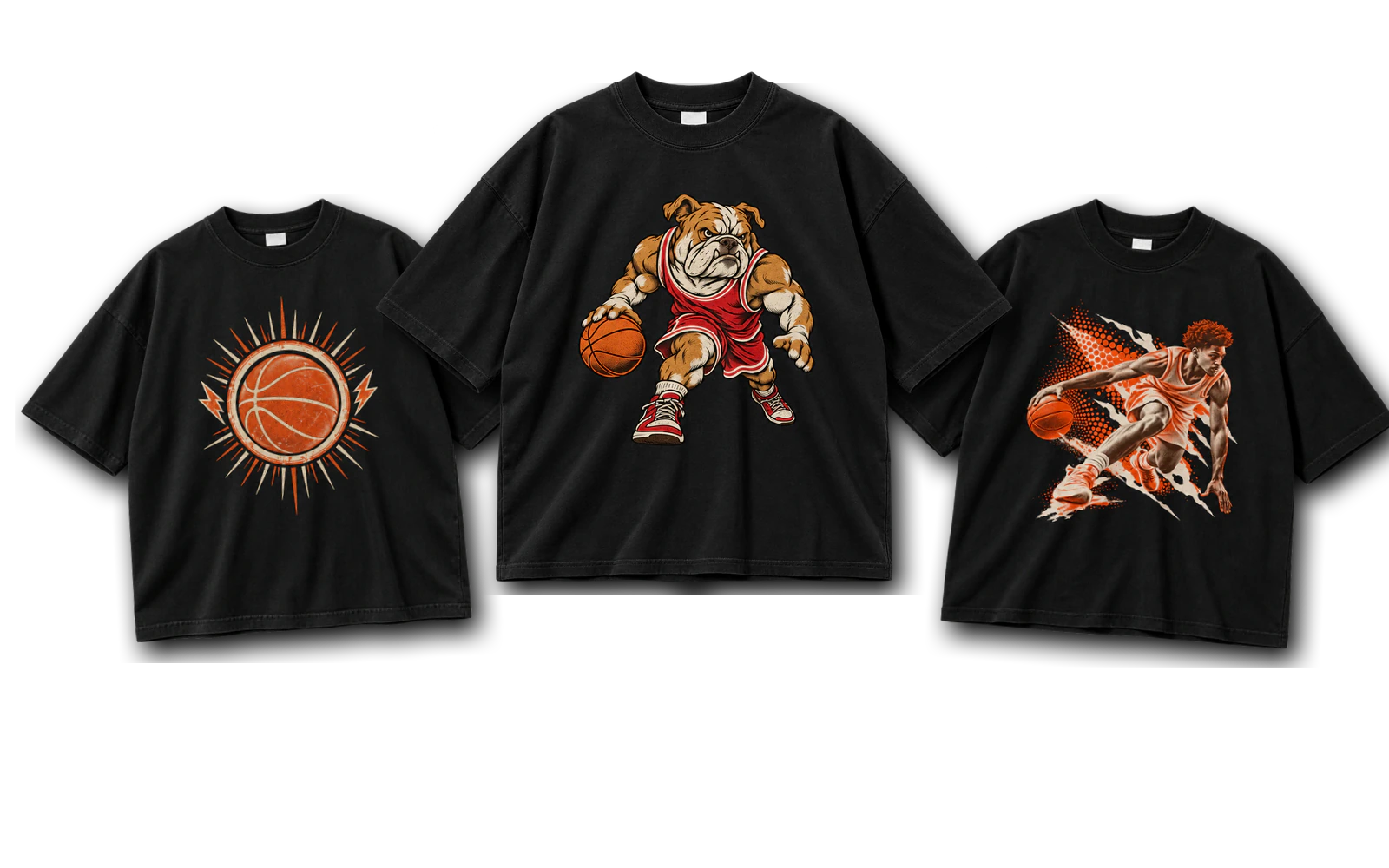
Basketball T-shirt design ideas can range from vintage athletic graphics, retro player collages, collegiate typography, team logos, and roster layouts to graffiti artwork, neon illustrations, watercolor graphics, character-based designs, championship t-shirts, and senior-night concepts. A clear visual direction helps each basketball t-shirt design communicate one dominant idea, while elements such as player numbers, team colors, school names, mascots, hoops, or basketball graphics provide supporting context.
The final result of a basketball T-shirt design idea also depends on scale, placement, garment color, and production method. Compact 2 to 4 inch marks work well for chest logos and embroidery, 8 to 12 inch graphics suit standard front designs, and 12 to 14 inch compositions provide more room for portraits, streetwear artwork, and oversized basketball graphics. Screen print fits bold limited-color designs, DTG and DTF support detailed artwork, embroidery suits simplified marks, puff print works with thick lettering, and patches fit badge-style graphics.
50 basketball T-shirt design ideas are:
- Vintage Basketball Graphic
- Retro 90s Basketball Graphic
- Collegiate Basketball Typography
- Varsity Basketball Typography
- Arched Team Name Design
- Basketball Team Logo Design
- Basketball Mascot Design
- Basketball Badge or Emblem Design
- High School Basketball Shirt Design
- Basketball Shooting Shirt Design
- Basketball Warm-Up Shirt Design
- Player Name and Number Design
- Player Portrait Design
- Halftone Player Graphic
- Slam Dunk Graphic
- Basketball Team Roster Design
- Basketball Legend Graphic
- All-Star Basketball Design
- Basketball Number Graphic
- Game Day Basketball Design
- Basketball Slogan Typography
- Motivational Basketball Quote Design
- Flaming Basketball Graphic
- Graffiti Basketball Design
- Streetwear Basketball Graphic
- Basketball Sneaker Graphic
- Basketball with Paint Splatter
- Neon Basketball Graphic
- Basketball and Rose Graphic
- Basketball Hoop Graphic
- Basketball and Net Illustration
- Basketball Doodle Character Design
- Cartoon Basketball Character
- Basketball Line Art Design
- Basketball Heartbeat Graphic
- Basketball Heart Design
- Watercolor Basketball Design
- Basketball Astronaut Design
- Basketball Character with Sunglasses
- Basketball Court Graphic
- Basketball Championship Design
- Basketball Tournament Design
- Basketball Camp Design
- Basketball Crown and Trophy Graphic
- State Basketball Shirt Design
- Senior Night Basketball Design
- Basketball Mom Design
- Basketball Coach Design
- Coquette Bow Basketball Design
- Youth Basketball Shirt Design
50 Basketball T-Shirt Design Ideas
1. Vintage Basketball Graphic
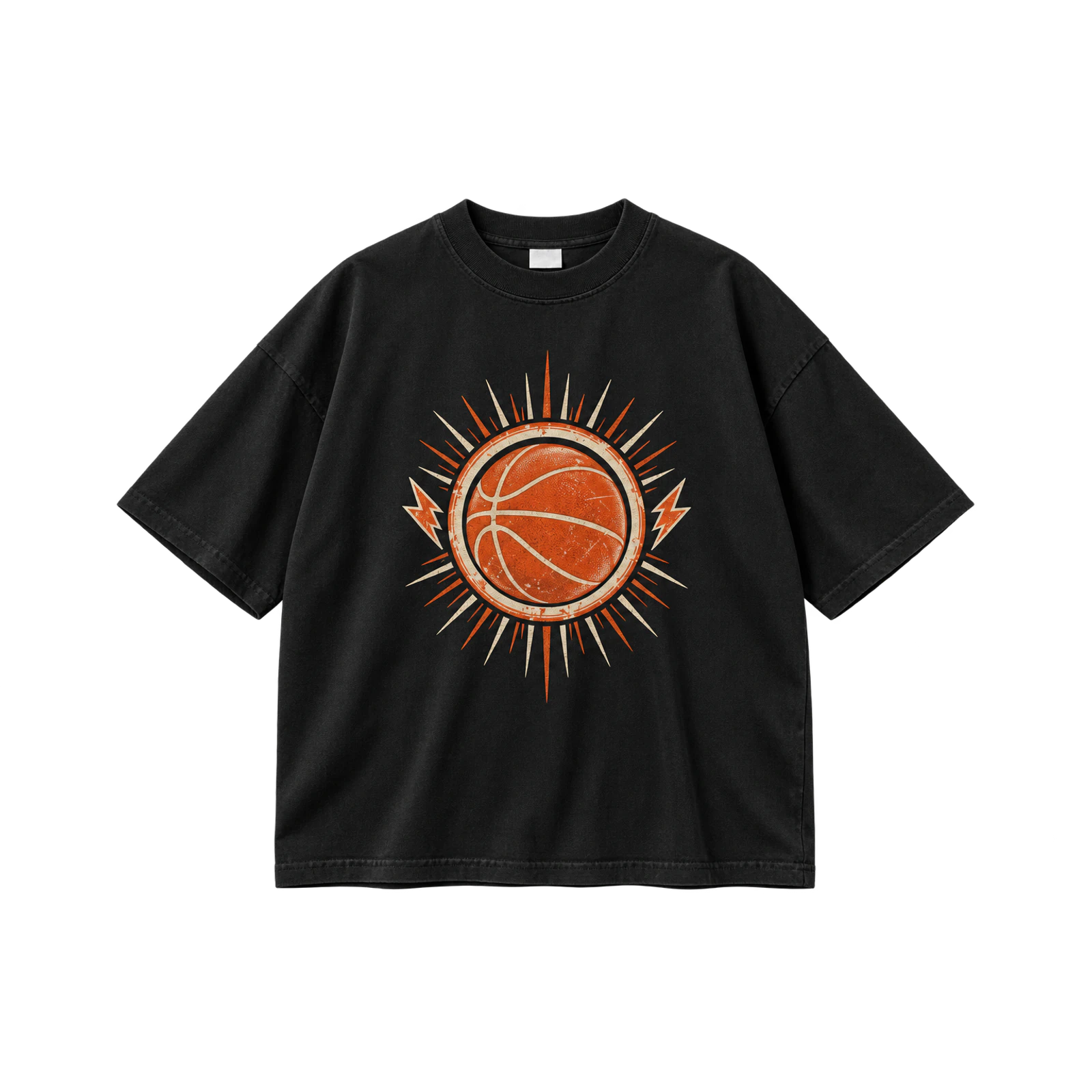
Among classic basketball T-shirt design ideas, a vintage graphic uses faded athletic lettering, distressed textures, limited colors, and old-school basketball emblems to recreate worn team apparel. A central ball anchors the composition beneath an arched team name, city, or established year, while controlled distressing adds age without reducing readability. An 8- to 12-inch chest graphic suits detailed layouts, while simplified emblems translate effectively into smaller embroidered applications.
Key Features: Distressed typography, faded colors, basketball emblems, team names, city names, established years, aged textures, and retro athletic details.
Best For: Retro basketball t-shirts, school teams, basketball clubs, fan apparel, vintage sportswear, team merchandise, and old-school basketball T-shirts.
Popular directions:
- Faded team graphic: Place distressed team lettering above a centered basketball, then add an established year or city name underneath to complete the old-school athletic layout.
- Old athletic emblem: Enclose the basketball inside a worn circular badge, curve the team name around the border, and use small dividers to structure the emblem.
- Retro wordmark: Build the design around aged athletic typography, then position a small basketball or team initial beside the wording as a secondary identifier.
- Established-year design: Make the team or school name dominant, place the founding year beneath it, and use one faded basketball to connect the typography with the sport.
- Distressed basketball: Enlarge the basketball as the focal graphic, apply controlled wear across its surface, and surround it with restrained team wording.
- Vintage city graphic: Combine a city name with a traditional basketball emblem, muted team colors, and a smaller club or season line for local retro merchandise.
2. Retro 90s Basketball Graphic
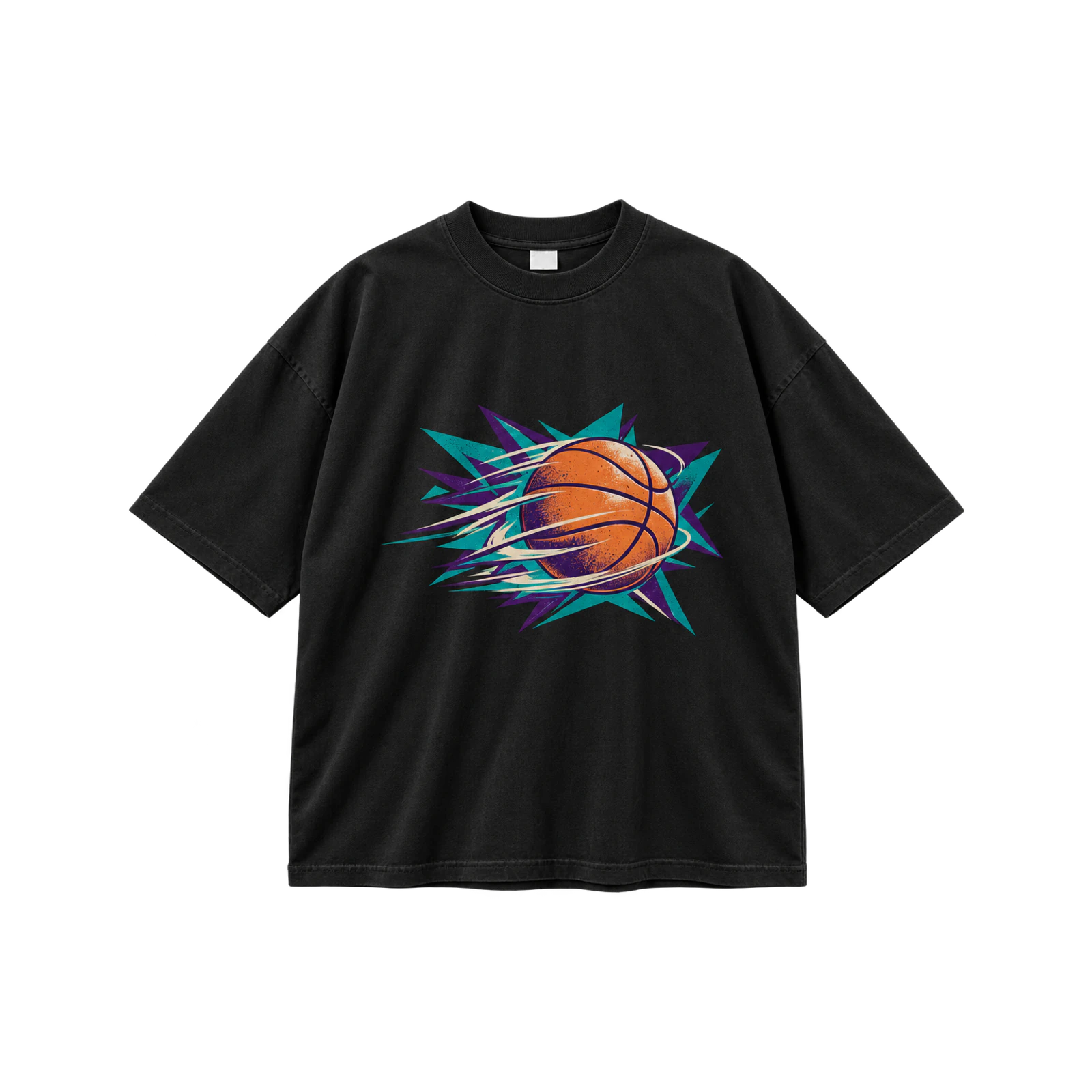
For a colorful basketball t-shirt design, a retro 90s graphic combines oversized player imagery, geometric shapes, layered typography, repeated numbers, and vivid color blocks. The player overlaps circles, grids, or angular forms while a large jersey number creates depth behind the figure. A 12- to 14-inch front or back composition gives each layer sufficient space, while DTG or DTF reproduces detailed multi-color artwork and tonal transitions.
Key Features: Player imagery, geometric shapes, layered typography, bright colors, large numbers, basketball graphics, grids, and 90s-inspired details.
Best For: Retro basketball apparel, player t-shirts, streetwear collections, fan merchandise, throwback graphics, fashion brands, and oversized basketball T-shirts.
Popular directions:
- Player collage: Place a large player image in the foreground, layer the jersey number behind it, and fill open areas with geometric shapes or repeated team text.
- Retro geometry: Build the background from circles, grids, triangles, and color blocks, then place a basketball or player silhouette over the strongest shapes.
- Oversized number: Make the jersey number the largest background element, overlap it with player imagery, and add smaller team wording across the foreground.
- Repeated wordmark: Repeat the player or team name in several rows behind the focal graphic, using scale changes to create depth without reducing readability.
- Bright color blocks: Frame a player or basketball with contrasting rectangular and angular color fields, keeping the brightest treatment around the main subject.
- Throwback back print: Build a large rear composition from a player portrait, jersey number, team name, and geometric details arranged in a poster-style hierarchy.
3. Collegiate Basketball Typography
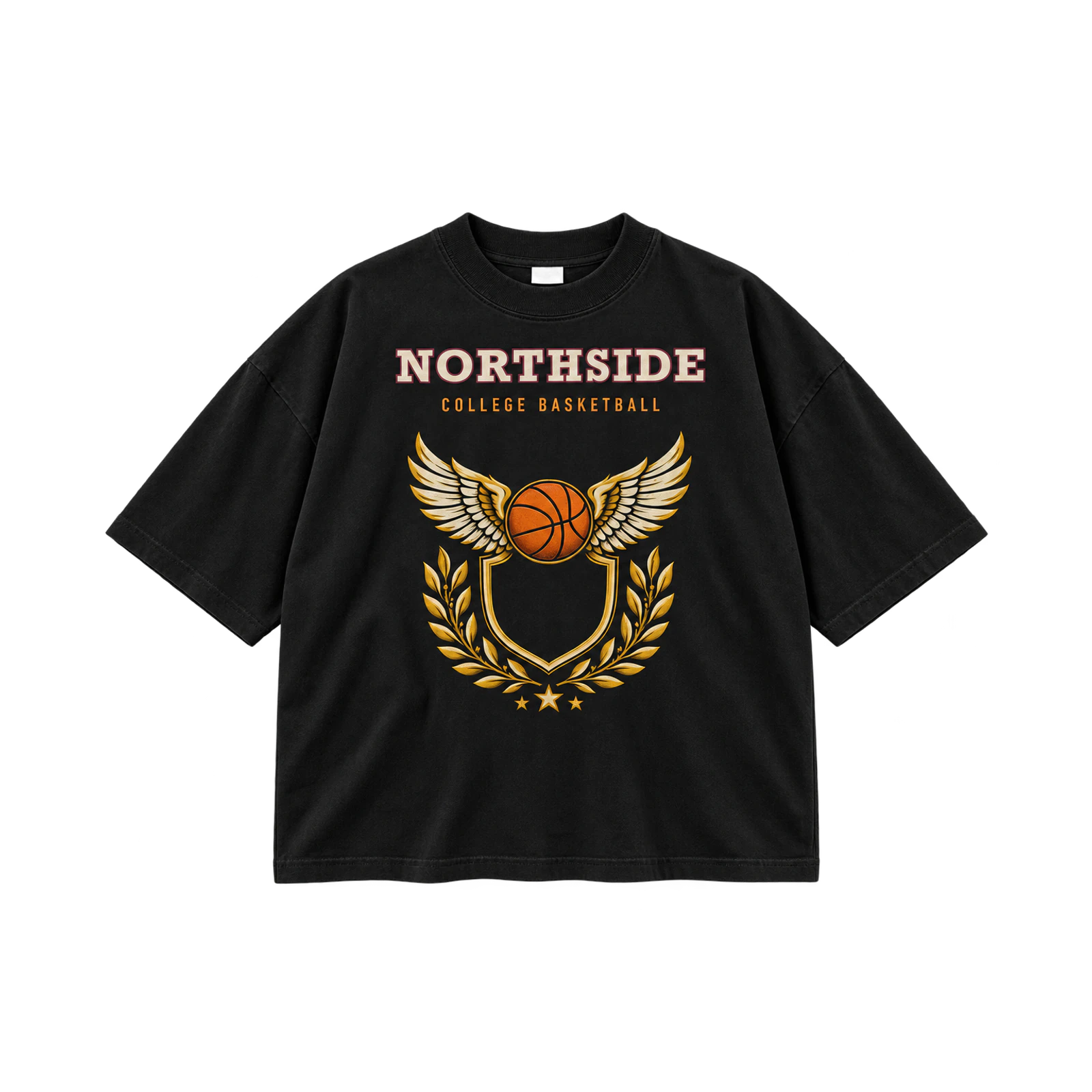
College-focused basketball t-shirt designs use arched school names, broad block lettering, basketball symbols, and established years to create a structured campus-athletics appearance. The school name dominates the upper section while a ball, location, or year fills the supporting space beneath it. An 8- to 12-inch chest layout keeps longer names readable, while screen print, puff print, and simplified embroidery reproduce the bold typographic structure effectively.
Key Features: Arched lettering, school names, team names, block typography, basketball symbols, established years, campus identity, and symmetrical layouts.
Best For: College basketball teams, school merchandise, campus apparel, student organizations, alumni t-shirts, intramural teams, and collegiate fan apparel.
Popular directions:
- Arched school name: Curve the full school name above a central basketball, then place the team nickname or campus location beneath it for a balanced collegiate structure.
- College seal layout: Arrange the school name around a circular border, position a basketball or initial in the center, and add an established year below.
- Initial and ball: Enlarge one school initial, overlap it with a basketball, and place the institution or team name in smaller lettering underneath.
- Campus wordmark: Use bold collegiate lettering for the school name, then add the city, state, or campus designation as a smaller secondary line.
- Established-year design: Place the school name across the top, position the founding year beneath it, and use a small basketball to separate the information.
- Two-line collegiate type: Stack the school and basketball wording in contrasting sizes, using a central ball or horizontal rule to connect both typographic lines.
4. Varsity Basketball Typography
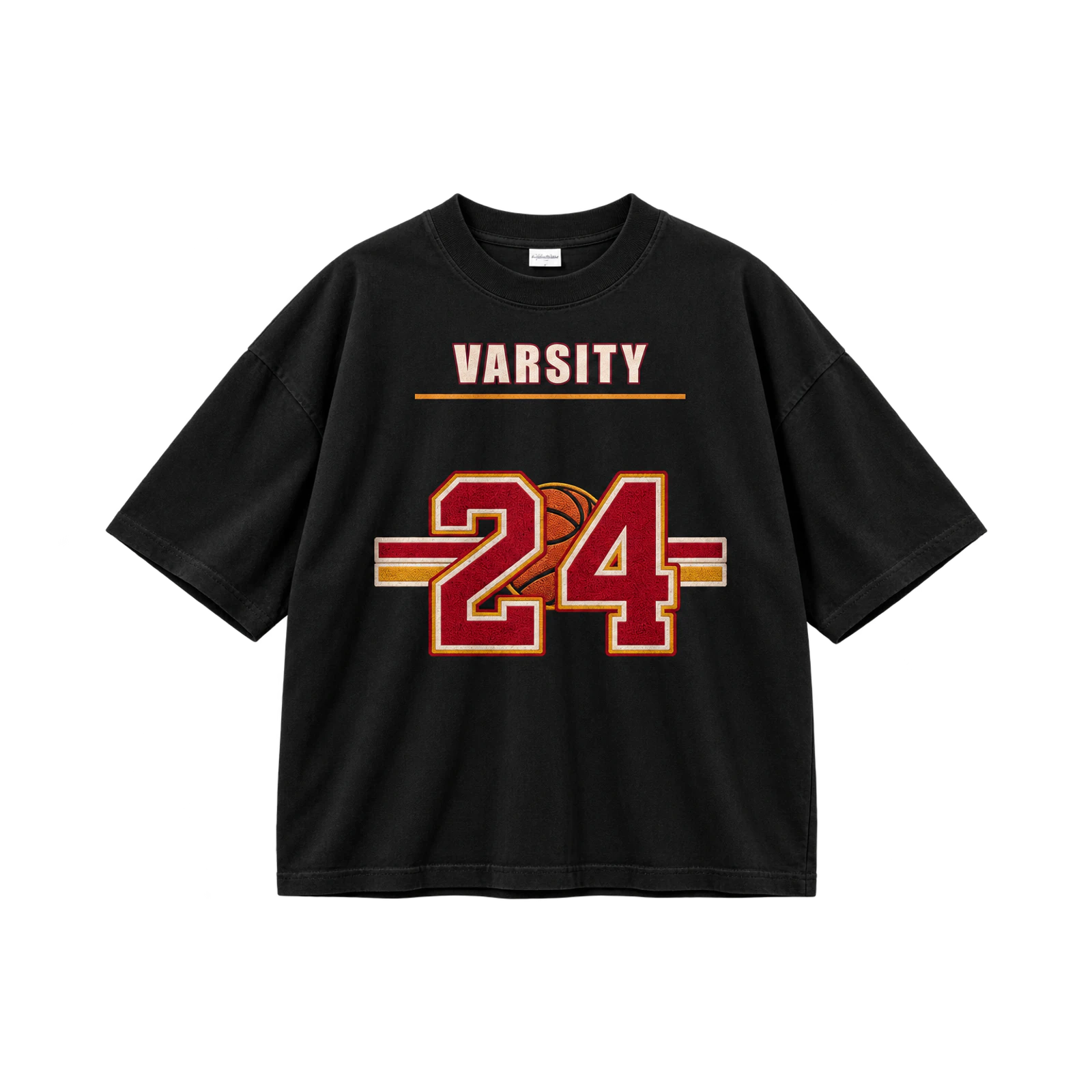
A varsity basketball T-shirt concept uses wide athletic letters, bold jersey numbers, contrasting outlines, stripes, and simple basketball marks to create a strong school-team identity. The number anchors the composition while the team name sits above or across it, establishing a clear hierarchy. An 8- to 12-inch print suits full chest layouts, while compact initials and numbers provide cleaner options for embroidery and smaller placements.
Key Features: Varsity letters, jersey numbers, athletic outlines, team names, stripes, basketball symbols, school colors, and bold typography.
Best For: School basketball teams, varsity programs, player t-shirts, student apparel, team merchandise, pep events, and athletic department clothing.
Popular directions:
- Team and number: Place the team name above a large jersey number, then add a smaller school or season line underneath to complete the varsity structure.
- Outlined varsity type: Use thick athletic letters with contrasting inner and outer borders, keeping secondary wording smaller so the team name remains dominant.
- Initial-based design: Make one school initial the primary graphic, overlap it with a small basketball, and place the team nickname across the lower section.
- Number centerpiece: Enlarge the player’s number at the center, position the surname above it, and add restrained team wording beneath for identification.
- Striped lettering: Add horizontal athletic stripes behind or through the team name, then use a small basketball or number to reinforce the sport.
- Back varsity layout: Position the player’s surname across the shoulders, place a large number beneath it, and add a small team identifier near the lower edge.
5. Arched Team Name Design
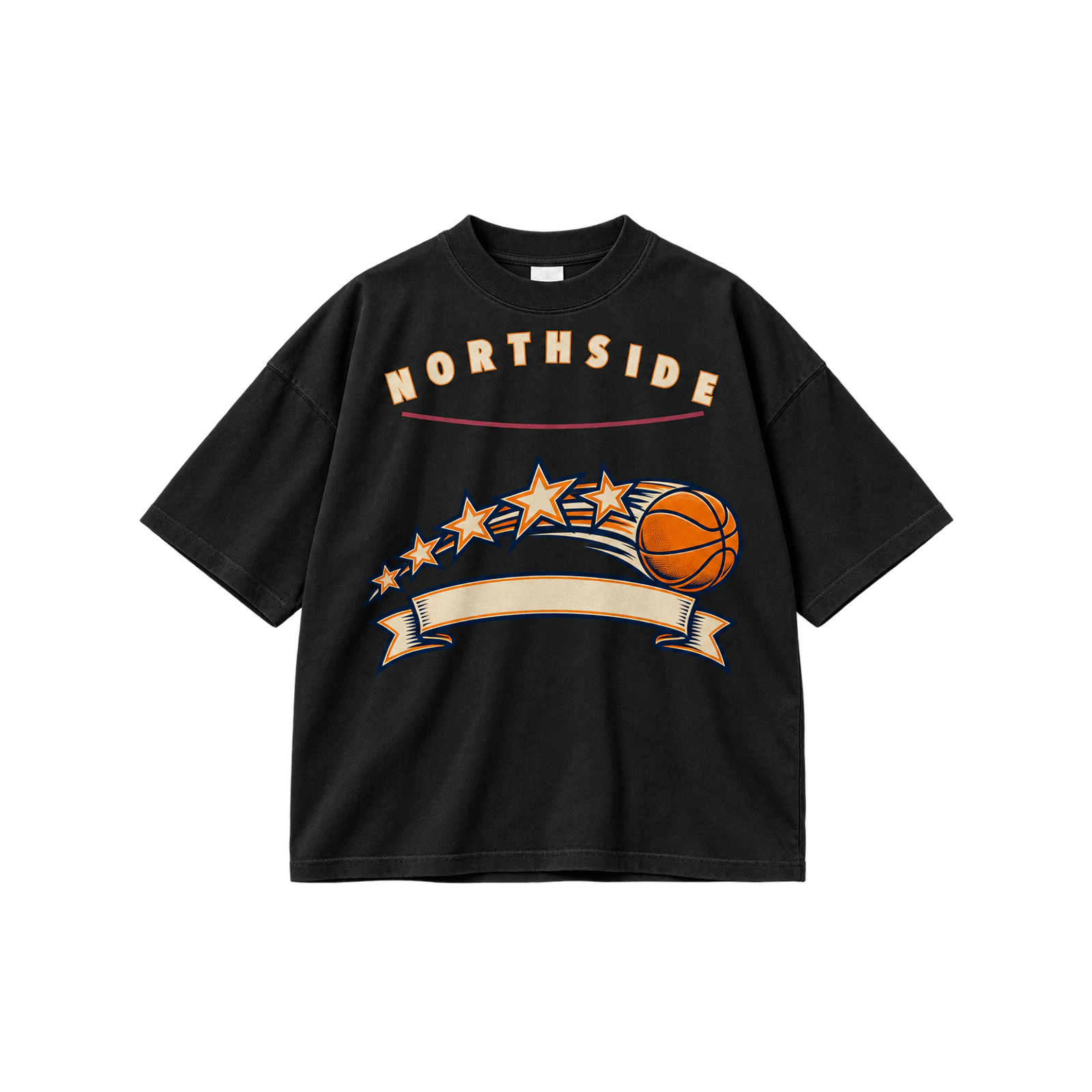
Team-centered basketball t-shirt ideas use an arched school, city, or club name to frame a basketball, mascot, jersey number, or compact team mark. A shallow curve suits longer names, while a tighter arch creates a stronger frame around smaller central graphics. An 8- to 12-inch chest width supports readable athletic lettering, while a simplified arch with one central symbol provides a practical option for embroidery.
Key Features: Arched team names, school names, basketballs, mascots, jersey numbers, athletic typography, team marks, and centered layouts.
Best For: Basketball teams, school programs, recreational leagues, club teams, fan apparel, tournament t-shirts, and matching team T-shirts.
Popular directions:
- Team and basketball: Curve the complete team name above a centered basketball, then add the season, city, or school name beneath for a balanced composition.
- School and mascot: Arch the school name over a mascot head, place a basketball beneath the character, and use the team nickname as supporting text.
- Team and number: Place a large jersey number beneath the curved team name, then add a small basketball between the number and secondary wording.
- City team design: Use the city name as the upper arch, place the club name beneath it, and anchor the layout with a basketball in the center.
- Double arch: Curve the school name above the central ball and the team nickname below it, creating a symmetrical badge-like typographic arrangement.
- Minimal arch: Use one clean curved team wordmark above a small basketball, leaving generous negative space for a simpler athletic t-shirt design.
6. Basketball Team Logo Design
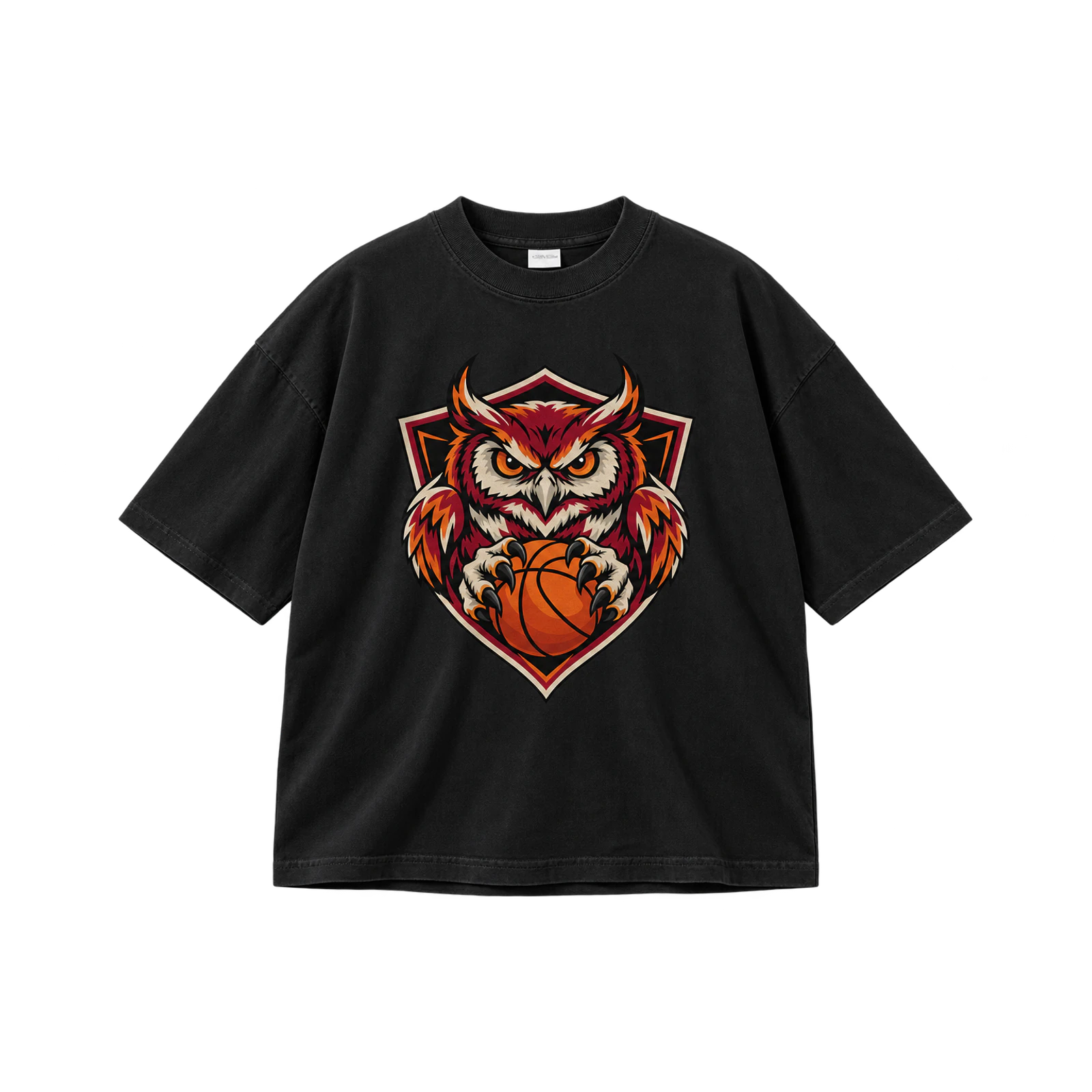
Logo-based basketball T-shirt designs rely on a recognizable team mark built from initials, basketball seams, mascots, geometric forms, or compact badge structures. The logo retains its identity at multiple sizes, supporting use across fan t-shirts, warm-ups, and staff apparel. A 2- to 4-inch chest mark creates restrained branding, while an 8- to 12-inch version gives the same team identity stronger front-shirt visibility.
Key Features: Team logos, initials, basketball symbols, mascots, geometric forms, team colors, compact marks, and recognizable identities.
Best For: Basketball clubs, school teams, recreational leagues, warm-up apparel, fan merchandise, staff clothing, and team branding systems.
Popular directions:
- Initial logo: Merge one or two team initials with basketball seam lines, then use a compact outer shape to keep the identity readable at smaller sizes.
- Mascot logo: Center a simplified mascot head inside the mark, place the team name around it, and use a basketball detail to establish the sport.
- Badge logo: Enclose the team name, initials, and basketball inside a circle or shield, using a strong border to unify the separate elements.
- Letter-ball logo: Replace part of a large team initial with basketball seams, keeping the letter recognizable while integrating the sport directly into the mark.
- Geometric logo: Construct the team identity from angular letters and simplified basketball shapes, using symmetry and negative space to create a compact modern symbol.
- Chest-and-back system: Place a small team logo on the front chest, then repeat an enlarged version on the back with the full team name.
7. Basketball Mascot Design
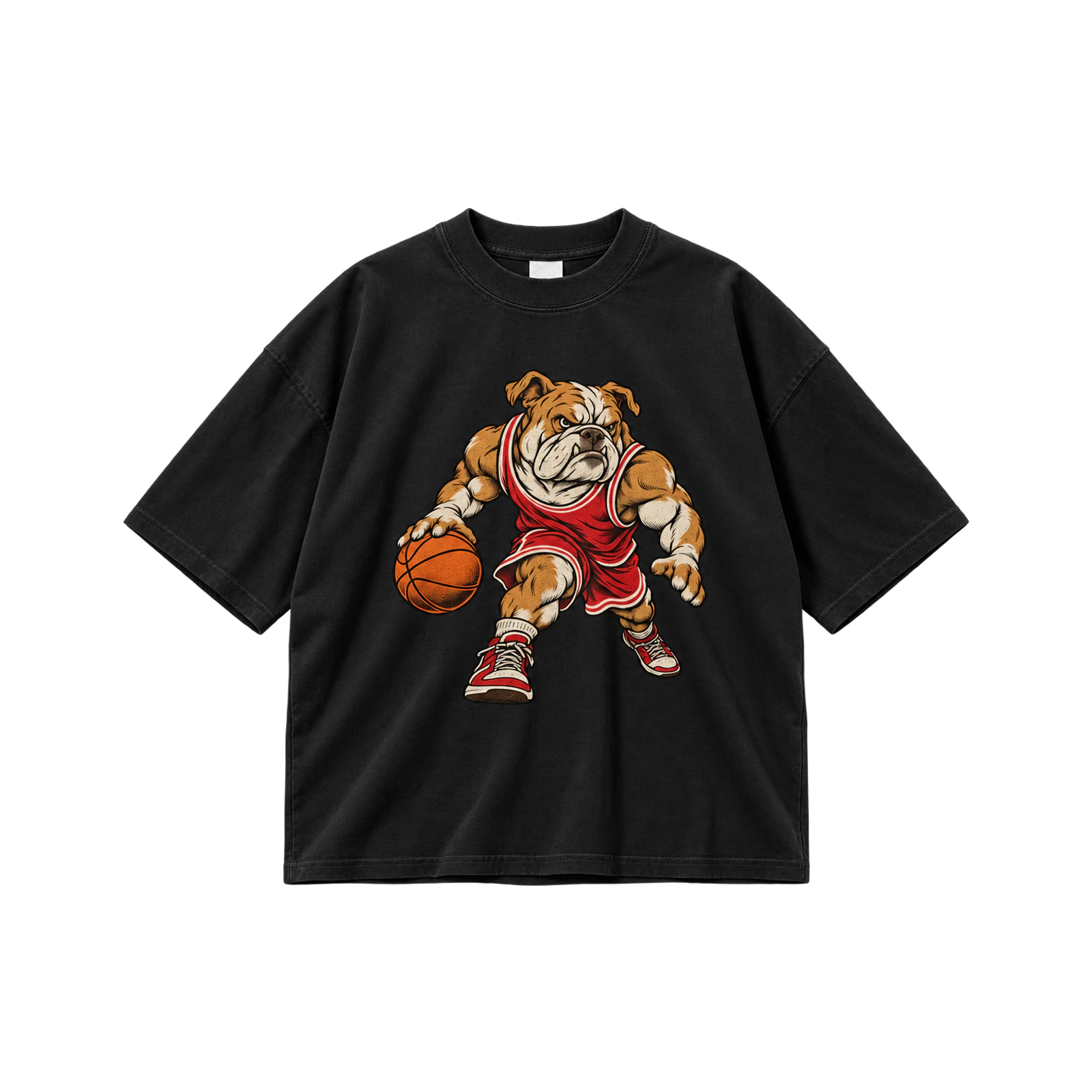
Character-led basketball t-shirt designs make one recognizable mascot the focal point and use the team name, ball, uniform, and school colors as supporting elements. The mascot holds a basketball, wears a jersey, or takes an active playing pose while its facial details remain unobstructed. An 8- to 12-inch print supports full character artwork, while a simplified mascot head suits compact embroidery and team-logo applications.
Key Features: Mascot characters, basketballs, uniforms, team names, school colors, expressive poses, athletic lettering, and team identity.
Best For: School basketball teams, youth programs, club teams, student apparel, fan merchandise, tournaments, and mascot-based team branding.
Popular directions:
- Mascot holding a ball: Position the mascot in a strong standing pose with a basketball in one hand, then frame it with the team name.
- Mascot and team name: Make the character the center of the graphic, arch bold team lettering above it, and add the school name below.
- Mascot head emblem: Crop the character to a recognizable head, surround it with a circular border, and add compact basketball and team details.
- Uniformed mascot: Dress the mascot in the team’s jersey and number, then use school colors throughout the character and supporting typography.
- Action mascot: Show the character dribbling, shooting, or dunking, using controlled motion lines to emphasize the basketball action.
- Mascot back graphic: Place a large illustrated mascot on the rear, then use a simplified team logo or initial on the front chest.
8. Basketball Badge or Emblem Design
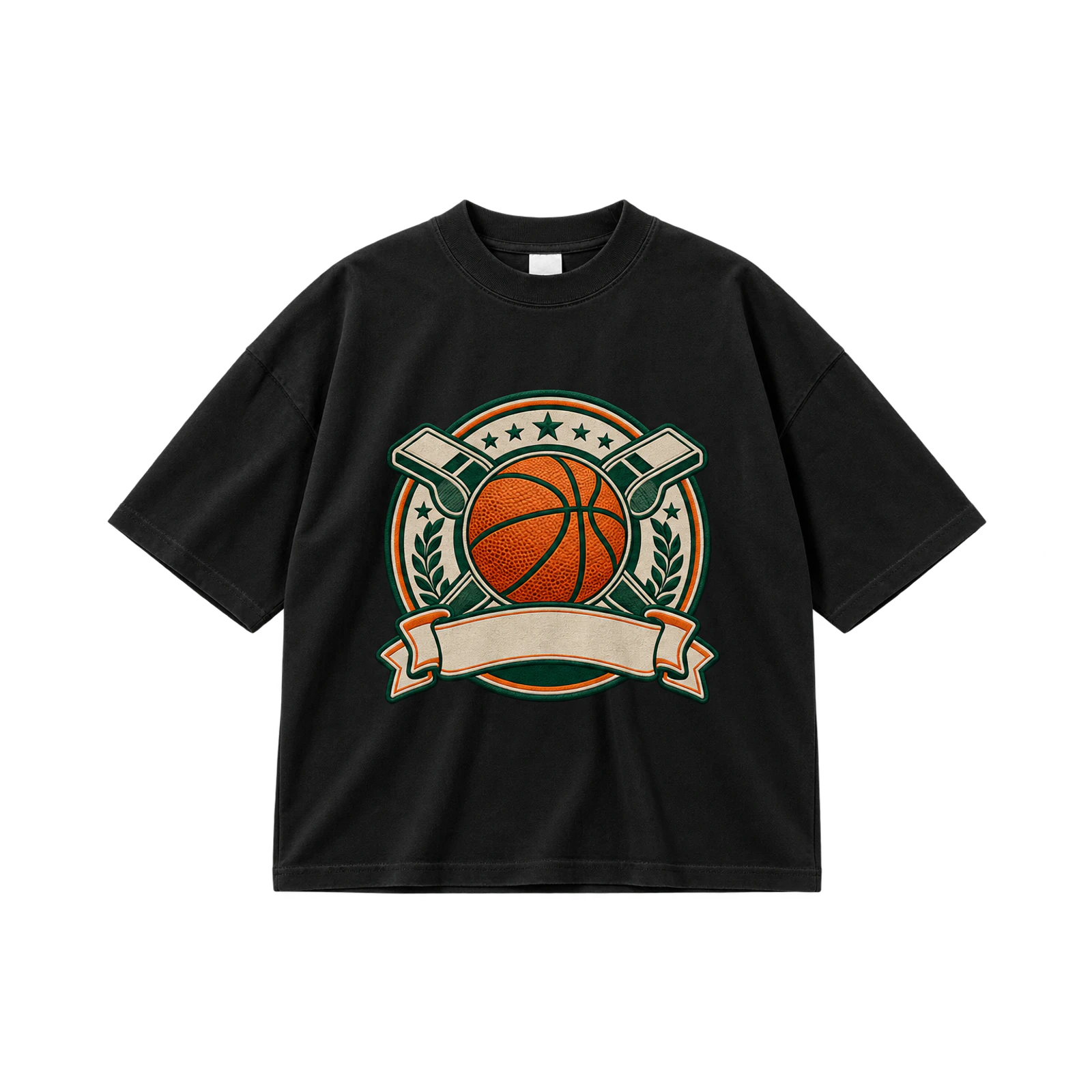
Compact basketball T-shirt design ideas use circular badges, shields, or crests to organize a team name, initials, basketball, stars, and year inside one defined border. The enclosed structure keeps multiple details visually connected while preserving a recognizable overall shape. A 2- to 4-inch emblem suits chest placement, while an 8-inch version creates a stronger front graphic and provides additional room for supporting text.
Key Features: Circular badges, shields, crests, basketballs, team initials, stars, established years, and defined borders.
Best For: Basketball clubs, school teams, tournaments, championship apparel, staff t-shirts, warm-ups, and heritage-style team merchandise.
Popular directions:
- Circular badge: Place a basketball in the center, curve the team name around the outer ring, and add the city or year along the bottom.
- Shield emblem: Position team initials above a basketball inside a shield, then place a short team name or year beneath the central symbol.
- Star badge: Use one large basketball as the focal point, surround it with restrained stars, and place the team identity around the border.
- Initial crest: Enlarge the team initials inside a bordered crest, add a small basketball beneath them, and keep supporting wording outside the central mark.
- Established-year emblem: Combine the team name, basketball, and founding year inside a symmetrical badge, using separators to keep each information group distinct.
- Patch-style badge: Use thick borders, simplified shapes, and limited colors so the emblem retains clear edges when reproduced as an embroidered or woven patch.
9. High School Basketball Shirt Design
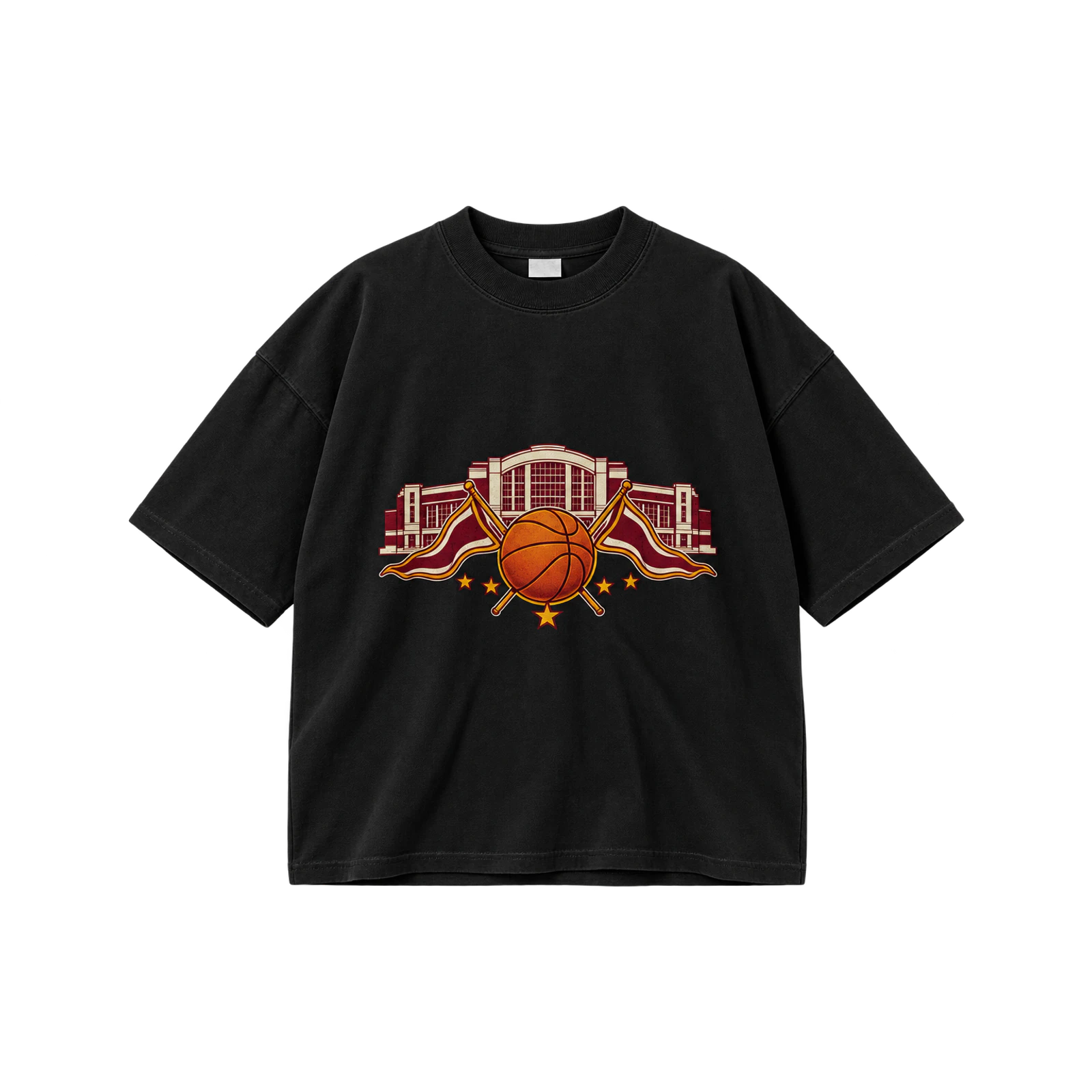
School basketball T-shirt ideas combine the school name, mascot, official colors, basketball imagery, and season details to create recognizable program apparel. The school identity receives the strongest visual weight while a ball, mascot, or large initial establishes the sports context. An 8- to 12-inch chest graphic suits players and supporters, while compact school marks provide consistent options for warm-ups, coaches, and staff garments.
Key Features: School names, mascots, school colors, basketballs, athletic lettering, seasons, years, and school initials.
Best For: High school basketball teams, students, parents, pep rallies, school stores, tournaments, and senior events.
Popular directions:
- School and mascot: Place the school name above its mascot, add a basketball near the character, and use official colors throughout the graphic.
- Season graphic: Make the school or team name dominant, place the current season beneath it, and add a basketball as the central sport identifier.
- School initial: Enlarge one recognizable school letter, overlap it with a basketball, and place the team nickname across the lower section.
- Team nickname: Give the nickname the strongest typography, position the school name above it, and use a basketball or mascot as supporting imagery.
- Student fan t-shirt: Combine school colors, bold team wording, and one recognizable mascot or basketball graphic in a layout readable from a distance.
- School badge: Place the school initial, basketball, and year inside a circular or shield-shaped emblem for a compact program identity.
10. Basketball Shooting Shirt Design
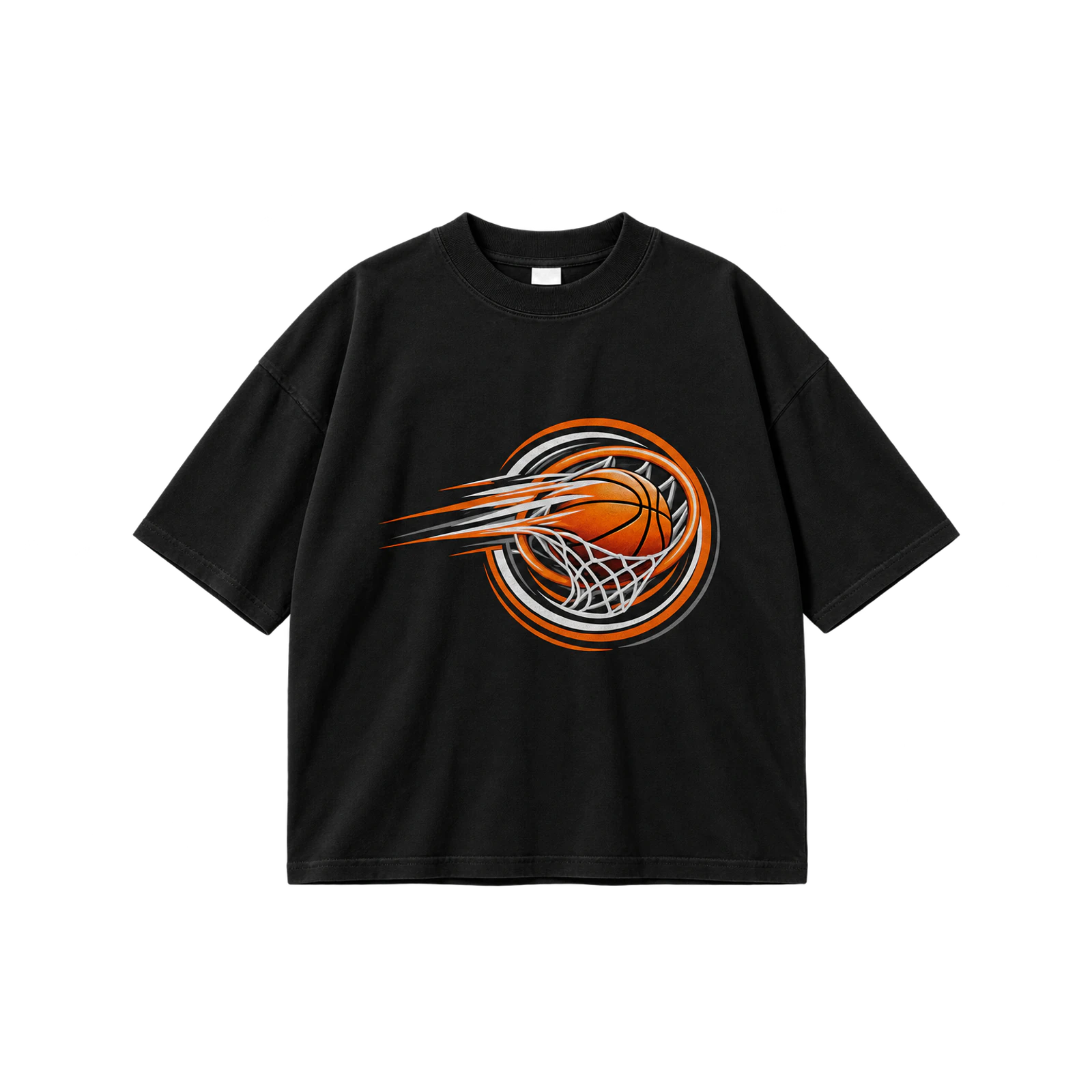
Player-focused basketball T-shirt designs for shooting t-shirts prioritize team identification and readable personalization through clean chest wordmarks, surnames, and dominant jersey numbers. A team logo or name leads the front while the player’s number and surname establish the back identity. Restrained decorative elements keep the design practical during warm-ups and pregame activity while maintaining a consistent appearance across every player on the roster.
Key Features: Team wordmarks, player surnames, jersey numbers, chest logos, athletic typography, team colors, front-back layouts, and personalization.
Best For: Basketball players, school teams, club programs, pregame warm-ups, tournaments, practice sessions, and coordinated team apparel.
Popular directions:
- Team front, number back: Place a clean team wordmark across the front, then use the player’s surname and large jersey number on the rear.
- Surname layout: Position the surname across the upper back, place the number directly beneath it, and maintain consistent typography across the complete roster.
- Chest identifier: Add a small team logo or player number to one chest area, leaving the rest of the front uncluttered.
- Two-sided team t-shirt: Use the front for shared team identity and reserve the back for individual player information such as surname and jersey number.
- Number-first back: Make the jersey number the largest rear element, then place the surname and small team name around it without reducing readability.
- Team-only version: Remove player-specific information, use the same team wordmark across every t-shirt, and add one compact basketball or school mark.
11. Basketball Warm-Up Shirt Design
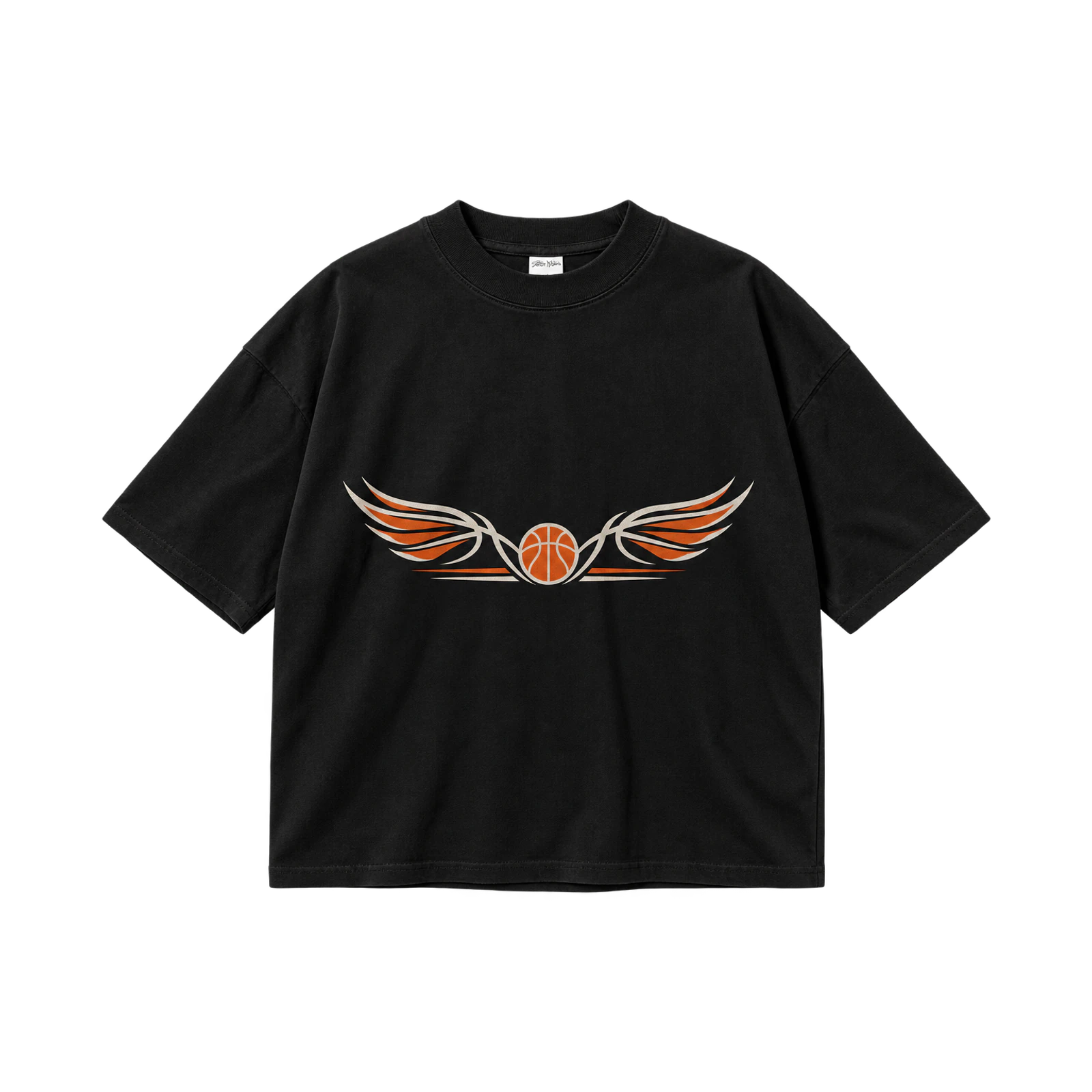
Pregame basketball t-shirt ideas use restrained team logos, school names, player identifiers, and back graphics to create functional warm-up apparel. A compact emblem occupies the chest while a larger team wordmark provides visibility across the upper back. Player numbers, initials, or staff roles introduce controlled personalization without creating unnecessary visual density, keeping the same design system consistent across athletes, coaches, and support staff.
Key Features: Team marks, wordmarks, player numbers, initials, school names, staff identifiers, back graphics, and restrained layouts.
Best For: Pregame warm-ups, basketball teams, coaching staff, school programs, club teams, practice apparel, and travel clothing.
Popular directions:
- Minimal chest logo: Place a compact team emblem on the left chest, using simplified lines and limited colors for a clean pregame appearance.
- Back wordmark: Stretch the complete team or school name across the upper back, leaving the front limited to a small identifying mark.
- Player-number version: Add a small jersey number beneath the chest logo or at the upper back while keeping the overall team layout consistent.
- Staff variation: Replace player numbers with Coach, Staff, or Manager wording while retaining the same team logo, typography, and placement system.
- Front-back identity: Pair a restrained front emblem with a larger rear team name, creating stronger recognition without covering the entire garment.
- Initial mark: Use one bold school initial with a small basketball detail, then repeat the full team name on the opposite side of the t-shirt.
12. Player Name and Number Design
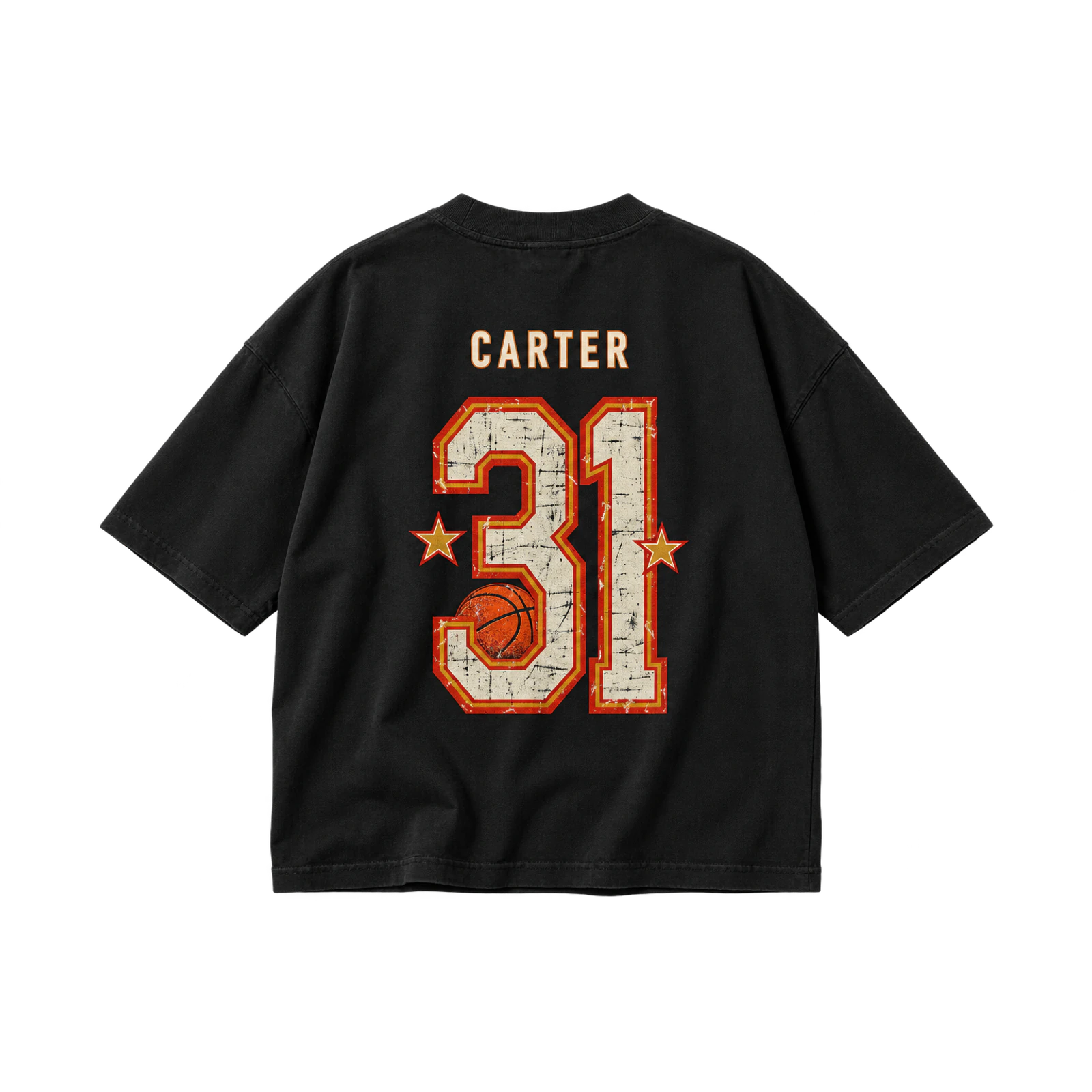
Personalized basketball tee designs make the surname and jersey number the core visual system, with the team name, basketball, or season serving as supporting information. The number dominates the back while the player’s name sits clearly above it, creating an immediately recognizable player identity. A smaller front number or team mark connects both sides, while thick varsity typography preserves readability from a normal viewing distance.
Key Features: Player names, jersey numbers, varsity lettering, team names, front numbers, outlines, personalization, and season details.
Best For: Player t-shirts, team apparel, fan merchandise, family supporter t-shirts, senior events, tournaments, and personalized basketball gifts.
Popular directions:
- Surname above number: Position the player’s surname across the upper back, place a large jersey number below, and use matching athletic typography for both.
- Outlined number: Give the number one or two contrasting borders, then keep the surname simpler so the personalized digits remain the focal point.
- Team and number: Place the team name above a large jersey number, then add the player’s surname beneath for a complete personalized layout.
- Front-back system: Use a small number or team logo on the chest and place the full surname-and-number treatment across the rear.
- Textured number: Fill the large jersey digits with subtle basketball seams, distressed texture, or team patterns while preserving strong outer edges.
- Season edition: Add the season or graduation year beneath the personalized number, keeping the date smaller than the player’s identifying information.
13. Player Portrait Design
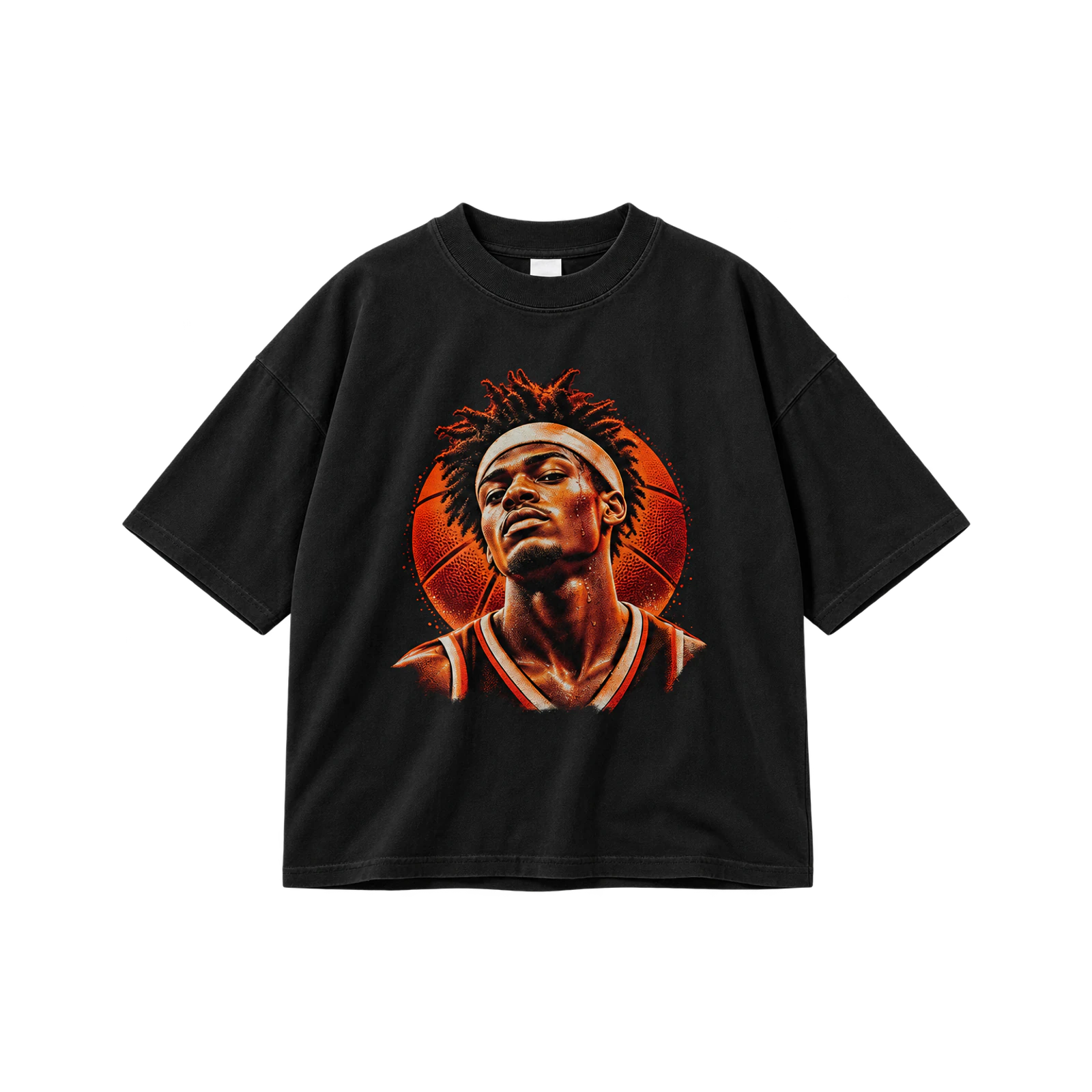
Portrait-based basketball t-shirt graphics make the athlete the central subject and use a name, jersey number, team colors, and restrained background elements to frame the image. Removing distracting photo backgrounds gives the player a clearer silhouette, while typography stays away from important facial details. A 12- to 14-inch front or back print provides enough room for facial definition, uniform details, and supporting basketball information.
Key Features: Player portraits, jersey numbers, names, team colors, action photography, silhouettes, background textures, and supporting typography.
Best For: Player merchandise, senior-night t-shirts, fan apparel, athlete gifts, team celebrations, commemorative designs, and personalized basketball t-shirts.
Popular directions:
- Portrait and number: Place the player’s portrait in front of an oversized jersey number, then add the surname beneath without covering facial details.
- Monochrome player: Convert the portrait to one tonal treatment, add a team-color accent around the number, and keep the background visually restrained.
- Action portrait: Use an in-game photograph as the focal image, then position the player’s name and number around the natural direction of movement.
- Name-led portrait: Place the athlete above a large surname treatment, use the jersey number as a secondary element, and keep supporting graphics minimal.
- Double-image layout: Combine a close-up portrait with a smaller action image, using the larger face as the primary point of recognition.
- Back tribute graphic: Build a large rear composition from the portrait, jersey number, player name, and season, then keep the front limited to a team mark.
14. Halftone Player Graphic
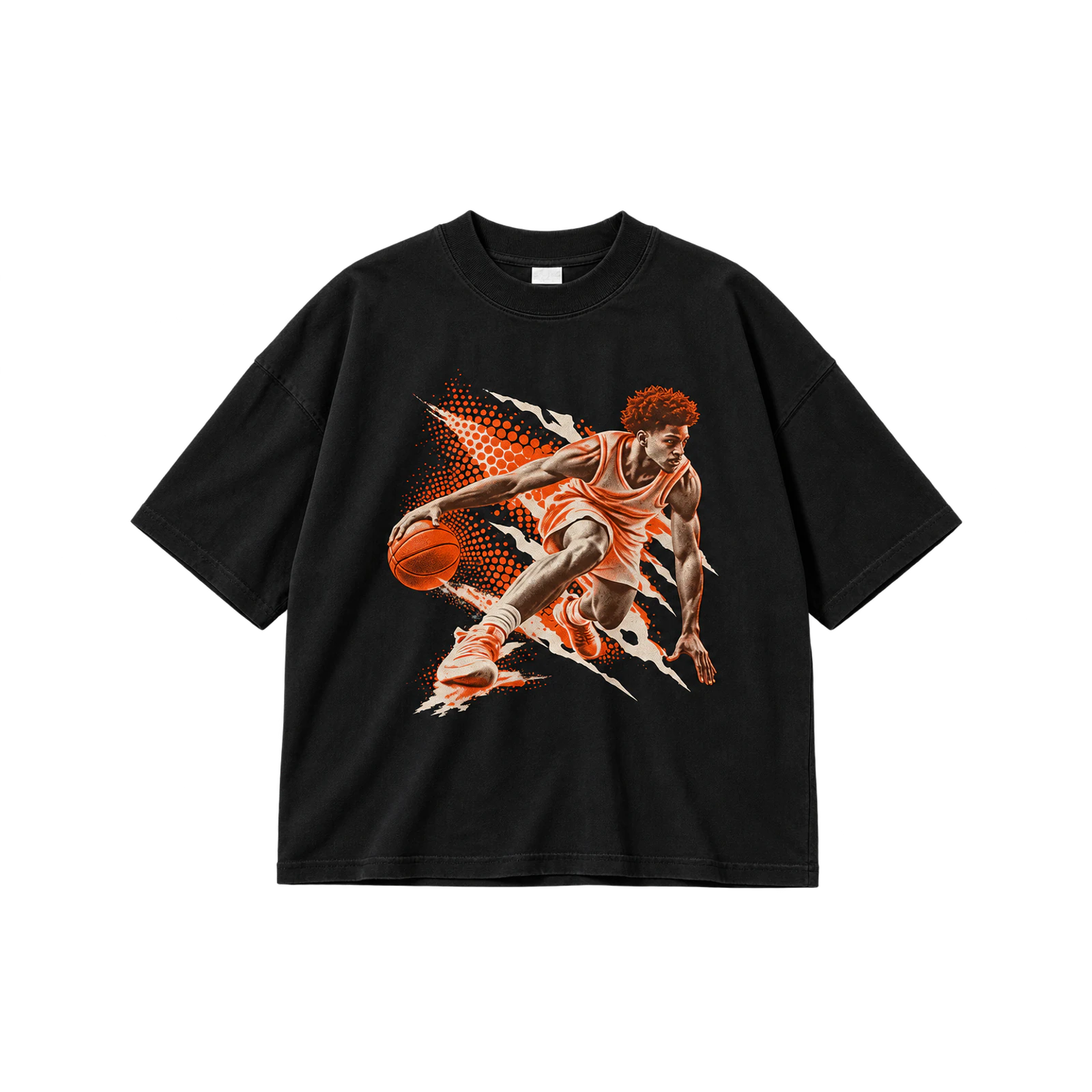
A halftone basketball T-shirt concept converts player photography into visible dot patterns that preserve the athlete’s face, jersey, and action while adding a print-oriented texture. A solid jersey number contrasts with the dotted portrait, while selected edges fade gradually into the garment. An 8- to 12-inch graphic gives the halftone dots enough space to remain distinct instead of merging into unclear tonal areas.
Key Features: Halftone dots, player images, high contrast, jersey numbers, names, faded edges, photographic texture, and tonal patterns.
Best For: Player t-shirts, retro basketball apparel, team merchandise, senior designs, monochrome graphics, streetwear, and photographic basketball T-shirts.
Popular directions:
- Monochrome halftone: Convert the complete player photograph into a single-color dot treatment, then add solid typography for stronger contrast against the textured image.
- Portrait and number: Position a halftone portrait over a large solid jersey number, allowing the number to remain readable behind the player’s silhouette.
- Faded-edge portrait: Keep the face and jersey detailed, then gradually reduce the outer edges into larger dots that disappear into the garment.
- Team-color halftone: Replace neutral photographic tones with one official team color, then use a contrasting number or name as the solid foreground element.
- Action halftone: Apply the dot treatment to a shooting or dribbling image, preserving enough negative space around the limbs to keep the pose recognizable.
- Halftone collage: Combine one large dotted portrait with a smaller action image, connecting both through a shared number, name, or team-color treatment.
15. Slam Dunk Graphic
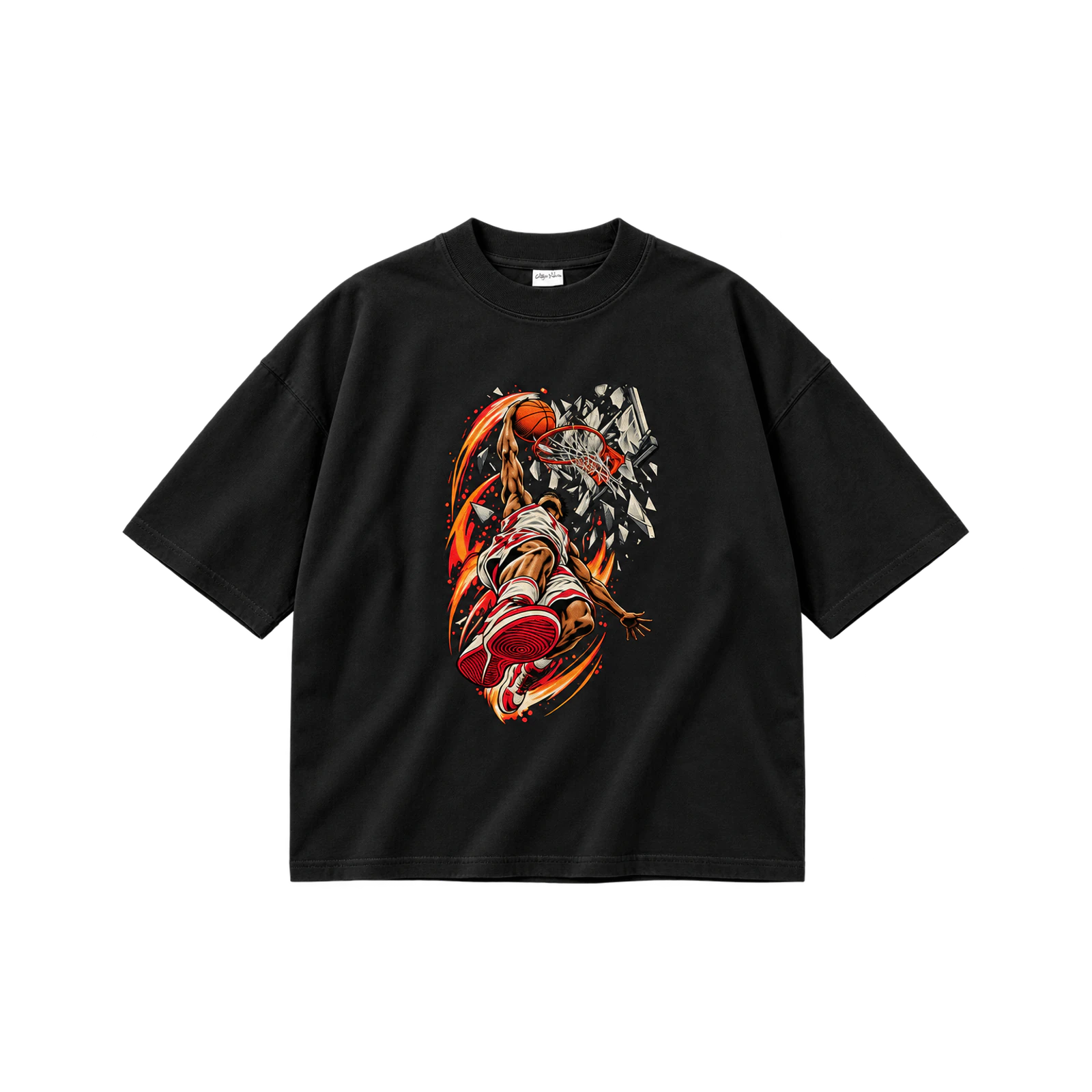
Action-based basketball T-shirt design ideas use a jumping player, rim, ball, and strong upward movement to turn a slam dunk into the central visual. Negative space around the athlete separates the arms, legs, and basketball from background details, preserving the action clearly. A large jersey number or ball supports the player from behind, while a tall front or back composition reinforces the vertical direction of the dunk.
Key Features: Dunking players, basketball hoops, balls, silhouettes, upward motion, jersey numbers, action poses, and vertical composition.
Best For: Player apparel, basketball teams, youth programs, fan t-shirts, streetwear, tournament merchandise, and action-focused basketball graphics.
Popular directions:
- Dunk silhouette: Use a bold player silhouette reaching toward the rim, then place a large team name or jersey number behind the action.
- Rim-focused graphic: Crop the composition around the player’s hand, basketball, and hoop, creating a close-up view of the finishing moment.
- Player and number: Place an oversized jersey number behind the dunking athlete, then add the surname or team name along the lower edge.
- Explosive dunk: Add controlled speed lines or geometric bursts behind the player, keeping the effects away from the face, ball, and rim.
- Back action graphic: Build a tall rear composition from the player, hoop, number, and team wording, then use a small chest logo in front.
- Minimal dunk icon: Reduce the athlete, basketball, and rim to bold simplified shapes, preserving the recognizable dunk pose without detailed background artwork.
16. Basketball Team Roster Design
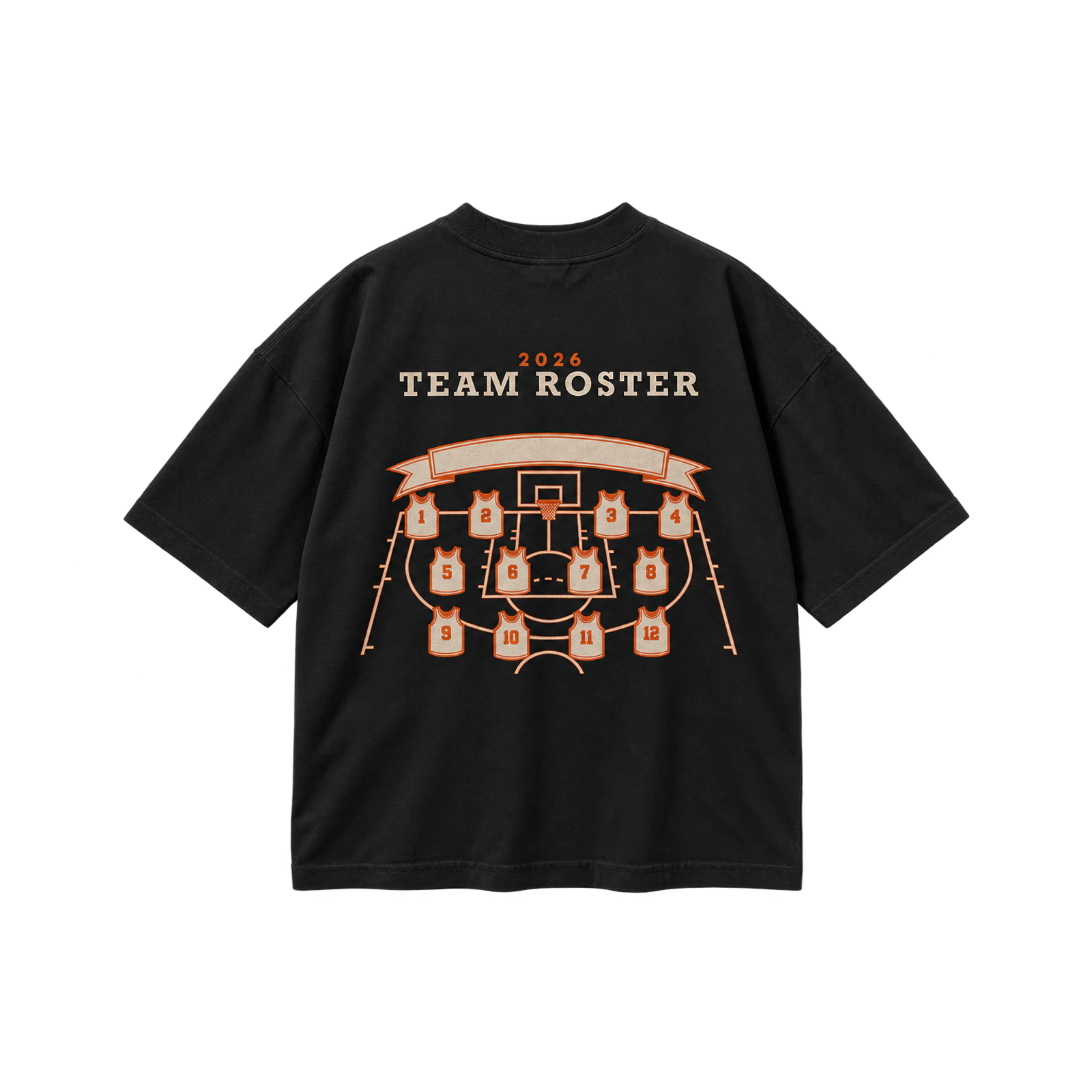
Roster-based basketball T-shirt designs organize player names and jersey numbers into a consistent list, grid, or structured back composition representing the complete team. Equal spacing and typography give every player comparable visual weight, while a team logo or season anchors the layout. The back provides enough room for longer rosters, leaving the front available for a compact school, club, or basketball identity mark.
Key Features: Player names, jersey numbers, team logos, roster lists, grids, seasons, structured typography, and team identity.
Best For: Basketball teams, school programs, tournaments, championship runs, parents, fan groups, and season commemorative t-shirts.
Popular directions:
- Centered roster: Stack every player name and number in one centered column, then place the team logo and season above the complete lineup.
- Two-column lineup: Divide longer rosters into two equal columns, maintain consistent spacing, and center a team name or basketball between both groups.
- Logo-centered roster: Place the team emblem near the top, arrange player names beneath it, and use jersey numbers as consistent secondary identifiers.
- Number list: Lead each roster entry with the jersey number, align player names along one edge, and keep every line typographically consistent.
- Front-back roster: Use a compact team logo on the front and reserve the entire back for the complete player lineup and season information.
- Season roster: Place the team name and season above the roster, then add a small basketball or championship detail beneath the final player entry.
17. Basketball Legend Graphic
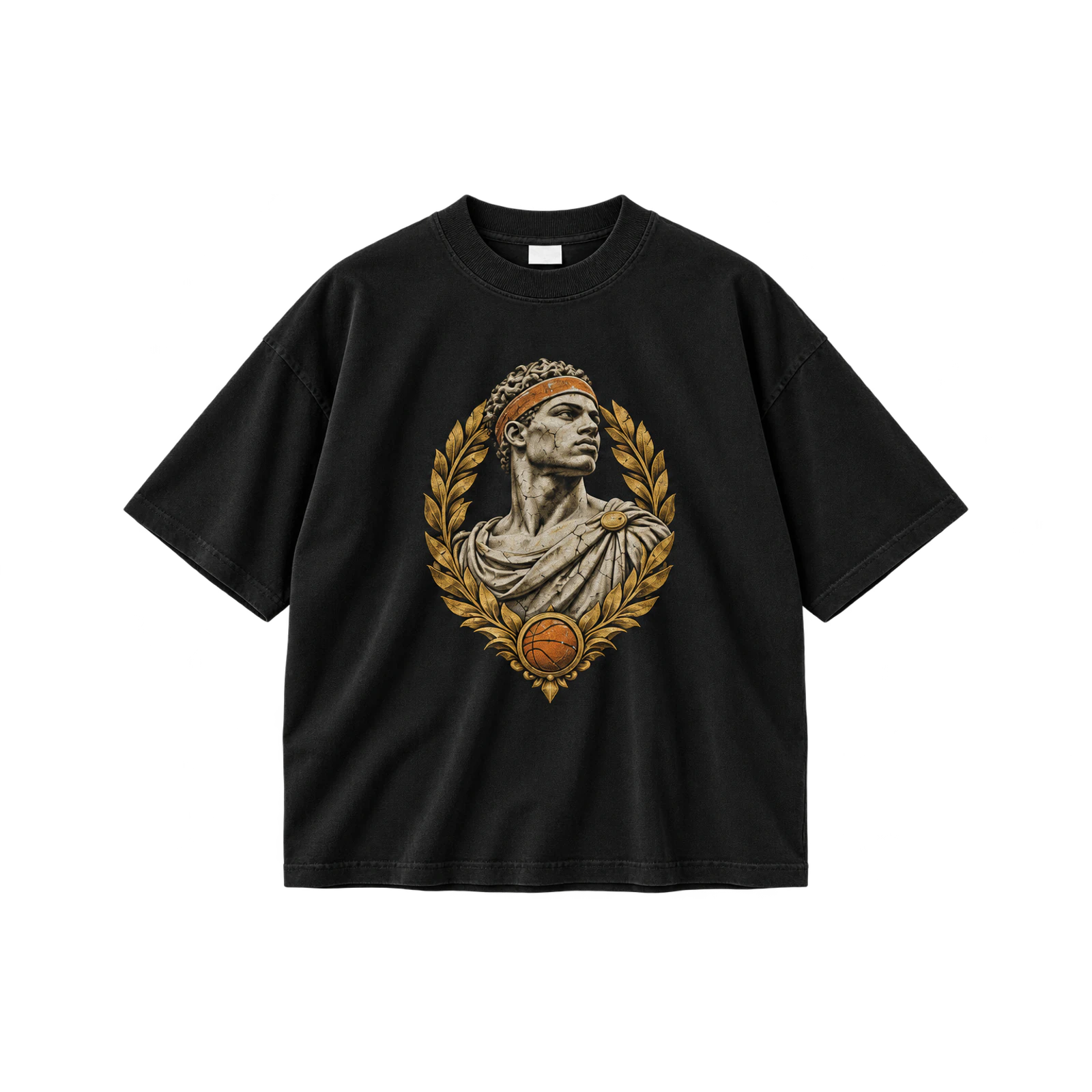
Tribute-style basketball t-shirt designs combine a recognizable player image or silhouette with a name, jersey number, and restrained commemorative details. The athlete or number carries the strongest visual weight so the tribute reads immediately, while halftone textures or muted colors establish a classic sports-poster appearance. A 12- to 14-inch composition provides sufficient room for portrait detail, identifying information, and supporting typography without overcrowding the t-shirt.
Key Features: Player portraits, silhouettes, jersey numbers, names, tribute wording, halftone textures, commemorative details, and classic sports styling.
Best For: Player tribute t-shirts, basketball fan apparel, commemorative merchandise, retro sports graphics, athlete celebrations, collector t-shirts, and player-focused designs.
Popular directions:
- Portrait tribute: Make the player portrait dominant, place the jersey number behind it, and position the athlete’s name across the lower section.
- Retro legend: Apply halftone texture and muted colors to the player image, then use aged athletic typography for the name and number.
- Number-led graphic: Enlarge the player’s jersey number behind a smaller portrait or silhouette, keeping the number recognizable around the figure.
- Career-style collage: Combine one primary portrait with smaller action images, using the player’s name and number to connect the separate photographs.
- Silhouette tribute: Use a recognizable playing pose as the main shape, then add the name, number, and restrained commemorative wording around it.
- Name and number: Build the tribute entirely from bold typography, jersey digits, and a small basketball symbol when photographic imagery is unnecessary.
18. All-Star Basketball Design
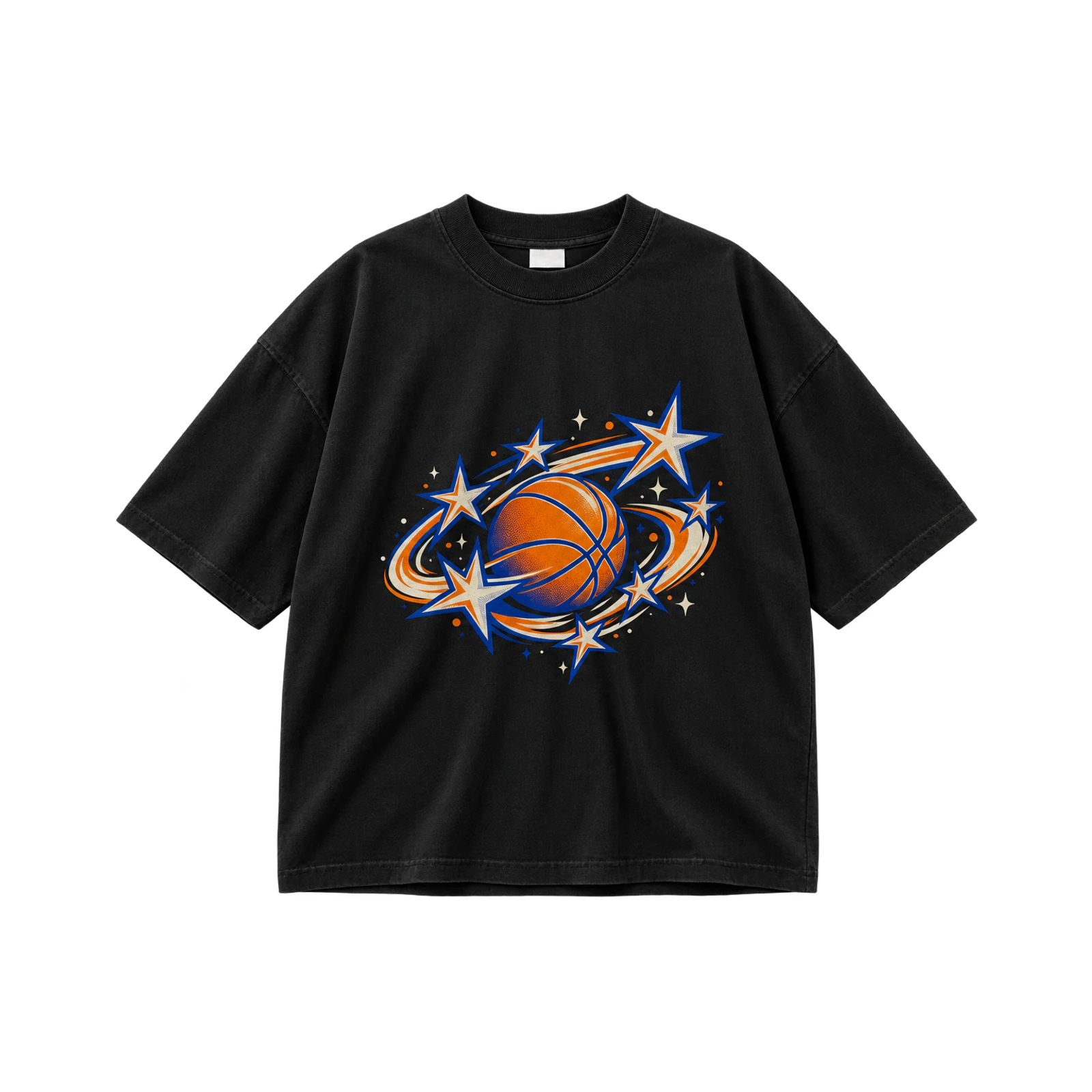
Showcase basketball T-shirt designs combine stars, basketball imagery, player numbers, badges, and event typography to distinguish All-Star apparel from standard team t-shirts. A dominant star frames the basketball or event name while smaller stars provide controlled supporting detail. An 8- to 12-inch central composition gives the event information enough space, while a simplified emblem format supports patches, embroidery, and smaller chest applications.
Key Features: Stars, basketballs, event names, player numbers, badges, team colors, showcase typography, and event years.
Best For: All-Star games, showcase events, school tournaments, youth leagues, player selections, fan merchandise, and commemorative basketball apparel.
Popular directions:
- Star and basketball: Place a basketball inside one large star, position the All-Star title above it, and add the event year underneath.
- Event badge: Enclose the All-Star name, basketball, year, and location inside a bordered emblem with one prominent star as the central accent.
- Player edition: Add the selected player’s jersey number beneath the event identity, keeping the All-Star title consistent across every personalized t-shirt.
- Star pattern: Use one large central basketball with smaller stars around it, controlling their size so the background does not compete with the title.
- Year edition: Make the event title dominant, position the year directly below, and use a star-and-basketball symbol as the central separator.
- Team-color version: Keep the same All-Star composition across participants while changing the accent colors and player number for each represented team.
19. Basketball Number Graphic
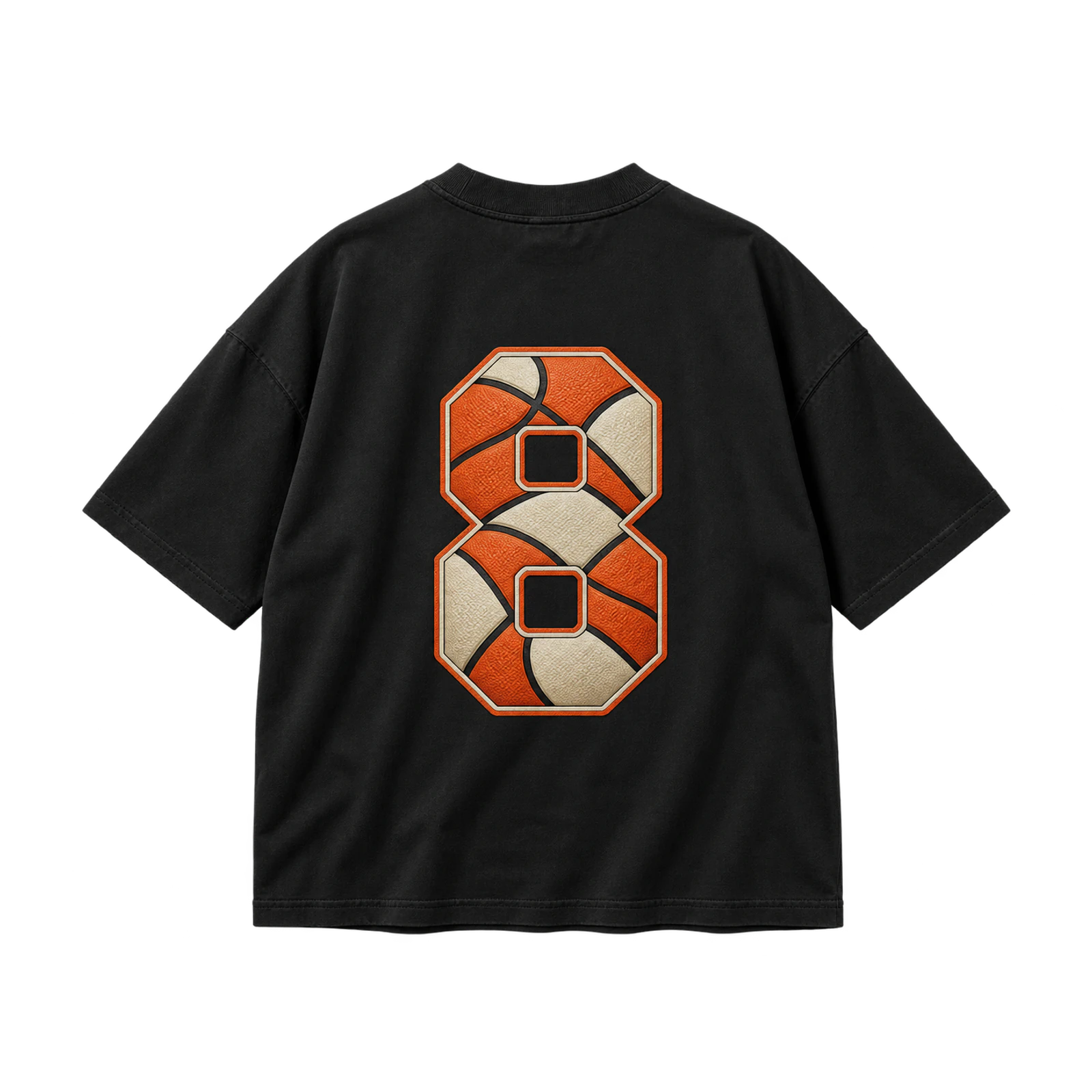
Number-led basketball T-shirt designs make one jersey number the visual anchor and use a team name, basketball, stripes, outlines, or player details as supporting elements. Double borders, inline treatments, shadows, and restrained textures add depth while preserving the shape of each digit. An 8- to 12-inch front number suits supporter apparel, while a larger back treatment creates stronger player identification and greater visual impact.
Key Features: Jersey numbers, outlines, team names, basketballs, stripes, shadows, textures, and athletic typography.
Best For: Player t-shirts, basketball teams, fan apparel, personalized gifts, senior events, youth teams, and number-focused streetwear.
Popular directions:
- Outlined number: Enlarge the jersey number, surround it with contrasting borders, and position a smaller player or team name directly above the digits.
- Basketball number: Fill selected areas of the number with basketball seam patterns, keeping the outer edges solid so the numeral remains immediately recognizable.
- Player number: Make the number dominant, place the player’s surname across the top, and add a small team mark beneath the personalized layout.
- Striped number: Extend athletic stripes through or behind the large digits, then use a compact basketball or team initial to complete the composition.
- Textured number: Apply distressed, halftone, or court-inspired texture inside the number while keeping the outline clean and the surrounding typography simple.
- Back number graphic: Use an oversized jersey number across the rear, position the surname above it, and keep the front limited to a small team logo.
20. Game Day Basketball Design
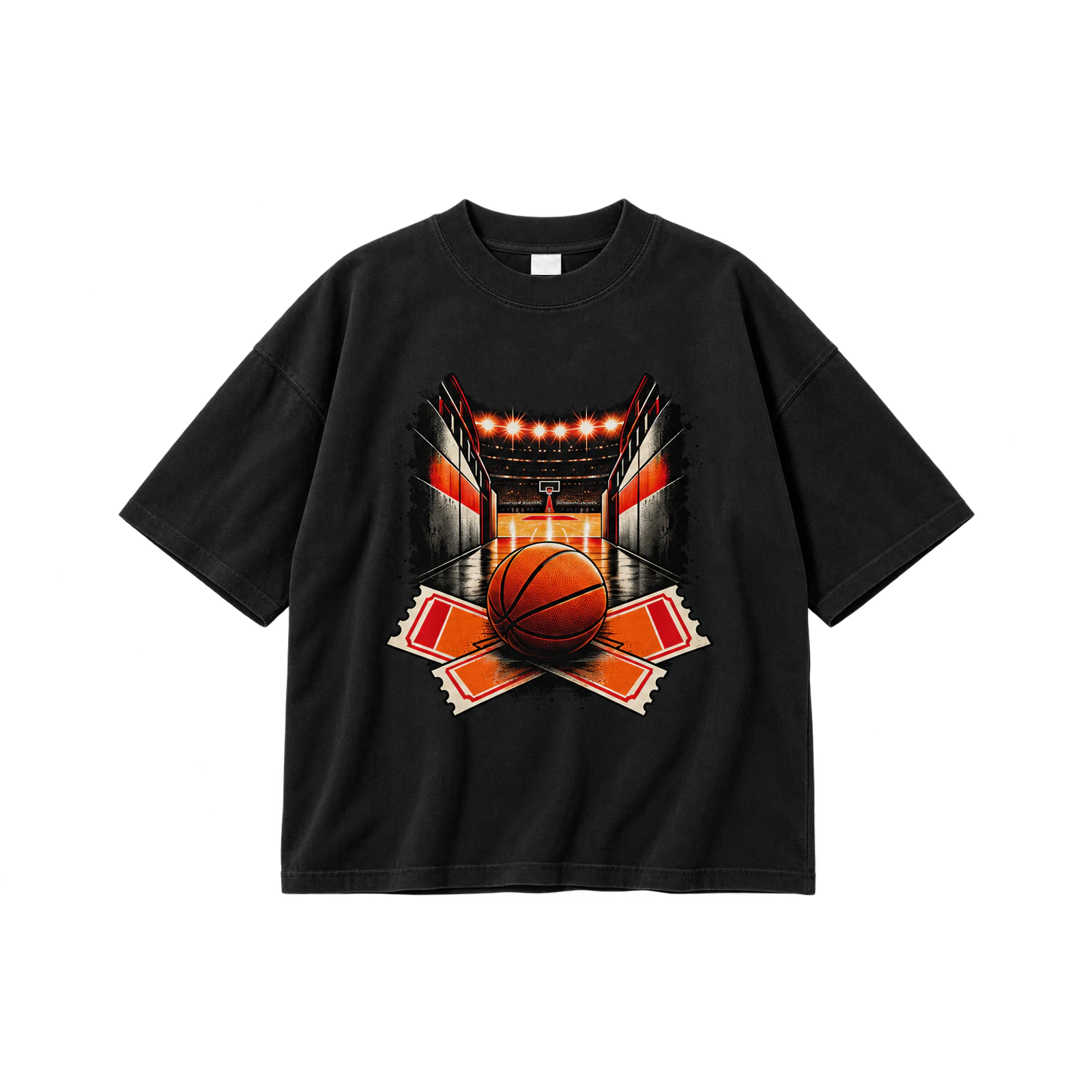
Game Day basketball t-shirt ideas make event-focused wording the main message and use a team name, mascot, basketball, or player number to identify the supported program. Broad typography carries most of the composition while one sport-specific graphic supplies context without competing with the phrase. An 8- to 12-inch front layout gives the wording strong visibility for parents, students, and fans attending games or tournaments.
Key Features: Game Day wording, team names, basketballs, mascots, player numbers, supporter phrases, team colors, and bold typography.
Best For: Basketball fans, parents, students, school games, tournaments, pep events, and player families.
Popular directions:
- Game Day typography: Make “Game Day” the largest wording, position a basketball beneath it, and add the team or school name as a secondary line.
- Team supporter design: Place the team name above the main phrase, use official colors throughout, and add one small mascot or basketball detail.
- Player-support version: Add the player’s jersey number below the Game Day wording, then include a surname or short supporter phrase for personalization.
- Mascot Game Day: Position the mascot beside or beneath the main wording, keeping the character smaller than the phrase so the message remains immediate.
- Ball-letter design: Replace one round letter or central typographic element with a basketball, maintaining enough spacing to keep the phrase easy to read.
- Home-game edition: Add the school, city, or venue below the Game Day title, using a smaller text size to preserve the primary hierarchy.
21. Basketball Slogan Typography
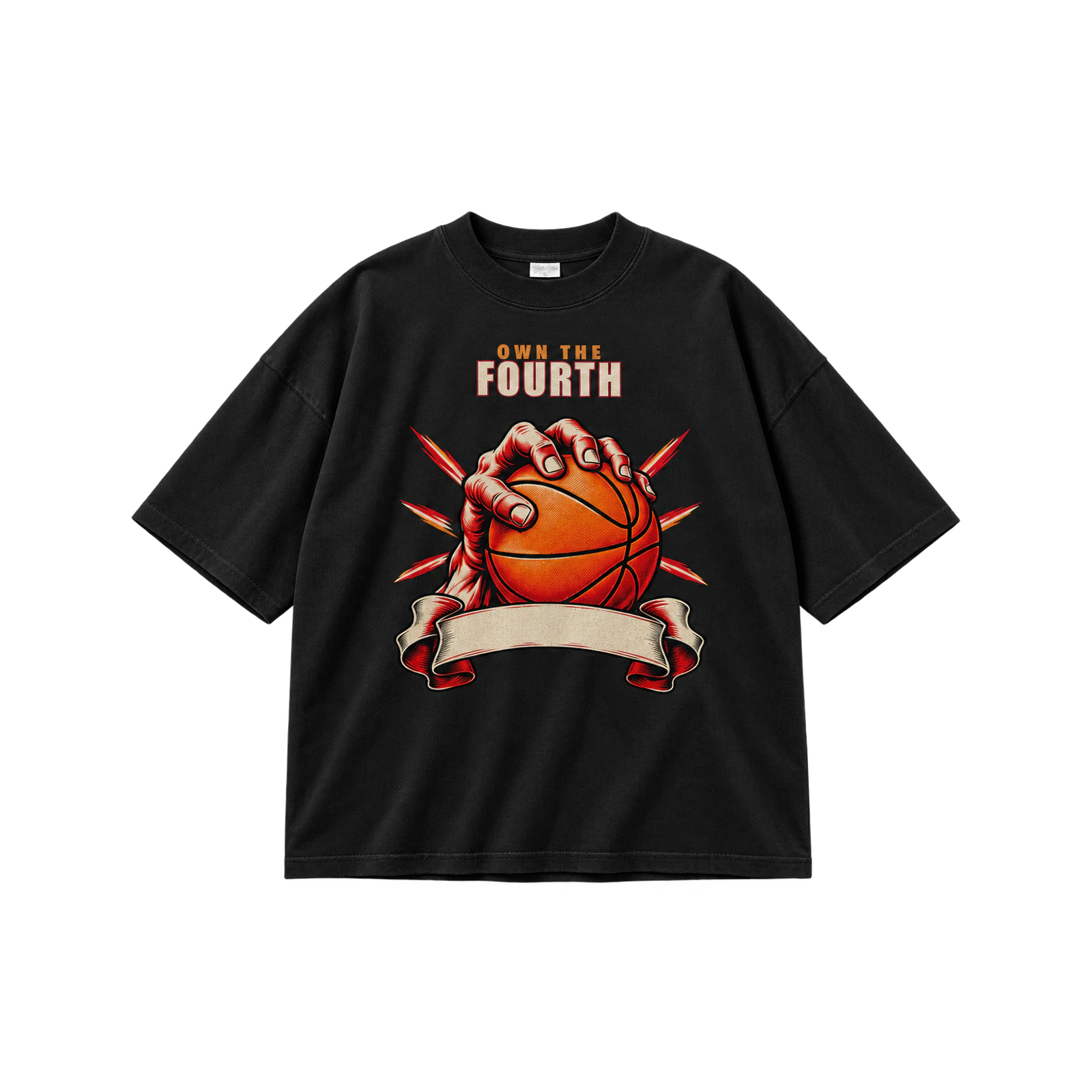
Typography-led basketball t-shirt designs use a short slogan as the primary graphic and rely on a ball, hoop, or court element to reinforce the message. Breaking the phrase into compact lines and enlarging one important word establishes hierarchy without excessive decoration. An 8- to 12-inch chest composition provides enough room for strong lettering, while screen print or puff print gives thicker words greater physical emphasis.
Key Features: Basketball slogans, bold typography, emphasized words, basketball symbols, hoops, line breaks, athletic lettering, and structured hierarchy.
Best For: Basketball fans, teams, training apparel, school programs, player t-shirts, motivational merchandise, and typography-focused sportswear.
Popular directions:
- Stacked slogan: Divide the phrase across two or three lines, enlarge the strongest keyword, and place a small basketball beneath the complete message.
- Ball-backed typography: Position a large basketball behind the central word, allowing the lettering to overlap the ball without losing readability.
- Hoop-supported phrase: Place a basketball rim beneath the slogan as a visual underline, then add a small ball near the final word.
- Mixed-weight type: Use heavy athletic lettering for the key words and narrower supporting typography for connecting terms, creating a clear reading order.
- Number slogan: Integrate a jersey number into the phrase, using the digits as a large central element rather than an unrelated decoration.
- Minimal statement: Use one short basketball phrase in bold lettering, pair it with a single ball icon, and leave generous negative space around both.
22. Motivational Basketball Quote Design
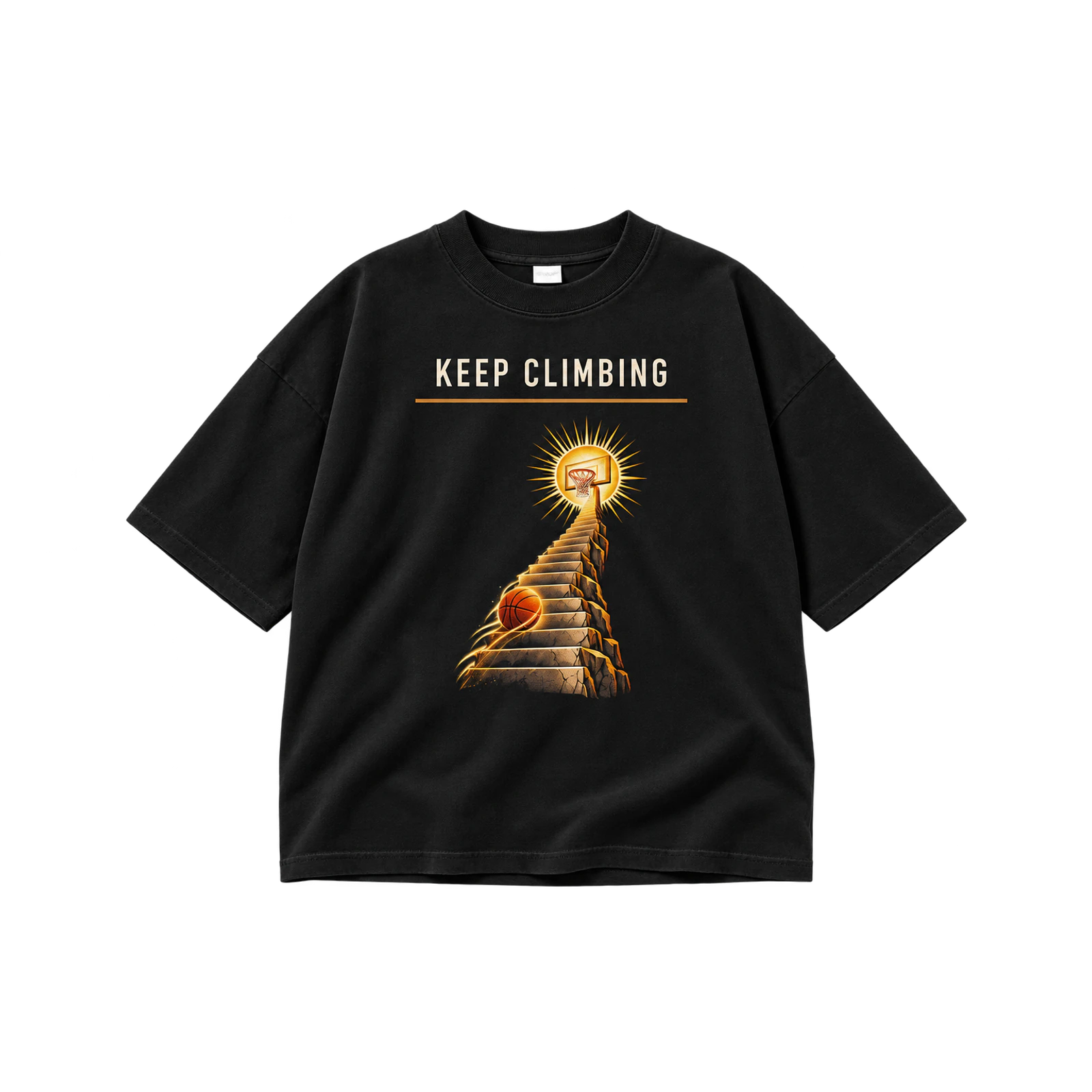
For message-driven basketball T-shirt design ideas, a motivational quote pairs concise wording with a ball, hoop, player, or court element that directly reinforces the message. One or two important words receive greater size or weight so the statement reads quickly. An 8- to 12-inch layout provides enough room for structured typography, while the supporting illustration remains secondary and strengthens the meaning rather than distracting from it.
Key Features: Motivational quotes, basketballs, hoops, players, court elements, emphasized words, structured typography, and concise messages.
Best For: Basketball players, coaches, training programs, youth teams, camps, practice apparel, and school teams.
Popular directions:
- Goal-focused quote: Make the achievement-related keyword dominant, place a hoop or basketball beside it, and keep the remaining phrase in smaller supporting typography.
- Practice message: Build the design around training-focused wording, then add a basketball, court line, or player silhouette to reinforce the practice theme.
- Player silhouette: Position a shooting or dribbling silhouette beside the quote, keeping the athlete secondary so the motivational message remains easy to read.
- Keyword emphasis: Enlarge one action word within the statement, use contrasting weight or outline, and keep the remaining wording visually restrained.
- Court-line quote: Frame the typography with a three-point arc, key, or baseline, using the court geometry to organize the text rather than decorate it randomly.
- Minimal motivation: Pair one concise statement with a small basketball symbol, relying on spacing and bold typography instead of multiple supporting graphics.
23. Flaming Basketball Graphic
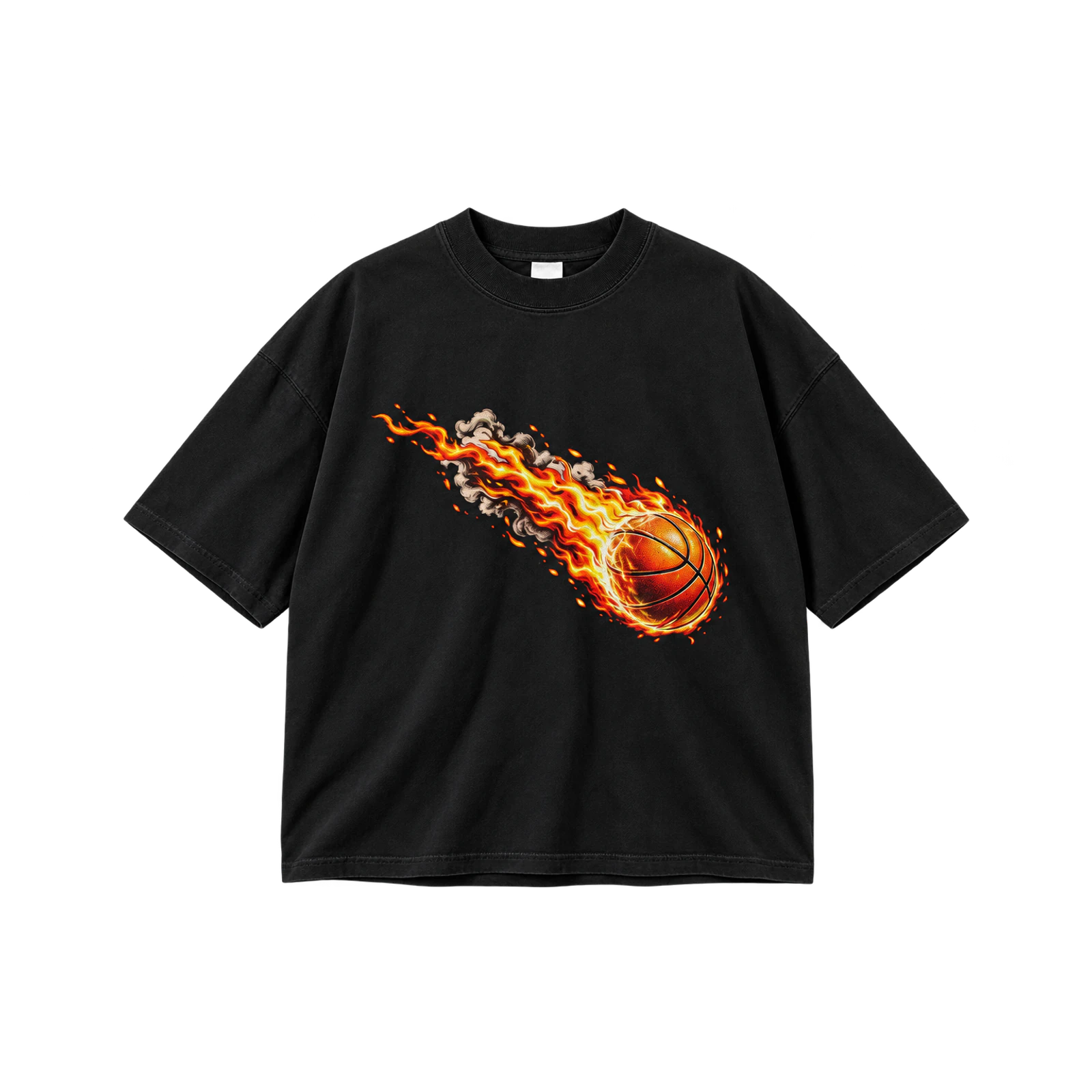
High-energy basketball t-shirt graphics use a flaming ball to communicate speed, intensity, and directional motion. The longest flames trail behind the basketball instead of surrounding every edge, keeping the circular shape and seams clearly recognizable. Orange, yellow, red, or team-color fire provides strong contrast against the garment, while an 8- to 12-inch composition gives the flames sufficient room to extend without overpowering the central basketball.
Key Features: Flaming basketballs, directional fire, motion, bright colors, ball seams, hoops, high contrast, and energetic graphics.
Best For: Basketball teams, youth apparel, streetwear, tournament t-shirts, fan merchandise, player graphics, and energetic sports designs.
Popular directions:
- Fast-moving ball: Position the basketball toward one side of the composition, trail long flames behind it, and use short motion marks to reinforce direction.
- Fire toward hoop: Show the flaming ball traveling toward a basketball rim, keeping the hoop simpler so the ball and fire remain the focal elements.
- Team-color flames: Replace traditional orange and yellow fire with official team colors, while keeping enough tonal contrast to separate flames from the basketball.
- Flame wordmark: Place a bold team or basketball wordmark beside the flaming ball, directing the fire toward or away from the lettering.
- Minimal fire icon: Reduce the basketball and flames to a few thick shapes, preserving clear seams and directional movement for a compact chest graphic.
- Oversized flame graphic: Extend a large flaming basketball across the back, using the team name or player number beneath it to anchor the energetic illustration.
24. Graffiti Basketball Design
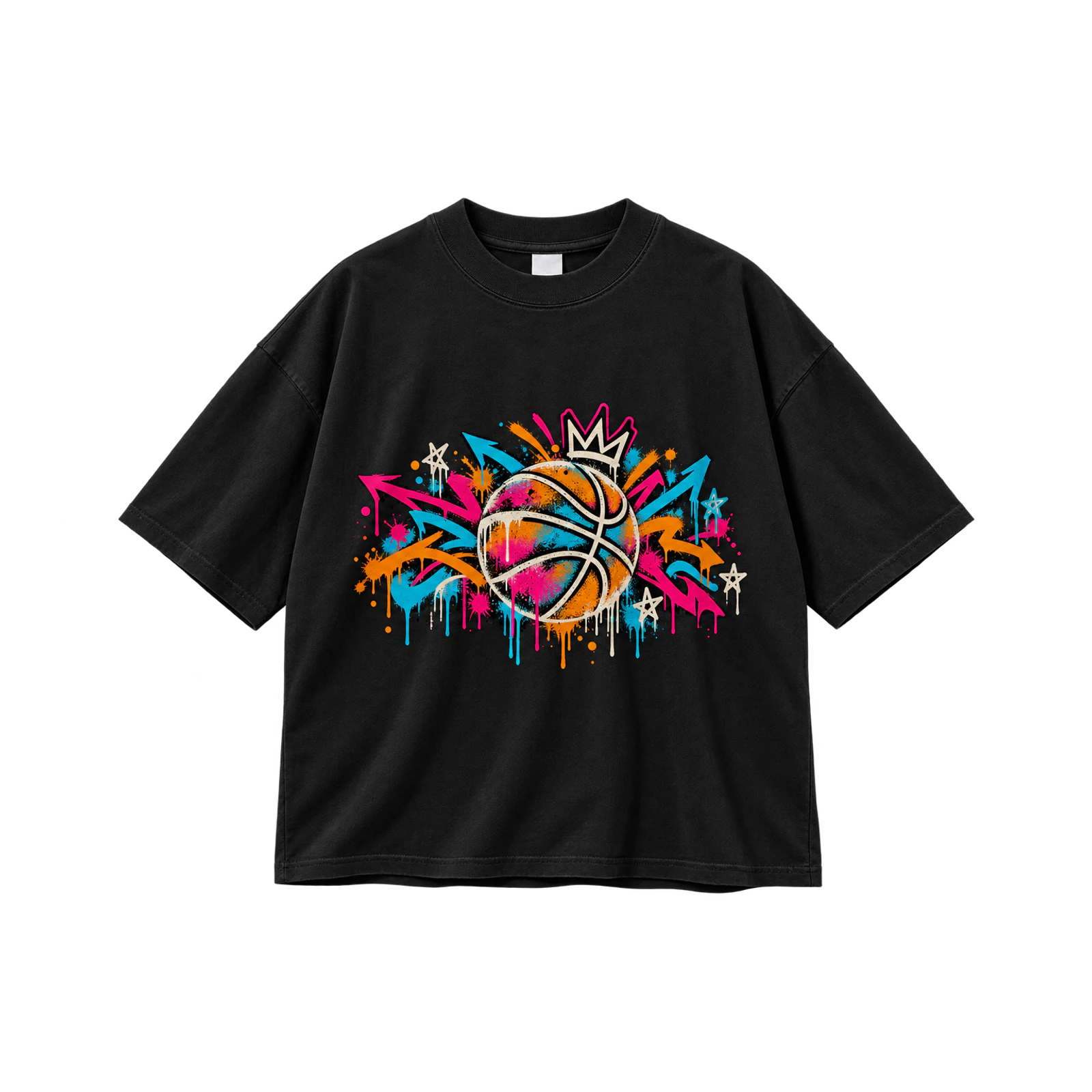
Urban basketball t-shirt designs combine spray-style lettering, rough textures, paint drips, hand-drawn marks, and basketball imagery while preserving one dominant focal point. A team name or basketball wordmark leads the composition, with the ball and paint effects layered behind it for depth. A 12- to 14-inch front or back area gives expressive lettering and irregular edges enough room without compressing the individual graphic elements.
Key Features: Graffiti lettering, spray textures, paint drips, basketballs, rough outlines, splatter, hand-drawn marks, and layered graphics.
Best For: Basketball streetwear, youth apparel, urban-inspired merchandise, fan t-shirts, creative team graphics, oversized T-shirts, and casual sportswear.
Popular directions:
- Graffiti wordmark: Make the team or basketball phrase the dominant sprayed element, then place a ball and restrained paint splatter behind the lettering.
- Ball and paint: Enlarge a basketball in the center, surround it with directional spray marks, and add one rough handwritten team name across the foreground.
- Back-piece graphic: Build an oversized rear composition from graffiti lettering, a basketball, player number, and layered paint textures arranged like street-art artwork.
- Marker lettering: Use thick handwritten strokes for the team name, then add a basketball and smaller rough annotations around the main word without overcrowding it.
- Dripping basketball: Give the ball a painted surface with selected drips beneath it, keeping the seam lines clean enough to preserve its recognizable structure.
- Layered tags: Place small initials, numbers, and short words behind one dominant graffiti wordmark, using scale differences to establish a clear visual hierarchy.
25. Streetwear Basketball Graphic
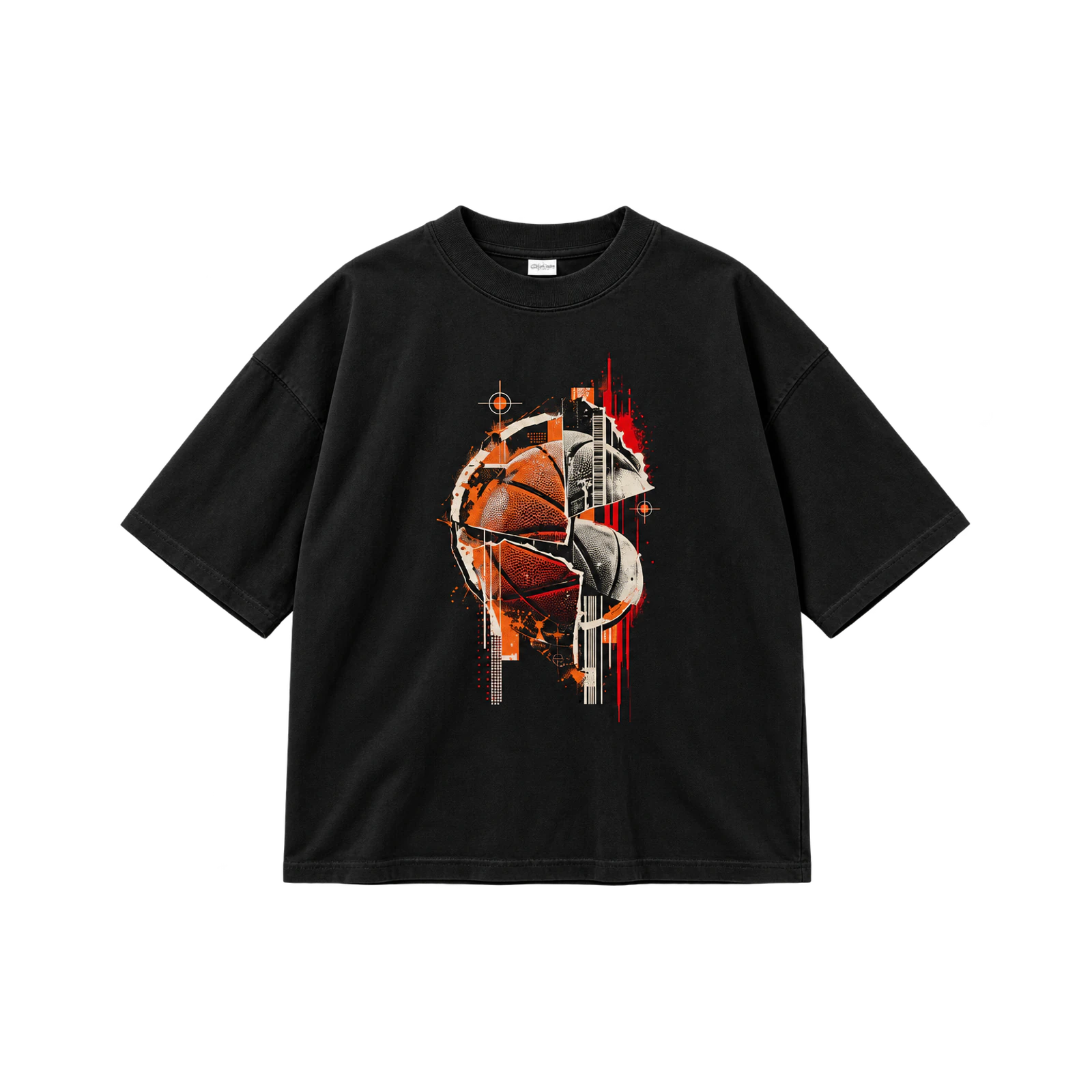
Fashion-led basketball T-shirt designs use oversized player imagery, jersey numbers, cropped typography, court references, and layered textures across a larger garment area. A small chest mark introduces the identity while a 12- to 14-inch rear composition carries the primary visual. Repeated text, dates, vertical lettering, and numbers provide additional depth when every element remains connected to the same basketball-focused concept.
Key Features: Oversized graphics, player imagery, jersey numbers, bold typography, textures, small front marks, court references, and large back prints.
Best For: Basketball streetwear, clothing brands, player merchandise, oversized T-shirts, fan apparel, fashion collections, and urban sports graphics.
Popular directions:
- Small front, large back: Place a compact basketball or team mark on the chest, then build the complete player, number, and typography composition across the rear.
- Player streetwear graphic: Use an oversized player image as the focal point, layer a jersey number behind it, and add vertical or cropped typography around the edges.
- Number composition: Make one large jersey number the foundation, overlap it with a basketball or player, and use smaller wording to fill selected negative spaces.
- Vertical wordmark: Run the team or player name vertically beside the main image, balancing the tall lettering with a horizontal number or basketball element.
- Repeated typography: Repeat the team or player name in several background rows, then place one larger image or number over the repeated text.
- Court-inspired back print: Combine simplified court lines, an oversized basketball, player number, and restrained typography into one structured rear streetwear graphic.
26. Basketball Sneaker Graphic
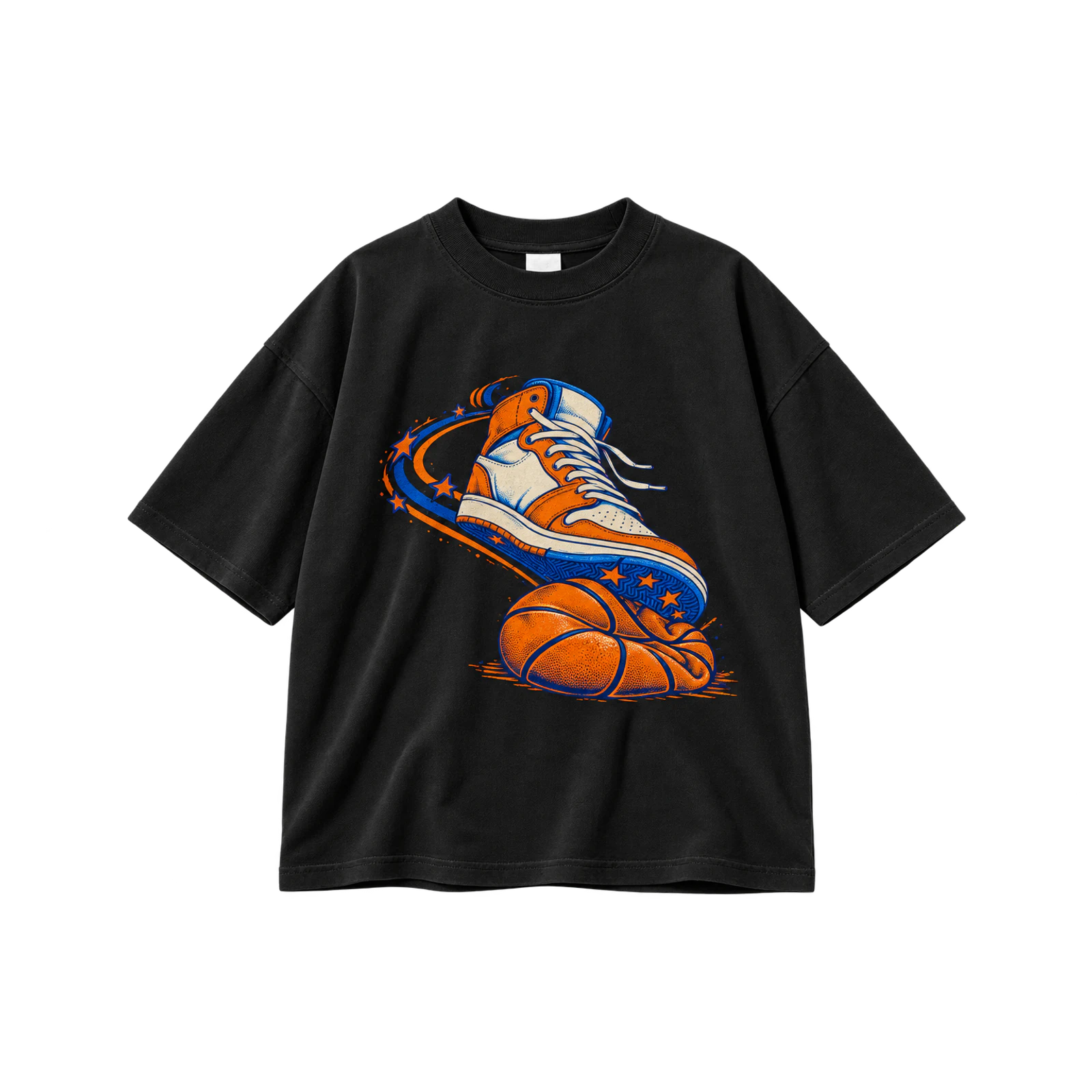
Footwear-focused basketball t-shirt designs make one sneaker or pair of basketball shoes the primary visual object and use a ball, hoop, or court line to establish the sport context. An angled shoe view displays the laces, panels, sole, and silhouette without requiring unrelated decorative elements. An 8- to 12-inch print gives detailed footwear sufficient room, while simpler shoe silhouettes suit limited-color printing and cleaner compositions.
Key Features: Basketball sneakers, basketballs, court lines, hoops, laces, soles, footwear details, and compact typography.
Best For: Sneaker enthusiasts, basketball fans, streetwear collections, youth apparel, player merchandise, fashion brands, and basketball lifestyle t-shirts.
Popular directions:
- Sneaker and ball: Place one detailed basketball shoe beside a ball, overlap the two slightly, and use a short wordmark beneath to anchor the composition.
- Court footwear: Position the sneaker over simplified hardwood or court lines, then add a small basketball near the toe or heel for clear sports context.
- Sneaker wordmark: Make the shoe the central illustration, place a short basketball phrase beside it, and align the typography with the sneaker’s angle.
- Ball-balanced shoe: Position the sneaker visually above or against a basketball, using the circular ball shape to contrast with the longer footwear silhouette.
- Sole graphic: Show the outsole or tread as a secondary background texture, then place a side-view sneaker and basketball in the foreground.
- Minimal sneaker: Reduce the footwear to a strong silhouette or thick outline, pair it with a small ball, and keep surrounding typography restrained.
27. Basketball with Paint Splatter
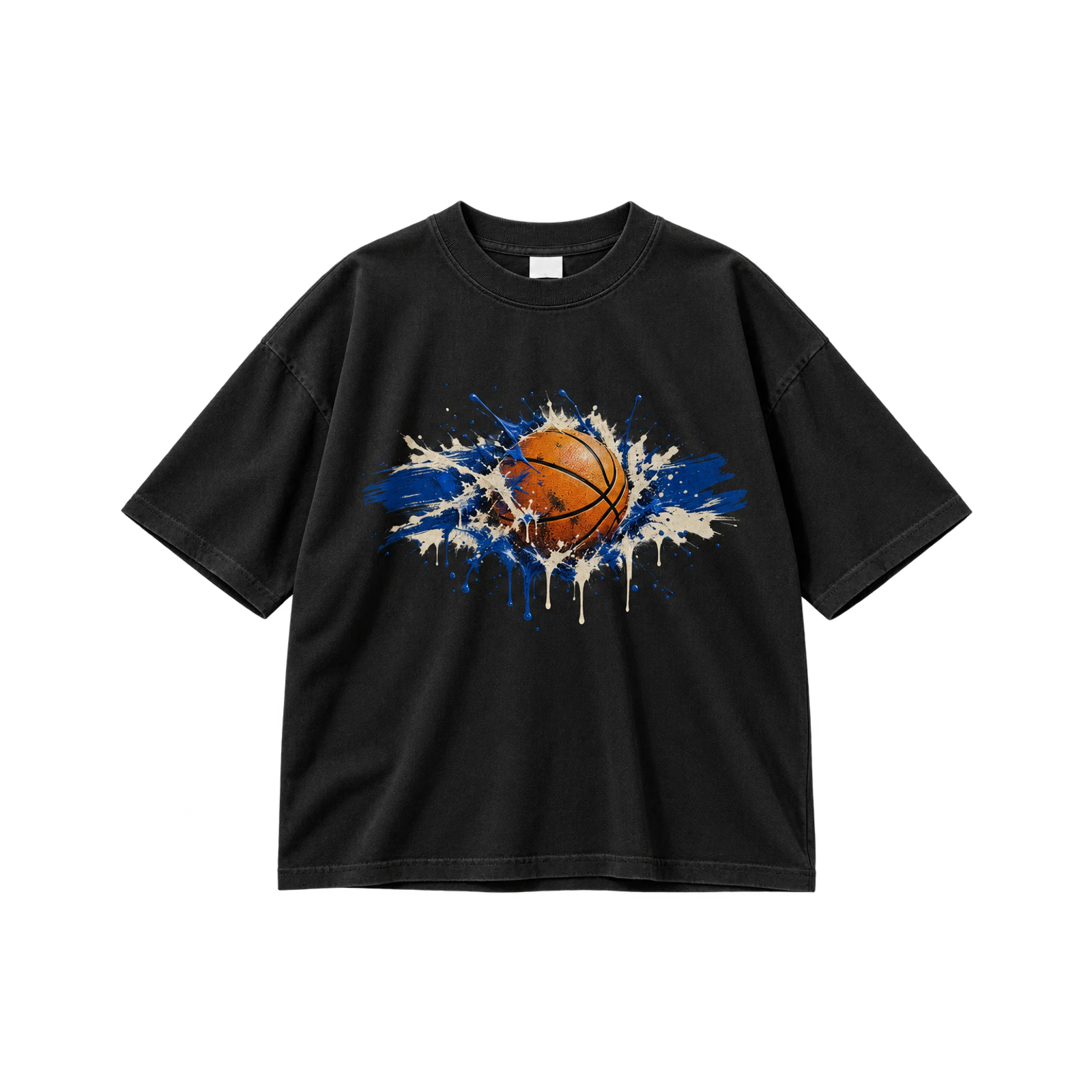
Color-driven basketball T-shirt ideas use paint splashes, drips, and brush marks to extend movement beyond a recognizable basketball. The splatter follows one or two clear directions, connecting the paint to the motion of a pass or shot rather than creating random visual noise. Team colors personalize the treatment, while an 8- to 12-inch composition provides enough room for irregular paint edges without covering the basketball seams.
Key Features: Basketballs, paint splatter, drips, brushstrokes, team colors, directional movement, irregular edges, and layered paint.
Best For: Creative basketball t-shirts, youth apparel, team merchandise, tournaments, streetwear, fan graphics, and colorful sports designs.
Popular directions:
- Directional splash: Position the basketball off-center and send paint outward in one clear direction, creating the appearance of movement through the composition.
- Team-color paint: Use official school or club colors for the splatter, then keep the basketball relatively neutral so the team palette remains distinctive.
- Brushstroke basketball: Place the ball over one broad painted stroke, using the brush direction to frame the basketball rather than cover its seam details.
- Dripping ball: Apply painted color across part of the basketball and extend selected drips downward, preserving enough clean surface to keep the ball recognizable.
- Two-color splash: Use two contrasting paint colors behind a standard basketball, keeping each color in separate areas so the composition remains visually organized.
- Paint-and-wordmark: Combine a clean team name with irregular paint effects around the basketball, using the typography as a stable counterpoint to the splatter.
28. Neon Basketball Graphic
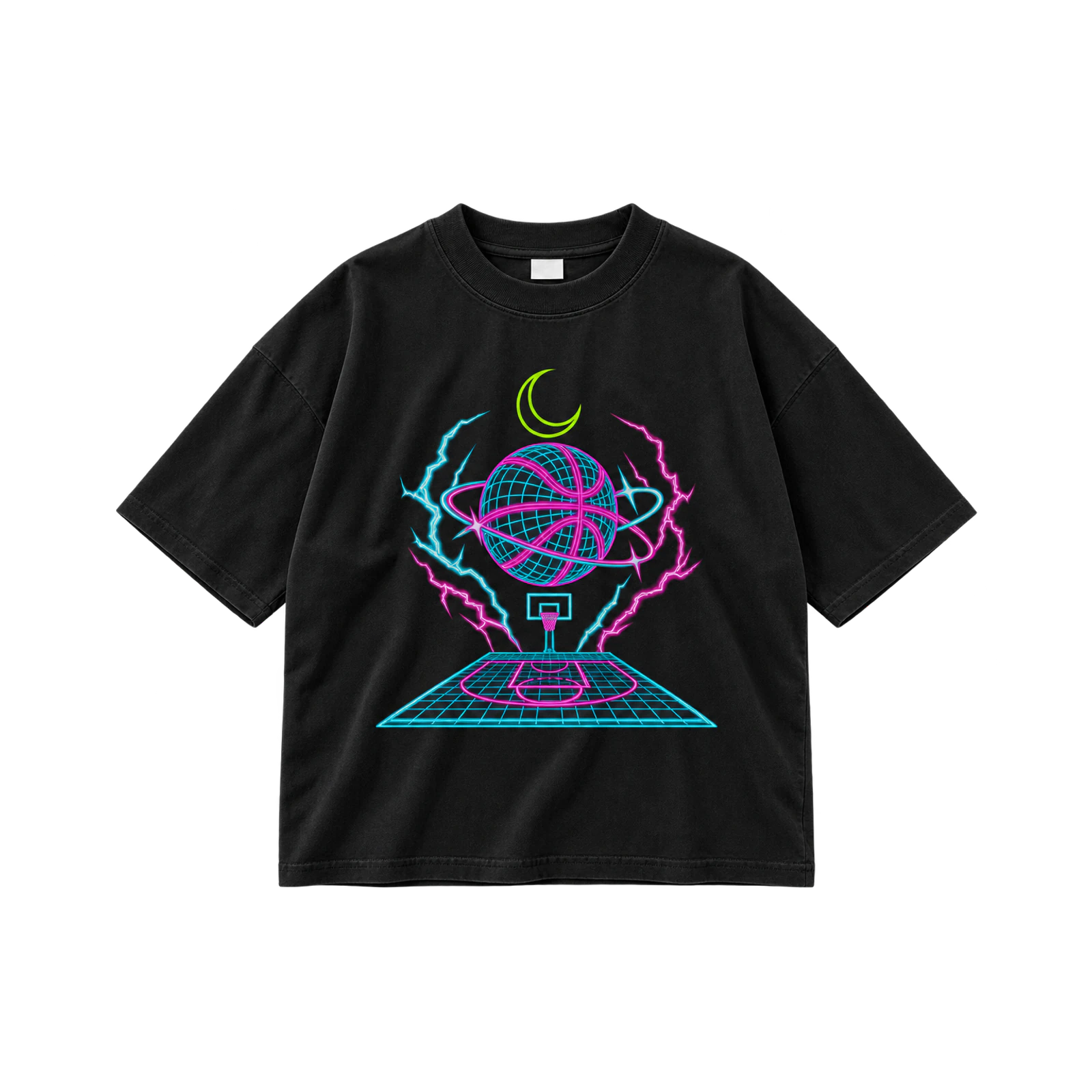
Modern basketball t-shirt graphics use luminous-looking outlines, glowing typography, and bright basketball or hoop elements against a dark garment. The neon effect stays concentrated around selected shapes, allowing the ball, rim, and lettering to remain clearly defined. An 8- to 12-inch chest or back graphic provides enough room for illuminated details, while DTG or DTF reproduces soft halos, bright transitions, and multi-color glow effects.
Key Features: Neon outlines, glowing basketballs, hoops, bright colors, dark backgrounds, light halos, illuminated typography, and high contrast.
Best For: Basketball streetwear, night-event apparel, youth merchandise, fashion graphics, tournament t-shirts, fan apparel, and modern basketball designs.
Popular directions:
- Neon ball: Outline the basketball with a bright luminous effect, keep the inner seams visible, and add a restrained halo around the outer edge.
- Glowing hoop: Draw the rim and net with illuminated lines, position a bright basketball above the basket, and keep the surrounding background dark.
- Neon wordmark: Use glowing typography for the team or basketball phrase, then add a smaller neon ball as a supporting visual element.
- Two-color glow: Apply one neon hue to the basketball and another to the typography or hoop, maintaining clear separation between both illuminated elements.
- Neon court: Build simplified court markings from glowing lines, then position a bright basketball or team name at the center of the geometry.
- Dark-shirt back print: Create an oversized glowing basketball composition across the rear, using a small matching neon mark on the front chest.
29. Basketball and Rose Graphic
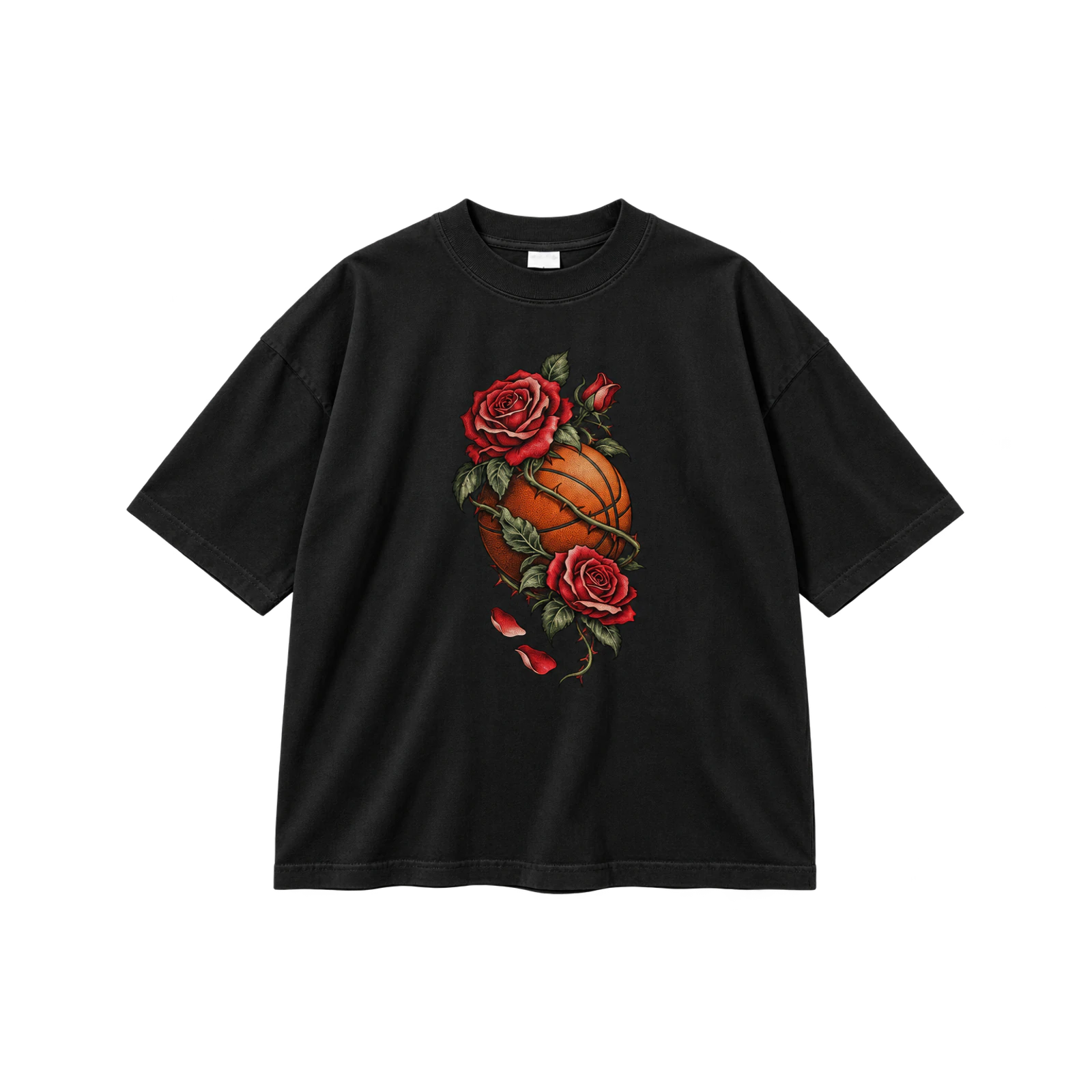
Floral basketball T-shirt design ideas combine a basketball with roses, petals, stems, and leaves to create a clear contrast between athletic geometry and organic shapes. Roses wrap around the ball or grow through a hoop while leaving the basketball seams visible. An 8- to 12-inch graphic provides enough space for botanical detail, while thicker outlines support simplified tattoo-style interpretations and smaller production applications.
Key Features: Basketballs, roses, petals, leaves, stems, hoops, botanical details, and tattoo-style linework.
Best For: Basketball lifestyle apparel, fan t-shirts, streetwear, player gifts, fashion collections, floral sports graphics, and personalized merchandise.
Popular directions:
- Rose-wrapped basketball: Curl stems around the basketball, position roses near opposite edges, and leave enough open surface for the seam pattern to remain recognizable.
- Floral hoop: Arrange roses and leaves around the rim, place a basketball near the net, and keep the botanical elements outside the main scoring area.
- Tattoo-style graphic: Use thick outlines for both the roses and basketball, add restrained shading, and organize the flowers around the circular ball shape.
- Single rose and ball: Pair one detailed rose with a basketball of similar scale, overlapping the two slightly to create a simple balanced composition.
- Floral frame: Surround the basketball with an open wreath of roses and leaves, keeping the center uncluttered and the botanical details evenly distributed.
- Team-color roses: Use official team colors across the flowers, retain recognizable basketball tones or outlines, and add a small team name beneath the arrangement.
30. Basketball Hoop Graphic
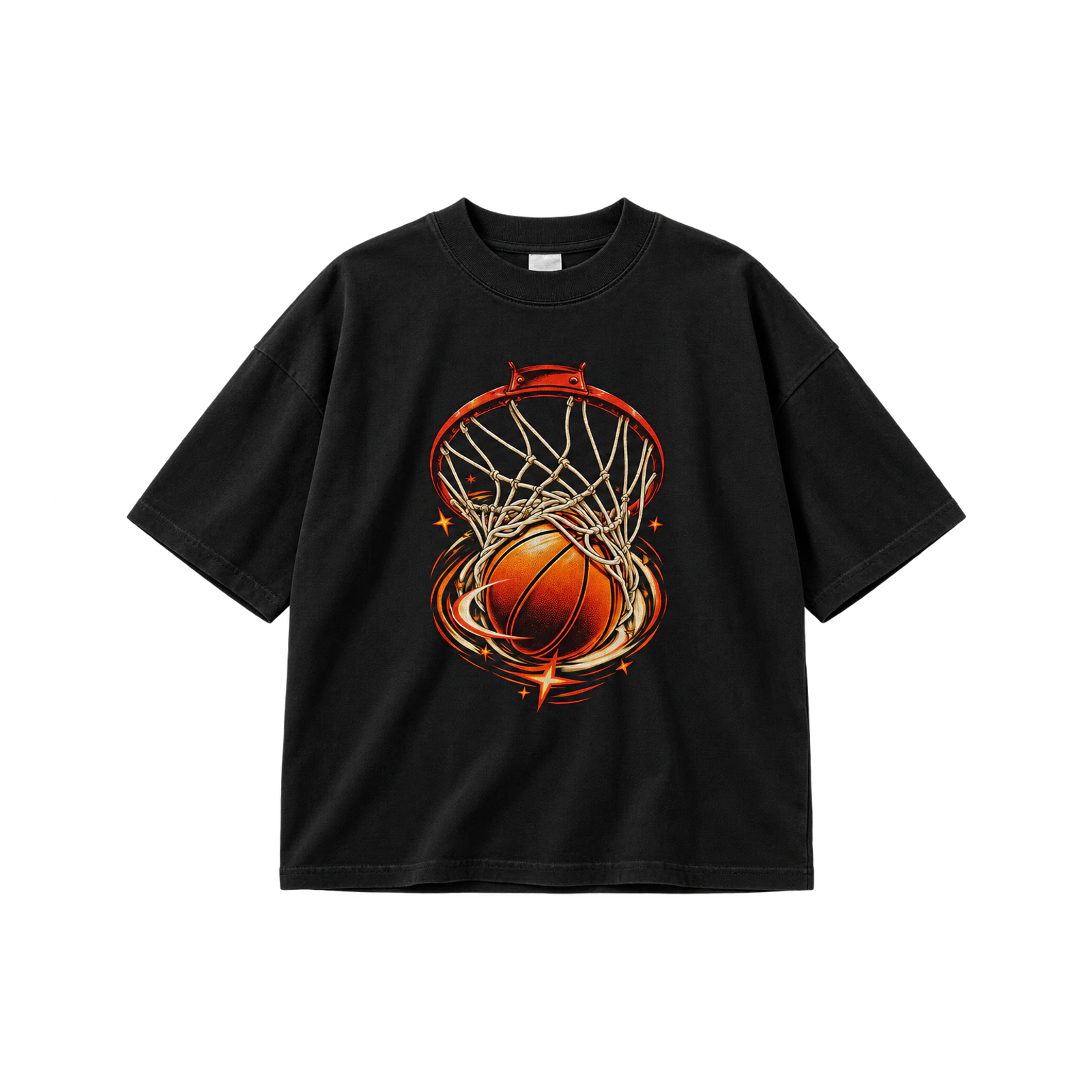
Hoop-centered basketball T-shirt designs use the rim, net, backboard, and ball to represent a specific game moment such as an approaching shot or made basket. The basketball’s position establishes the action, while front-facing or angled perspectives change the visual structure. A compact hoop works as a small chest mark, while an 8- to 12-inch illustration provides additional space for detailed net lines, backboard shapes, and typography.
Key Features: Basketball hoops, rims, nets, backboards, basketballs, scoring motion, perspective, and court imagery.
Best For: Basketball teams, player t-shirts, fan apparel, youth programs, camps, tournament merchandise, and minimal sports graphics.
Popular directions:
- Approaching shot: Position the basketball directly above the rim, use a few motion lines behind it, and keep the hoop centered beneath the ball.
- Made basket: Show the ball entering the net, stretch the net downward around it, and use the rim as a strong horizontal anchor.
- Minimal hoop: Reduce the composition to a simple rim, net, and basketball, using thick lines and generous negative space for a cleaner appearance.
- Perspective hoop: Draw the basket from a low or angled viewpoint, place the basketball near the rim, and use perspective lines to emphasize depth.
- Team-name hoop: Position the team name above the basket, place a ball near the rim, and use the net to complete the lower section.
- Backboard graphic: Include the backboard and target square behind the rim, then position the basketball at the point of an approaching or completed shot.
31. Basketball and Net Illustration
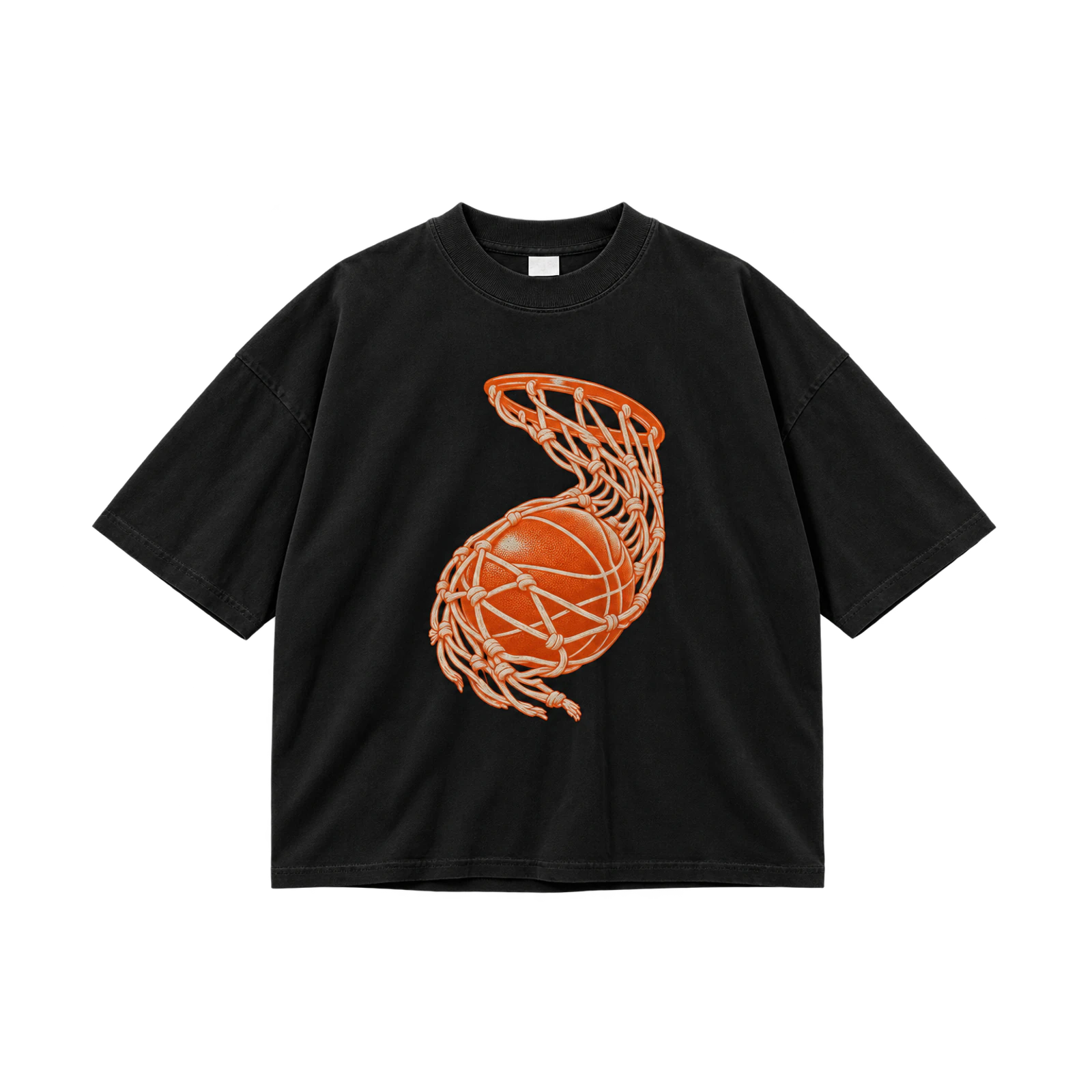
Scoring-focused basketball t-shirt graphics capture the moment when a basketball passes through a stretched net beneath the rim. The distorted net creates visible motion without requiring a player, while the rim provides a stable horizontal reference. A minimal version uses only the ball, rim, and essential net lines, while an 8- to 12-inch treatment provides room for motion marks, team wording, or a short scoring phrase.
Key Features: Basketballs, nets, rims, scoring motion, stretched lines, hoops, typography, and minimal sports illustration.
Best For: Player apparel, basketball teams, fan t-shirts, camps, youth programs, tournaments, and scoring-themed basketball graphics.
Popular directions:
- Ball through net: Position the basketball midway through the basket, stretch the net around its lower half, and keep the rim clearly visible above.
- Net distortion: Exaggerate the downward movement of the net after a made shot, using the basketball as the central point pulling the lines downward.
- Minimal scoring icon: Reduce the graphic to one basketball, a short rim, and essential net lines, leaving generous space around the compact symbol.
- Swish graphic: Pair the scoring illustration with a short “Swish” or team phrase, placing the wording beside rather than over the net.
- Team-color net: Apply team colors selectively to the rim or net, while keeping the basketball distinct and the overall illustration easy to identify.
- Close-up basket: Crop the scene tightly around the rim, basketball, and upper net, emphasizing the scoring moment instead of showing the complete backboard.
32. Basketball Doodle Character Design
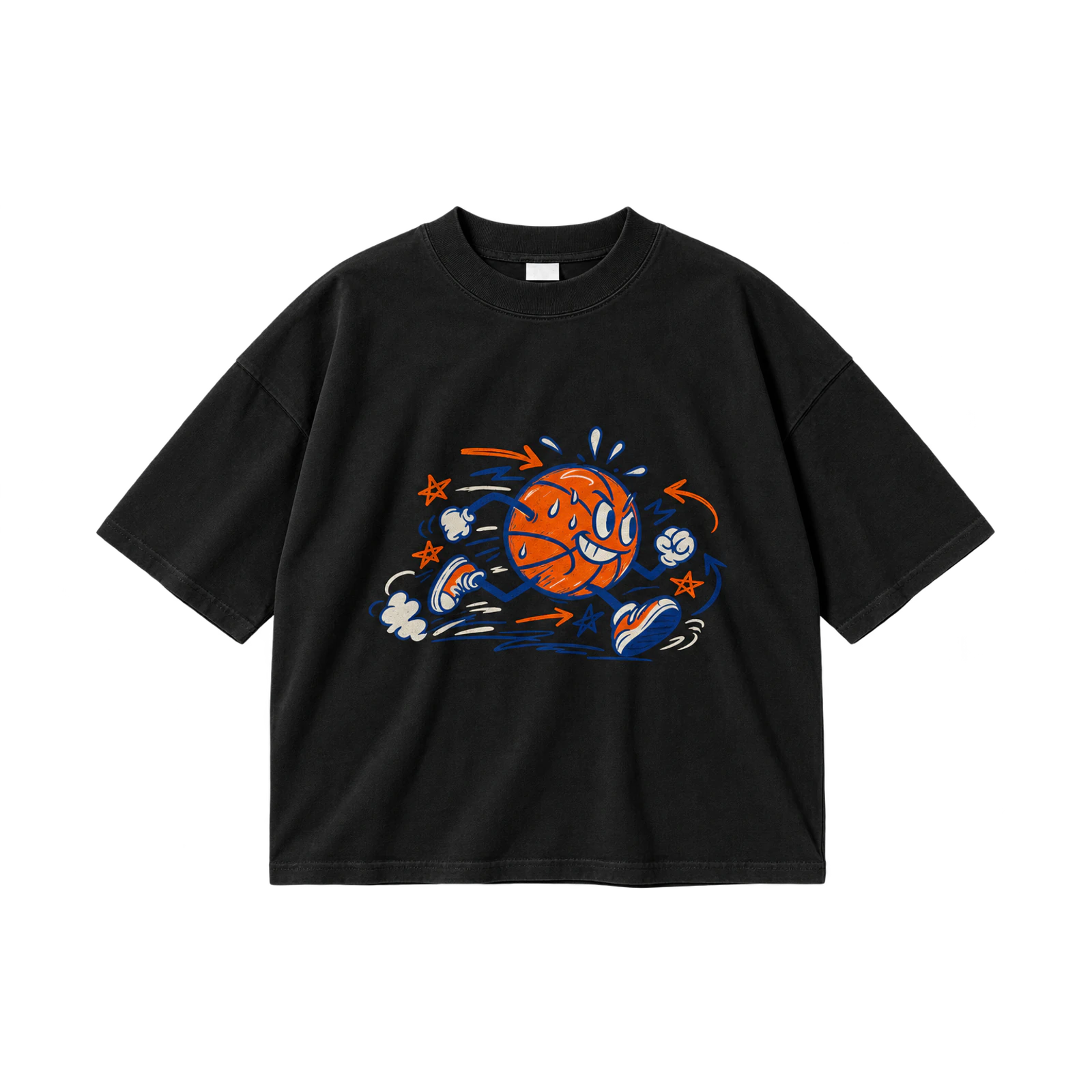
Playful basketball T-shirt concepts combine hand-drawn balls, hoops, sneakers, jerseys, whistles, scoreboards, and characters within one consistent doodle style. Varying the size of individual objects creates hierarchy and prevents the composition from resembling a repeated icon pattern. An 8- to 12-inch chest or back layout gives the illustrations enough room, while handwritten basketball terms fill selected spaces without creating unnecessary visual clutter.
Key Features: Doodle linework, basketballs, hoops, sneakers, whistles, jerseys, scoreboards, and handwritten details.
Best For: Youth basketball t-shirts, camps, casual apparel, school events, creative merchandise, fan t-shirts, and playful sportswear.
Popular directions:
- Equipment doodles: Mix basketballs, sneakers, whistles, hoops, and jerseys at different sizes, arranging them loosely around one larger central sports element.
- Character doodles: Give selected basketballs simple faces, arms, or expressions, then surround them with smaller hand-drawn equipment and court symbols.
- Sketchbook layout: Scatter basketball-related drawings across the print area, vary their angles, and connect selected objects with arrows or handwritten notes.
- Central ball cluster: Place one large basketball in the center, surround it with smaller doodled sneakers and hoops, and fill gaps with simple line marks.
- Handwritten words: Add short basketball terms between the illustrations, using the same hand-drawn line quality so the typography belongs to the doodle system.
- One-color doodle: Draw every object with one consistent ink-like line treatment, relying on scale and spacing rather than multiple colors for visual hierarchy.
33. Cartoon Basketball Character
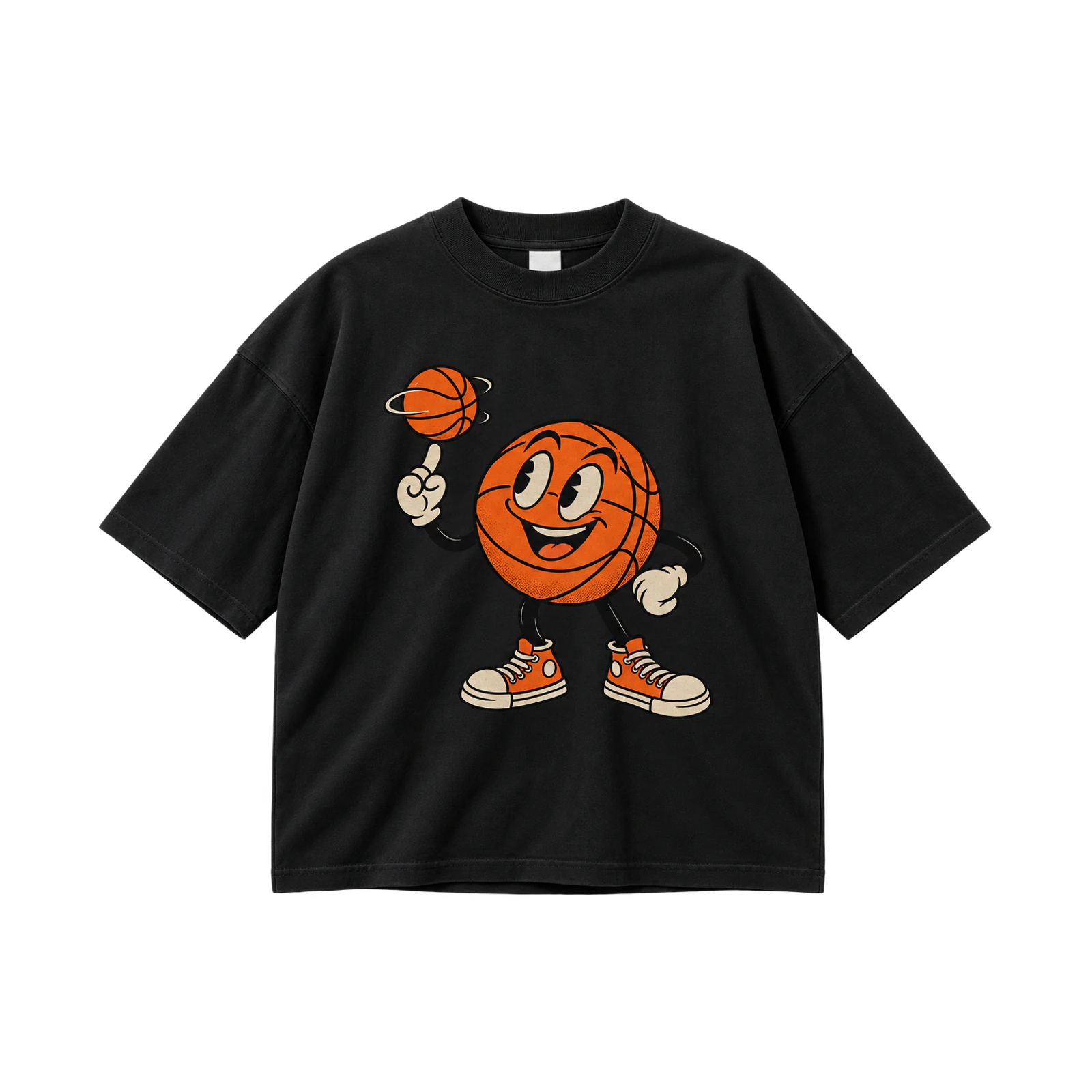
Character-based basketball t-shirt designs turn the ball into a personality by adding a face, arms, legs, sneakers, and an expressive athletic pose while keeping its seams visible. The character dribbles, runs, celebrates, or stands confidently, with one or two accessories reinforcing its personality. An 8- to 12-inch print provides enough space for facial details and footwear while keeping the background simple and the character immediately recognizable.
Key Features: Basketball characters, faces, arms, legs, sneakers, expressive poses, accessories, and visible ball seams.
Best For: Youth teams, basketball camps, children’s apparel, school programs, casual fan t-shirts, mascot merchandise, and playful basketball designs.
Popular directions:
- Dribbling character: Give the basketball character arms and legs, place another ball beneath one hand, and use bent limbs to establish a clear dribbling pose.
- Sneaker character: Add oversized basketball shoes to the character, keep the facial expression simple, and use the footwear as the strongest supporting detail.
- Mascot-style ball: Give the basketball a bold facial expression and athletic stance, then add team colors or a small school identifier around the character.
- Running character: Position the arms and legs in a forward-moving pose, add restrained speed lines, and keep the basketball seams visible across the body.
- Uniform character: Dress the basketball figure in a small team jersey, place a readable number on the uniform, and coordinate the sneakers with team colors.
- Celebration pose: Raise the character’s arms or place it in a victory stance, then add a short team or championship phrase beneath the illustration.
34. Basketball Line Art Design
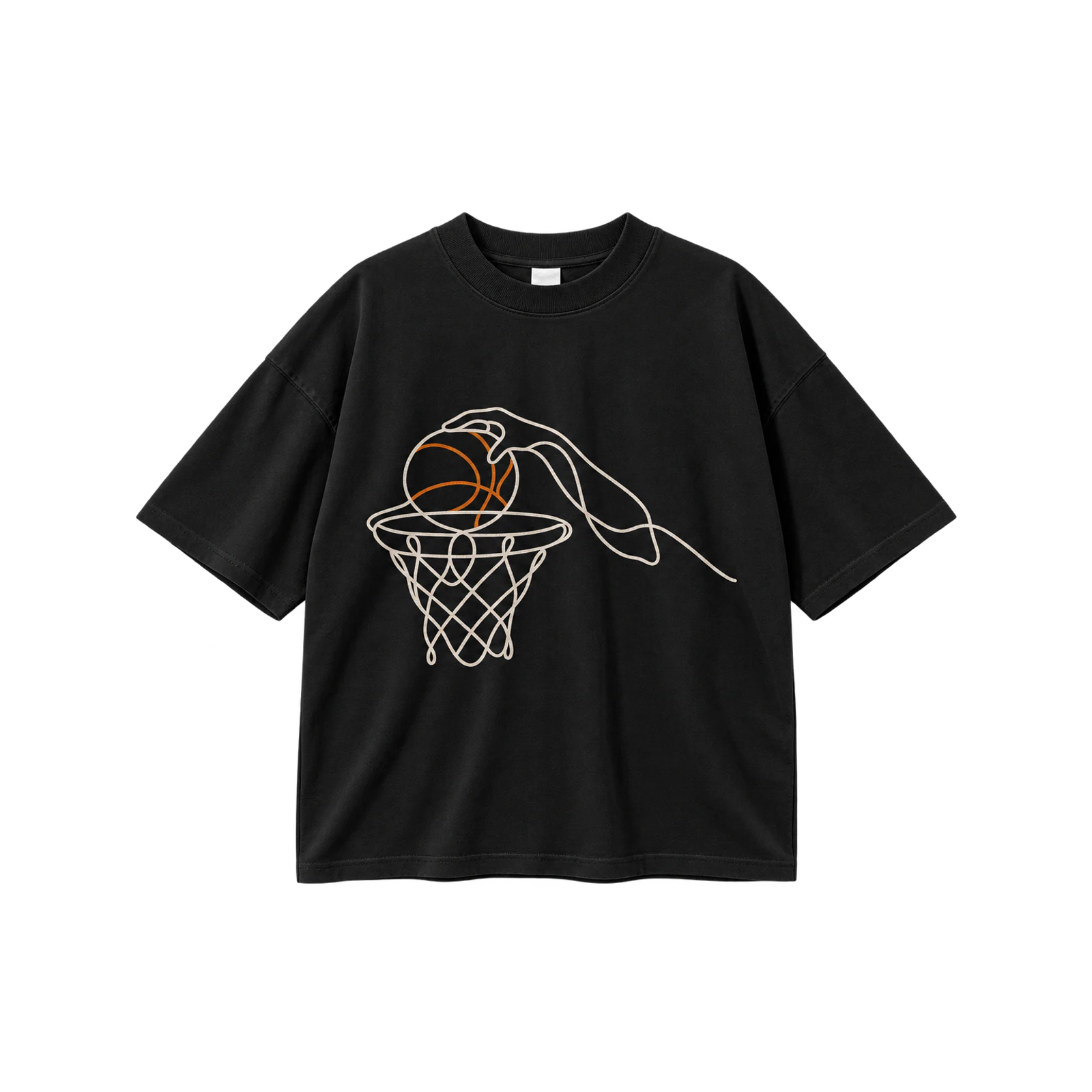
Minimal basketball t-shirt designs use clean contours, negative space, and restrained linework to represent a ball, player, hoop, or court without relying on large filled areas. A continuous line links the basketball with a rim or traces an athlete’s shooting pose in one fluid composition. A 2- to 4-inch chest mark suits simple versions, while an 8-inch treatment provides room for more detailed linear relationships.
Key Features: Continuous lines, basketball contours, player outlines, hoops, minimal details, negative space, clean forms, and geometric structure.
Best For: Minimal basketball apparel, lifestyle t-shirts, team merchandise, fashion collections, embroidered marks, subtle fan apparel, and modern sports graphics.
Popular directions:
- Continuous-line ball: Draw the basketball with one flowing contour, incorporate the seam pattern into the same line, and avoid unnecessary shading or filled areas.
- Player outline: Reduce a shooting or dribbling athlete to essential body contours, then add one basketball line to make the action immediately recognizable.
- Ball-to-hoop line: Start the continuous line at the basketball, extend it toward the rim, and use the path itself to suggest the trajectory of a shot.
- Minimal court line: Pair a simple basketball outline with a few recognizable court markings, using geometric spacing to keep the composition clean.
- Face-and-ball line art: Merge a player profile with basketball seam lines, allowing both forms to share selected contours without losing their individual identities.
- Small chest mark: Reduce the concept to one ball, hoop, or player outline sized for the chest, keeping line thickness consistent for production clarity.
35. Basketball Heartbeat Graphic
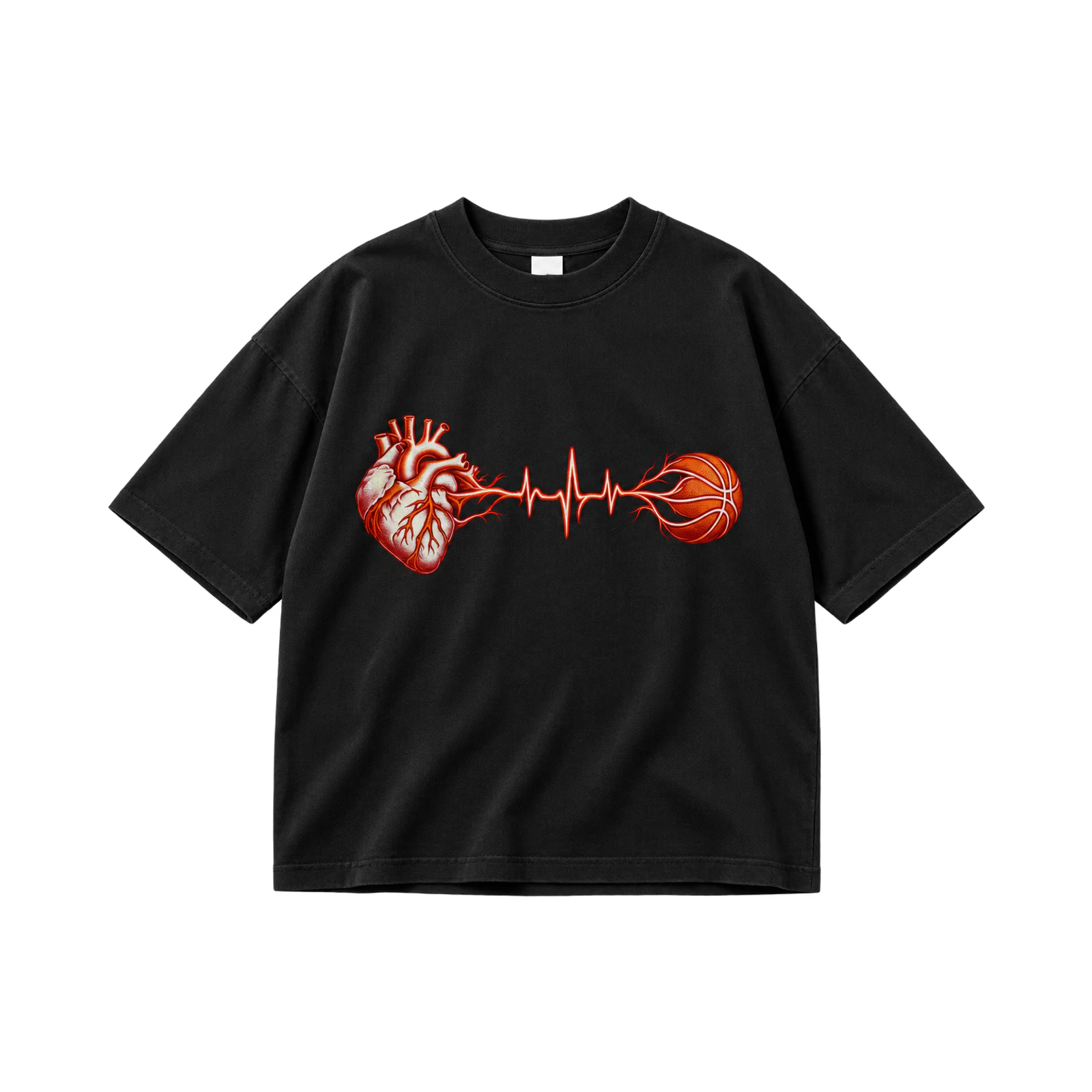
Symbolic basketball T-shirt designs connect a pulse line with a ball, hoop, player number, or team name to create a compact horizontal composition. The heartbeat passes through the basketball or uses it as the central interruption in the line, keeping both elements visually connected. A 6- to 10-inch chest width provides enough room for the pulse pattern, while restrained personalization preserves the clean symbolic structure.
Key Features: Heartbeat lines, basketballs, hoops, jersey numbers, player names, pulse patterns, horizontal layouts, and symbolic graphics.
Best For: Basketball fans, players, parents, coaches, personalized gifts, team supporters, and minimal basketball t-shirts.
Popular directions:
- Ball heartbeat: Run a pulse line across the chest, place a basketball at its center, and continue the line from the opposite side of the ball.
- Hoop heartbeat: Extend the heartbeat toward a basketball rim, position a small ball near the basket, and keep the scoring elements aligned horizontally.
- Player heartbeat: Place a jersey number beside the pulse line, add a basketball at the center, and use the player’s surname as a small supporting detail.
- Team-color pulse: Use official team colors for selected peaks in the heartbeat, while keeping the basketball and primary line visually distinct.
- Minimal chest graphic: Keep the pulse, basketball, and optional initial within a narrow horizontal area, avoiding additional wording that weakens the simple symbol.
- Name heartbeat: Integrate a player or team name into a straight section of the pulse line, then place a basketball before the heartbeat resumes.
36. Basketball Heart Design
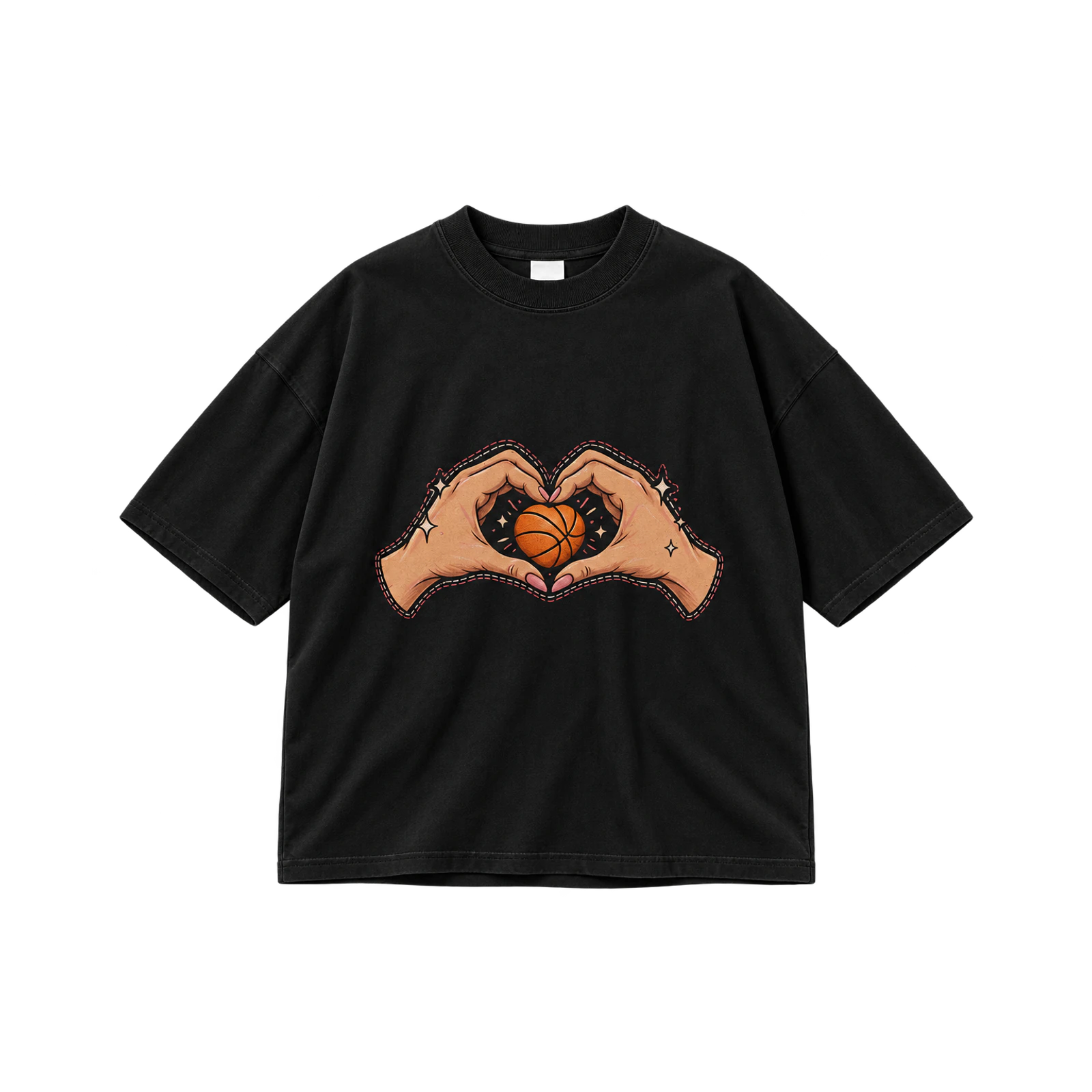
Supporter-focused basketball T-shirt design ideas merge a heart shape with ball seams, team colors, player numbers, or parent wording to create a simple sport-and-support symbol. The basketball sits inside the heart or becomes part of its structure, keeping both visual ideas recognizable. A compact version suits chest placement, while an 8-inch centered design provides room for a player name, number, or short supporter phrase.
Key Features: Hearts, basketballs, ball seams, team colors, player numbers, supporter wording, compact symbols, and personalization.
Best For: Basketball parents, player supporters, fan apparel, personalized gifts, youth teams, family t-shirts, and basketball lifestyle merchandise.
Popular directions:
- Heart-shaped basketball: Build the outer shape as a heart, add basketball seam lines inside it, and use team colors to strengthen the supporter identity.
- Ball inside heart: Center a complete basketball inside a heart outline, then place a player number or team name directly beneath the symbol.
- Player-support heart: Combine the heart and basketball with a large jersey number, keeping the player’s surname smaller so the symbol remains visually dominant.
- Team-color heart: Divide the heart into official team colors, add basketball seam details, and use a small school or club name as supporting typography.
- Heartbeat-heart combination: Run a pulse line into the heart-and-basketball symbol, then extend it outward to create one connected horizontal supporter graphic.
- Small chest symbol: Reduce the heart and basketball to a compact mark, then add a player initial or number without expanding the design unnecessarily.
37. Watercolor Basketball Design
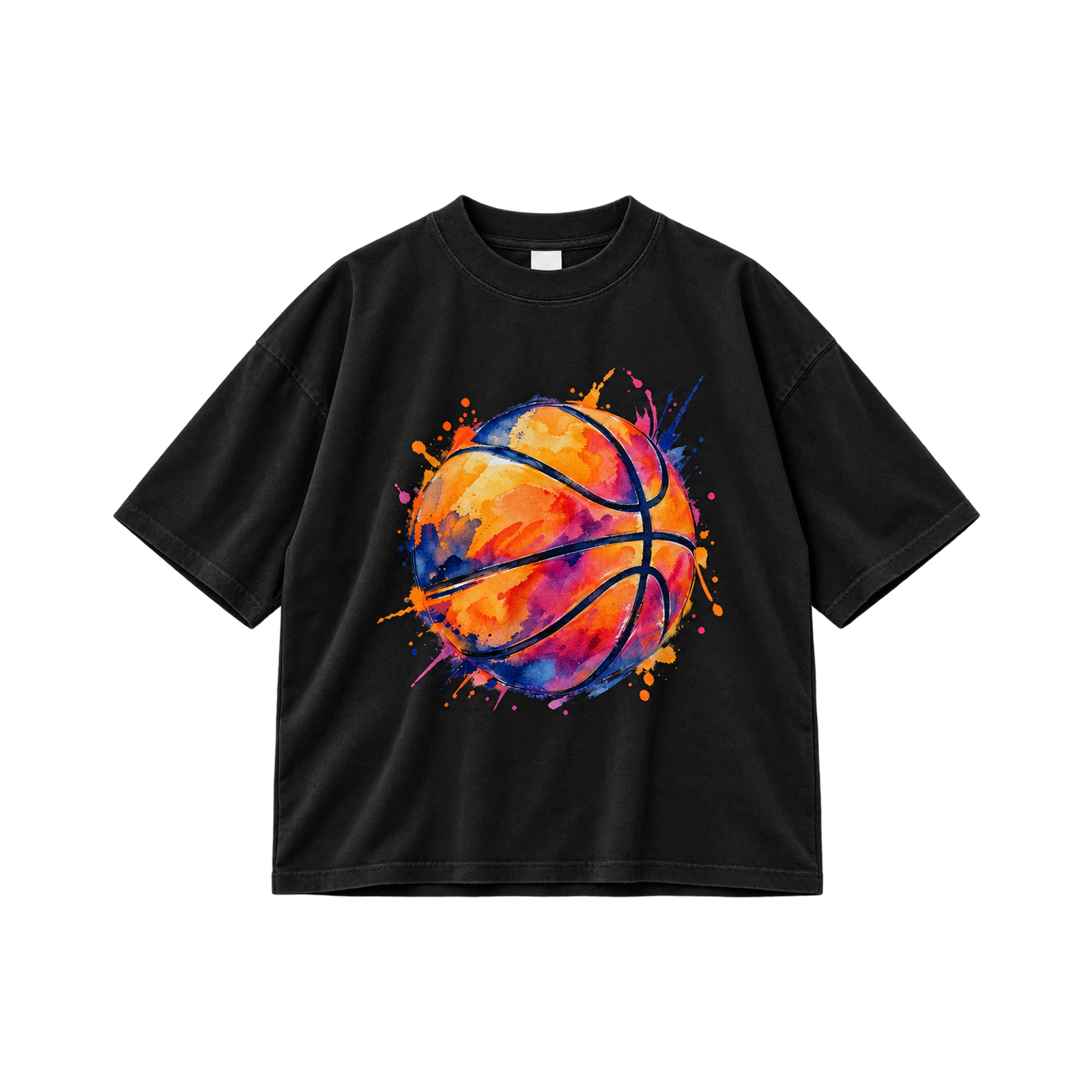
Artistic basketball T-shirt ideas use soft pigment washes, irregular brush edges, layered color, and visible seams to create a painted interpretation of a basketball. Defined seam lines preserve the shape while watercolor spreads beyond the outer edge, producing controlled contrast between structure and fluid color. An 8- to 12-inch print gives gradients and transparent-looking transitions enough space, while DTG or DTF reproduces detailed color variation effectively.
Key Features: Watercolor washes, basketballs, soft transitions, brush textures, irregular edges, layered colors, crisp seams, and painted effects.
Best For: Artistic basketball t-shirts, fan apparel, youth merchandise, fashion graphics, player gifts, colorful team designs, and creative sportswear.
Popular directions:
- Painted basketball: Fill the basketball with layered watercolor pigment, keep the seam lines sharp, and allow selected colors to extend slightly beyond the outer edge.
- Color splash: Position a recognizable basketball over loose watercolor washes, directing the largest splash toward one side to create a sense of movement.
- Brushstroke backdrop: Place one broad painted stroke behind the basketball, use contrasting color on the ball, and keep the remaining garment area uncluttered.
- Team-color watercolor: Restrict the washes to official team colors, retain strong basketball seams, and add a small team name beneath the painted graphic.
- Dripping watercolor: Extend a few soft paint drips below the basketball, varying their length while preserving a cleaner upper edge around the main ball.
- Watercolor hoop: Pair a loosely painted basketball with a simplified rim and net, using the same pigment palette to connect both sport elements.
38. Basketball Astronaut Design
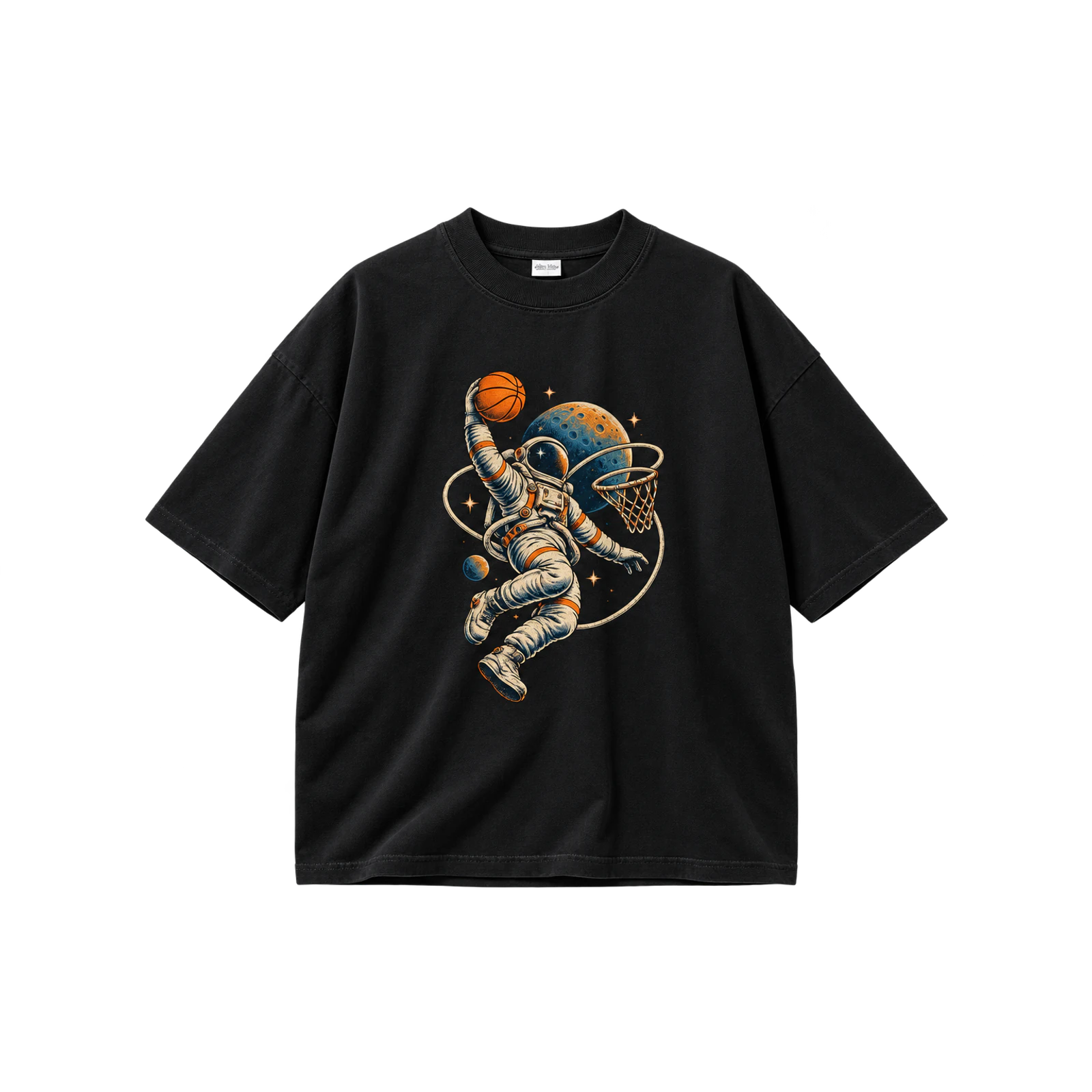
Surreal basketball t-shirt designs show an astronaut holding, dribbling, reaching for, or floating beside a basketball so the relationship between space and sport remains immediate. Sparse stars, planets, and orbit lines establish the setting while remaining secondary to the astronaut and ball. An 8- to 12-inch chest or larger back illustration provides enough room for helmet, suit, and basketball details without overcrowding the surrounding space.
Key Features: Astronauts, basketballs, space suits, stars, orbit lines, planets, floating poses, and space-themed details.
Best For: Basketball streetwear, youth apparel, creative merchandise, fashion graphics, fan t-shirts, novelty sportswear, and oversized T-shirt designs.
Popular directions:
- Astronaut holding ball: Position the astronaut upright with a basketball in one hand, then add sparse stars and one orbit line around the figure.
- Zero-gravity dribble: Show the astronaut floating above the basketball, separate the ball slightly from the hand, and use small space elements to reinforce weightlessness.
- Orbiting basketball: Place the astronaut at the center, draw a curved orbit path around the figure, and position the basketball along that path.
- Moon-court concept: Stand the astronaut on a simplified lunar surface, add a basketball and restrained court markings, and keep the space background relatively open.
- Floating dunk: Position the astronaut reaching toward a basketball hoop in zero gravity, using the body angle to create the main directional movement.
- Space back print: Build a large rear composition with the astronaut, basketball, planet, and sparse stars, then use a small space-ball mark on the front.
39. Basketball Character with Sunglasses
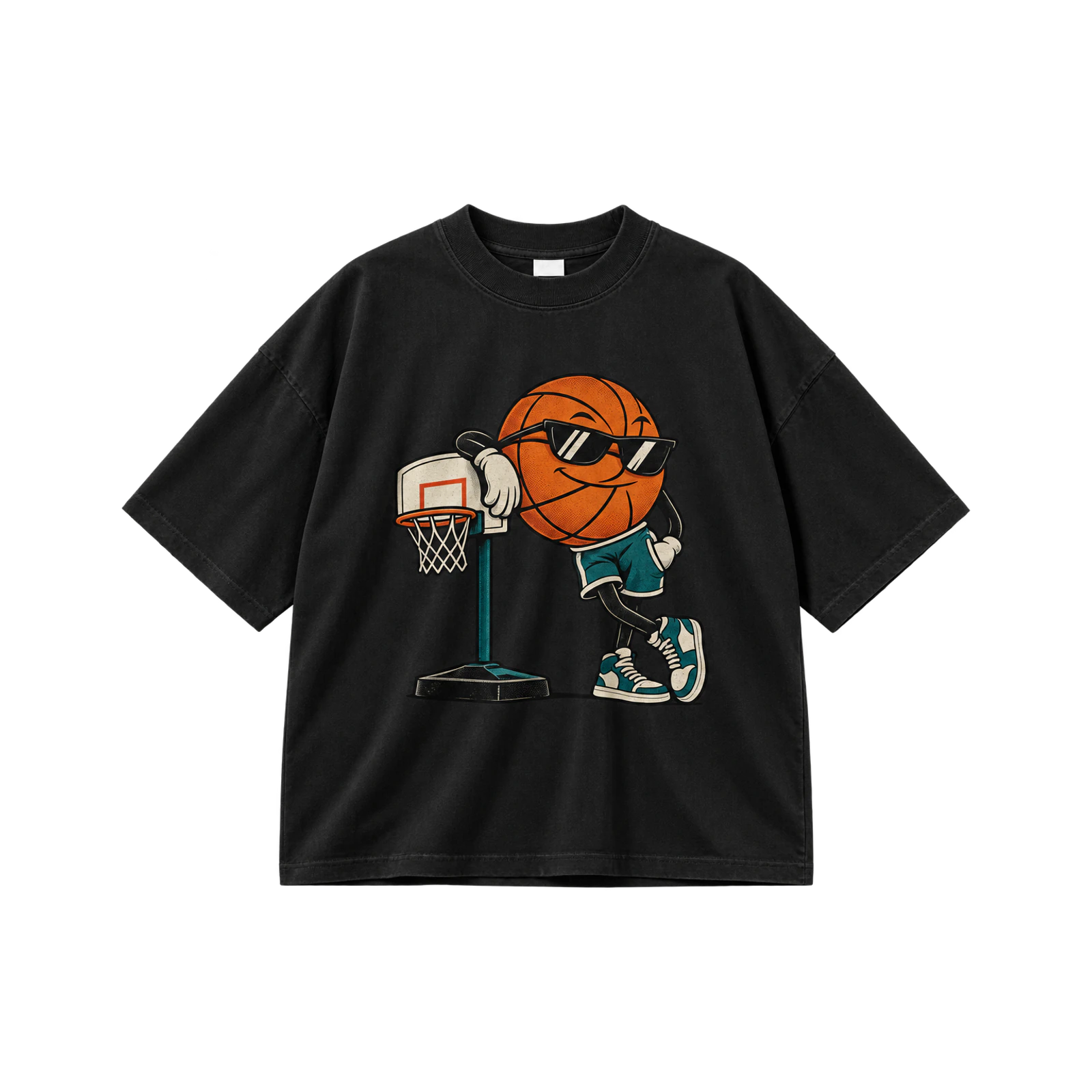
Playful basketball tee designs give a ball-shaped character visual personality through oversized sunglasses, sneakers, facial expressions, arms, and legs. The eyewear remains the defining accessory while visible basketball seams preserve the character’s sports identity. An 8- to 12-inch graphic gives the pose and footwear enough room, with standing, ball-spinning, and hoop-side positions providing different character attitudes without requiring a detailed background.
Key Features: Basketball characters, sunglasses, faces, arms, legs, sneakers, confident poses, and visible ball seams.
Best For: Youth apparel, basketball camps, casual fan t-shirts, school merchandise, character graphics, novelty sportswear, and playful team designs.
Popular directions:
- Cool standing character: Give the basketball crossed arms, oversized sunglasses, and sneakers, then use a confident facial expression as the main personality cue.
- Ball-spinning character: Position one hand above the character with a smaller basketball spinning on the finger, keeping the main body clearly ball-shaped.
- Hoop character: Place the sunglasses-wearing figure beside a rim, lean one arm against the hoop structure, and keep the background free from unnecessary details.
- Team-color glasses: Use the team’s primary color on the sunglasses and footwear, then add a small jersey number or school initial for personalization.
- Uniform character: Dress the ball-shaped figure in a team jersey, keep the sunglasses prominent, and place a readable number across the uniform.
- Back character graphic: Enlarge the complete character across the rear, add a short team or basketball phrase beneath it, and use a small front symbol.
40. Basketball Court Graphic
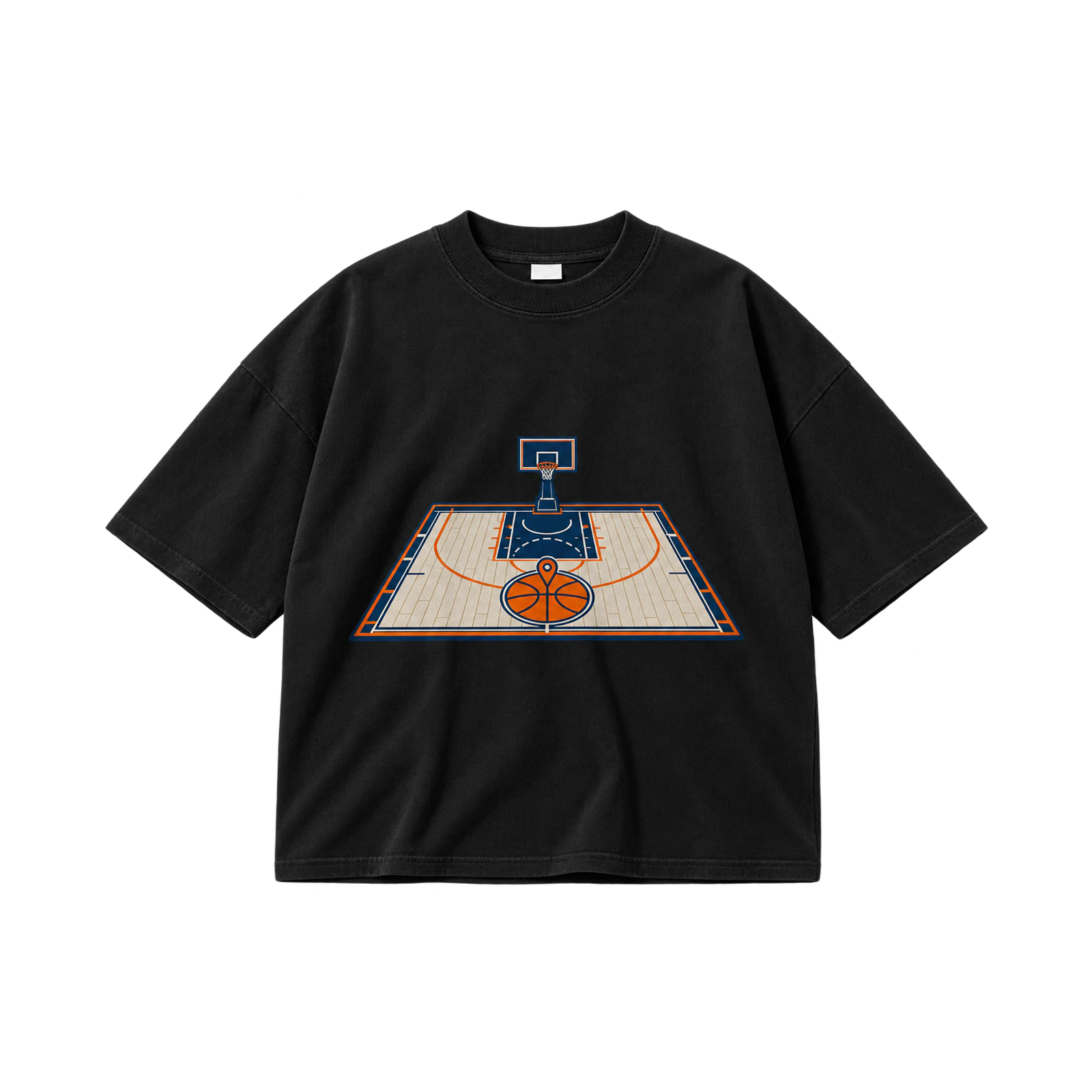
Geometric basketball T-shirt designs use the key, center circle, three-point arc, baseline, or half-court shape as the primary visual structure. Selecting only recognizable court markings creates a cleaner graphic than reproducing the entire floor. Team names, player numbers, or basketballs sit inside the geometry, forming an 8- to 12-inch structured composition that connects team identity with the physical layout of the game.
Key Features: Court lines, keys, center circles, three-point arcs, baselines, basketballs, team names, and geometric layouts.
Best For: Basketball teams, coaches, fan apparel, streetwear, school merchandise, camps, and tournament t-shirts.
Popular directions:
- Half-court plan: Draw the hoop, key, and three-point arc from above, then place a basketball or team name inside the open court space.
- Center-circle identity: Use the center circle as a frame for the team name or initials, then extend simplified half-court lines around it.
- Number in key: Place a large jersey number inside the painted key, position the hoop above it, and keep other court markings restrained.
- Ball and court: Overlay a basketball on geometric floor lines, using the contrast between circular seams and straight court markings as the main visual relationship.
- Vertical court: Rotate or crop the court into a tall composition, place a team wordmark along one edge, and use the hoop as the upper anchor.
- Minimal line court: Reduce the floor to the center circle, arc, and key, then add one small basketball without introducing unrelated decorative graphics.
41. Basketball Championship Design
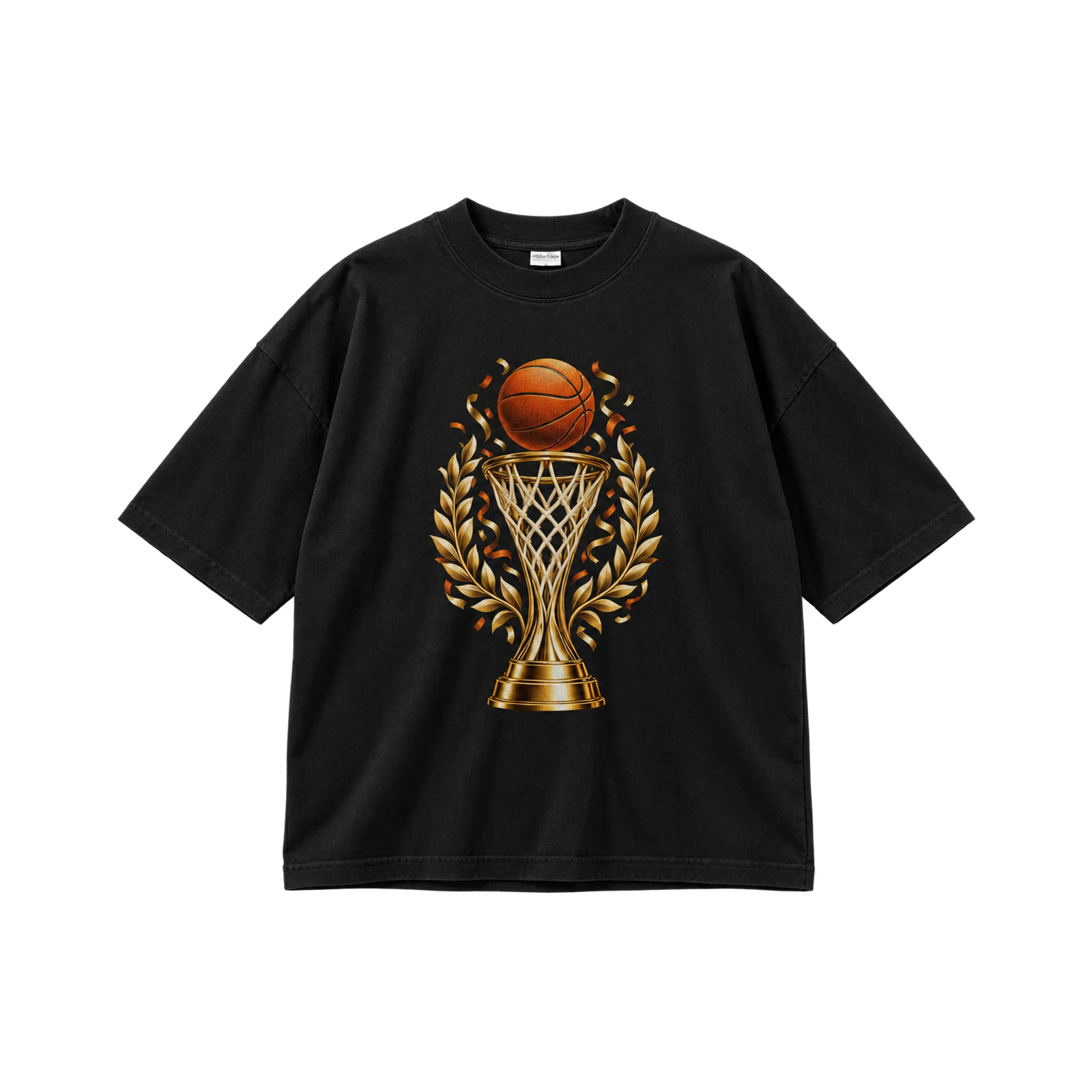
Commemorative basketball t-shirt designs use a championship title, trophy, basketball, winning team, and season year to record the achievement clearly. The title or trophy receives the strongest visual weight while the year and team identity provide supporting context. An 8- to 12-inch chest composition gives the details sufficient room, while simplified versions translate effectively into puff print, embroidery, or badge-style championship patches.
Key Features: Championship titles, trophies, basketballs, team names, winning years, celebratory typography, commemorative emblems, and achievement details.
Best For: Championship teams, school programs, tournaments, players, coaches, fans, and title celebrations.
Popular directions:
- Trophy-centered design: Place the trophy at the center, position the championship title above it, and add the team name and winning year beneath.
- Year-led graphic: Make the championship year a large background element, overlap it with a trophy or basketball, and keep the team name in the foreground.
- Championship badge: Enclose the title, basketball, trophy, and year inside a bordered emblem, using symmetrical spacing to create a formal commemorative mark.
- Ball-and-trophy design: Integrate the basketball into the upper portion of the trophy, then frame the combined symbol with the winning team and season.
- Team title t-shirt: Give the team name strong prominence, place “Champions” directly beneath it, and use a trophy or basketball as a secondary visual.
- Back celebration graphic: Build a large rear composition from the trophy, championship title, team name, and year, then use a small winning emblem in front.
42. Basketball Tournament Design
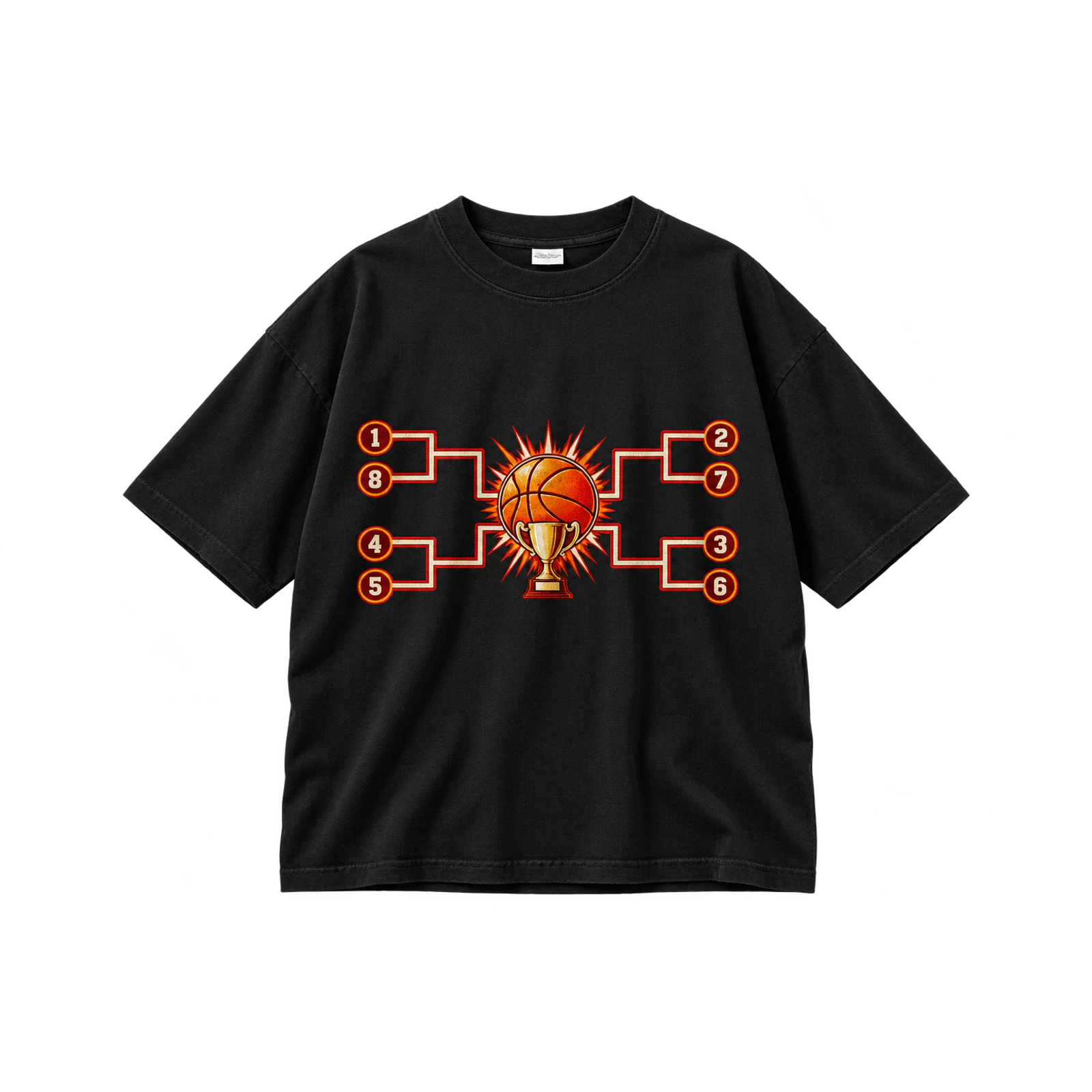
Event-based basketball T-shirt designs organize the tournament name, year, location, and basketball identity into a readable hierarchy without turning the garment into an information poster. The event title remains the largest element while dates and locations stay secondary. An 8- to 12-inch front graphic carries the tournament identity, while longer team lists and additional event information move to the back for clearer separation.
Key Features: Tournament names, basketballs, event years, locations, team identities, event typography, front-back information, and event branding.
Best For: Basketball tournaments, school competitions, youth leagues, invitational events, participants, volunteers, and staff.
Popular directions:
- Event-title graphic: Make the tournament name the largest element, position a basketball beneath it, and place the year and location in smaller supporting lines.
- Location-based design: Pair the event title with a city or state silhouette, then add a basketball to connect the geographic identity with the sport.
- Front-back tournament t-shirt: Use the front for the event logo, year, and location, then place participating team names or divisions across the rear.
- Tournament badge: Enclose the event name, basketball, year, and location inside a circular or shield-shaped mark that remains consistent across staff and participant t-shirts.
- Court event graphic: Use simplified court lines behind the tournament title, then place a basketball at the center without reducing the readability of event information.
- Annual edition: Keep the core event identity and composition consistent each year, updating the date, year, location, or accent detail for each tournament edition.
43. Basketball Camp Design
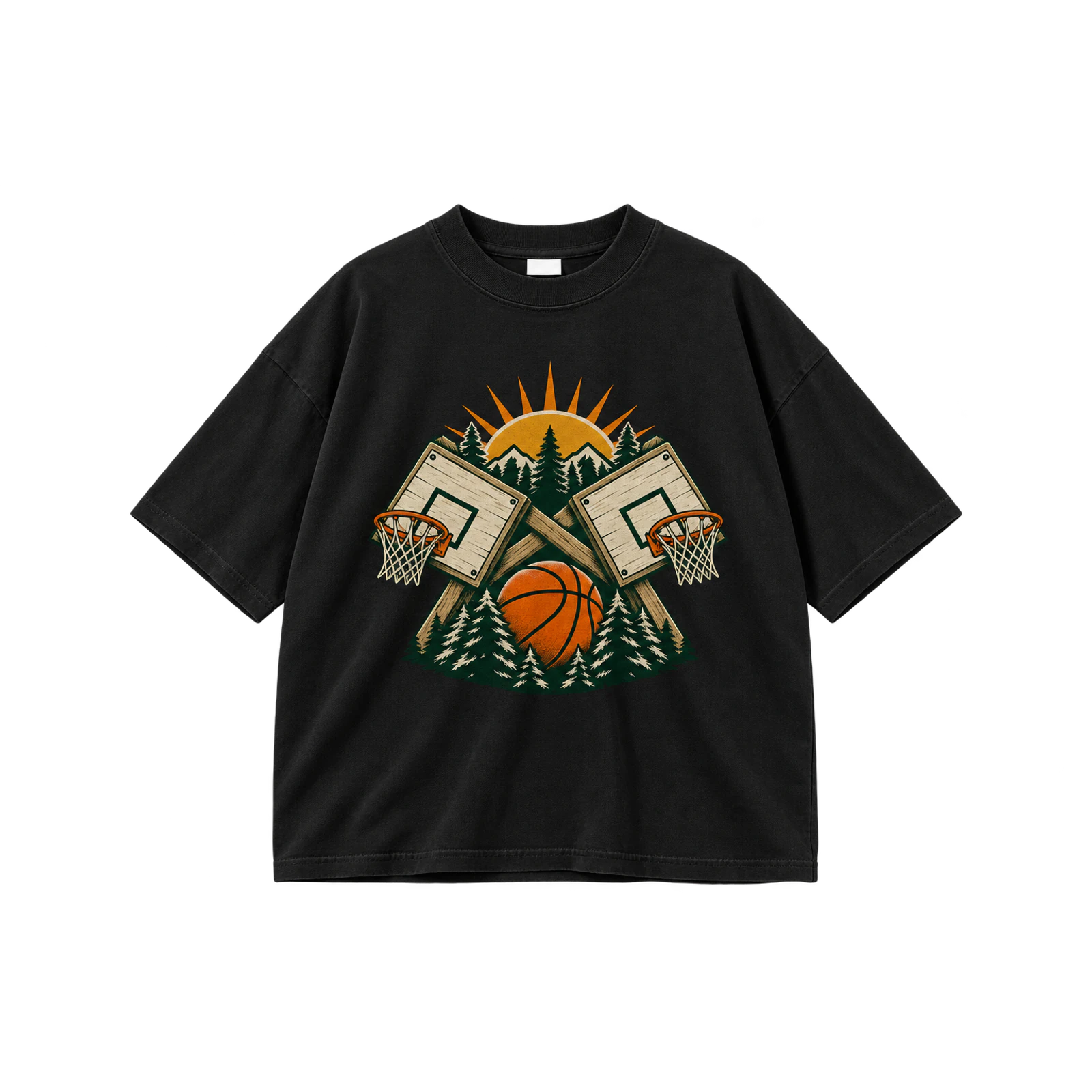
Program-focused basketball T-shirt design ideas use the camp name, year, basketball, and training identity to create coordinated apparel for participants, coaches, and staff. The camp title remains immediately readable while one ball, hoop, or court element establishes the sports context. An 8- to 12-inch front design carries the main program identity, while smaller role labels distinguish staff versions without changing the overall visual system.
Key Features: Camp names, basketballs, camp years, training symbols, role labels, team identity, athletic typography, and program branding.
Best For: Youth basketball camps, school clinics, summer programs, training sessions, coaches, staff, and participants.
Popular directions:
- Camp identity: Make the camp name dominant, place a basketball directly beneath it, and add the host school, club, or city as a secondary line.
- Annual camp t-shirt: Keep the core camp wordmark consistent, add the current year prominently, and update one basketball or color detail for each edition.
- Staff variation: Use the same camp design for everyone, then add Coach, Staff, or Instructor beneath the main identity to distinguish operational roles.
- Training graphic: Pair the camp name with a basketball, cone, hoop, or simple court marking, keeping the training imagery secondary to the program title.
- Camp badge: Enclose the camp name, basketball, year, and host identity inside a compact emblem suitable for both front prints and smaller applications.
- Participant edition: Use the standard camp identity without staff wording, then add the year or age division as a small secondary identifier.
44. Basketball Crown and Trophy Graphic
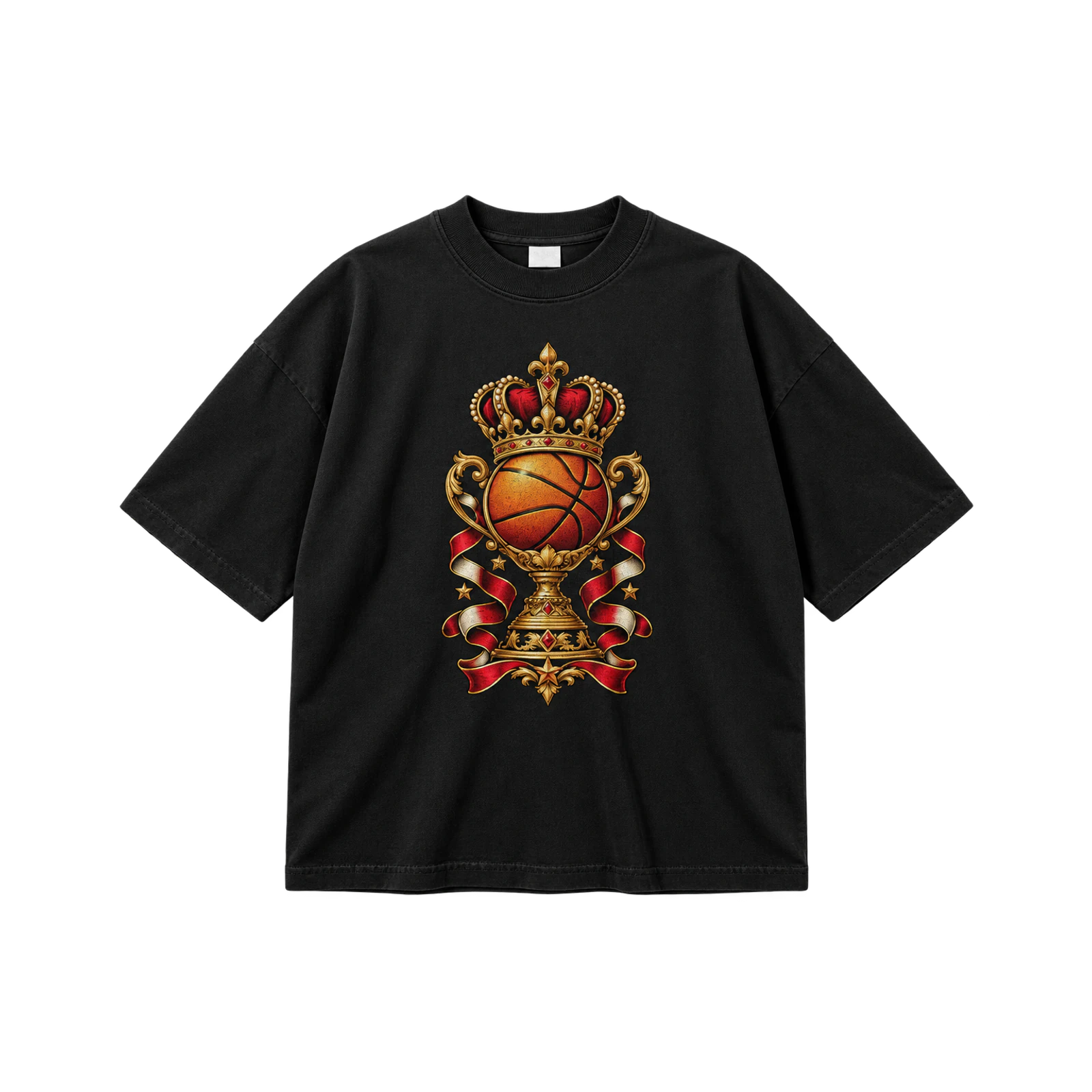
Winning-themed basketball t-shirt designs combine crowns, trophies, basketballs, titles, and years in a clear vertical hierarchy that communicates achievement immediately. A crown sits above the ball, or the basketball becomes part of the trophy itself, creating a direct connection between the sport and award. An 8- to 12-inch central graphic keeps the symbols visually connected, while metallic-looking or team colors reinforce the celebratory theme.
Key Features: Crowns, trophies, basketballs, championship wording, years, metallic-looking colors, vertical layouts, and winning symbols.
Best For: Championship teams, tournament winners, player awards, basketball clubs, fan merchandise, victory celebrations, and commemorative apparel.
Popular directions:
- Crowned basketball: Place a crown directly above a large basketball, add the team name beneath, and use the winning year as the smallest supporting element.
- Basketball trophy: Replace the upper trophy element with a basketball, retain the cup or pedestal beneath it, and frame the symbol with championship wording.
- Winner emblem: Enclose a crown, basketball, title, and year inside a badge, using thick borders to keep the multiple symbols visually unified.
- Metallic-look graphic: Use gold- or silver-inspired tones on the crown and trophy, then apply team colors to the basketball and supporting typography.
- Year and trophy: Make the winning year prominent behind a central trophy, place a basketball near the base, and add the team name above.
- Team champion design: Position the team name across the top, place a crowned basketball or trophy underneath, and finish the composition with the championship year.
45. State Basketball Shirt Design
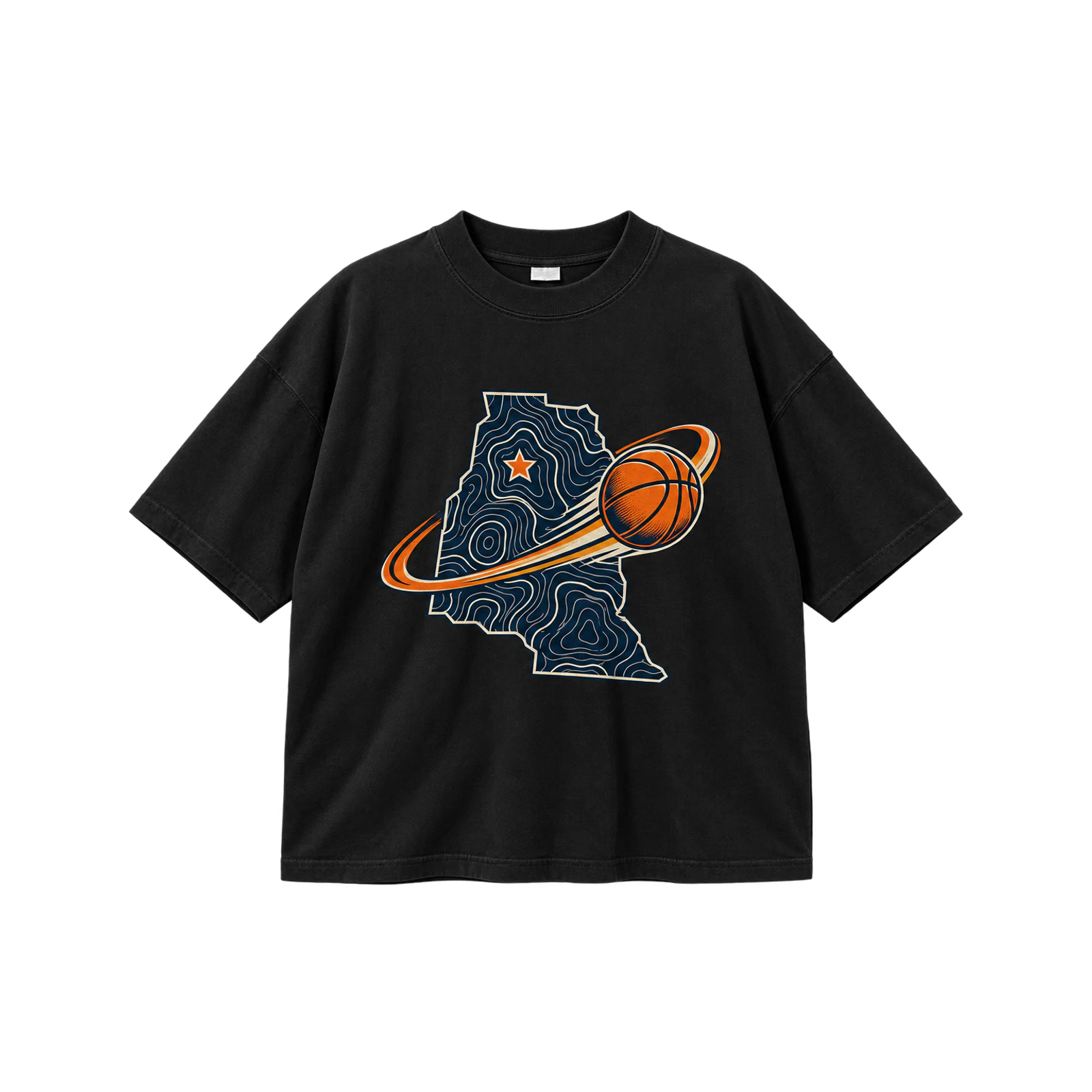
Regional basketball T-shirt ideas use a recognizable state silhouette with a basketball, team name, city, tournament title, or year to establish a clear geographic identity. The ball overlaps the state, marks a specific city, or contributes seam lines inside the silhouette. An 8- to 12-inch central graphic gives irregular state shapes enough room to remain recognizable while keeping the supporting basketball information readable and visually balanced.
Key Features: State silhouettes, basketballs, city markers, team names, school colors, tournament details, years, and regional identity.
Best For: State tournaments, regional teams, school programs, local basketball clubs, championship events, fan apparel, and location-based merchandise.
Popular directions:
- State and ball: Place a basketball partly over the state silhouette, position the team name above, and use the city or region as smaller supporting text.
- Tournament state graphic: Make the state shape central, add the tournament title across it, and place the year and basketball around the outer edges.
- Local team design: Pair the state silhouette with the school or club name, then mark the team’s city using a small basketball or star.
- City marker: Keep the state shape simple, position a basketball at the relevant city location, and add the team name beside the geographic marker.
- Basketball-seam state: Fill the state silhouette with curved basketball seam lines, then place a clean regional or team wordmark beneath the graphic.
- State badge: Enclose the state, basketball, year, and tournament or team name inside a bordered emblem for a compact regional identity.
46. Senior Night Basketball Design
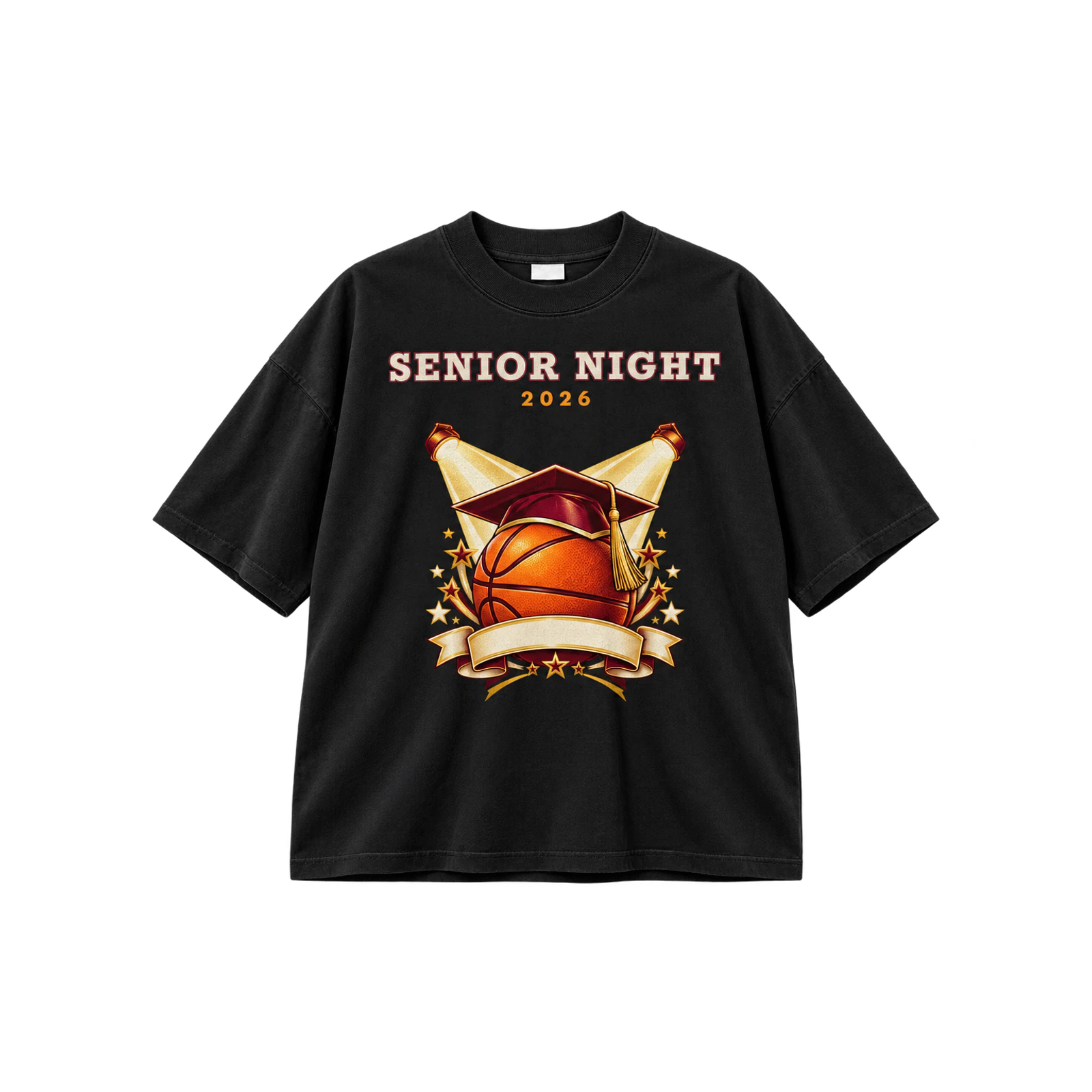
Player-tribute basketball t-shirt designs for Senior Night use a portrait, surname, jersey number, class year, and school identity to commemorate a graduating athlete. The player or number receives the strongest visual emphasis while school colors and event wording support the tribute. A 12- to 14-inch composition provides enough room for photographic detail and personalized typography, producing a balanced commemorative graphic for players, families, and teammates.
Key Features: Senior portraits, player names, jersey numbers, class years, school names, team colors, commemorative details, and personalized typography.
Best For: Senior Night events, graduating players, player families, school teams, teammates, coaches, and fan groups.
Popular directions:
- Senior portrait: Make the graduating player’s portrait dominant, place the surname and jersey number around it, and add the class year as supporting information.
- Class-year layout: Enlarge the graduation year behind the player image, overlap the portrait across the digits, and place the surname in the foreground.
- Action collage: Combine one main portrait with one or two smaller game images, then use the number and class year to unify the photographs.
- Number tribute: Make the player’s jersey number the visual foundation, place the portrait inside or over it, and add Senior Night wording beneath.
- School-color edition: Build the complete portrait and typography treatment around official school colors, keeping enough contrast for names and jersey numbers to remain readable.
- Family supporter t-shirt: Use the same player portrait and number, then replace team-focused wording with Mom, Dad, Family, or another supporter identifier.
47. Basketball Mom Design
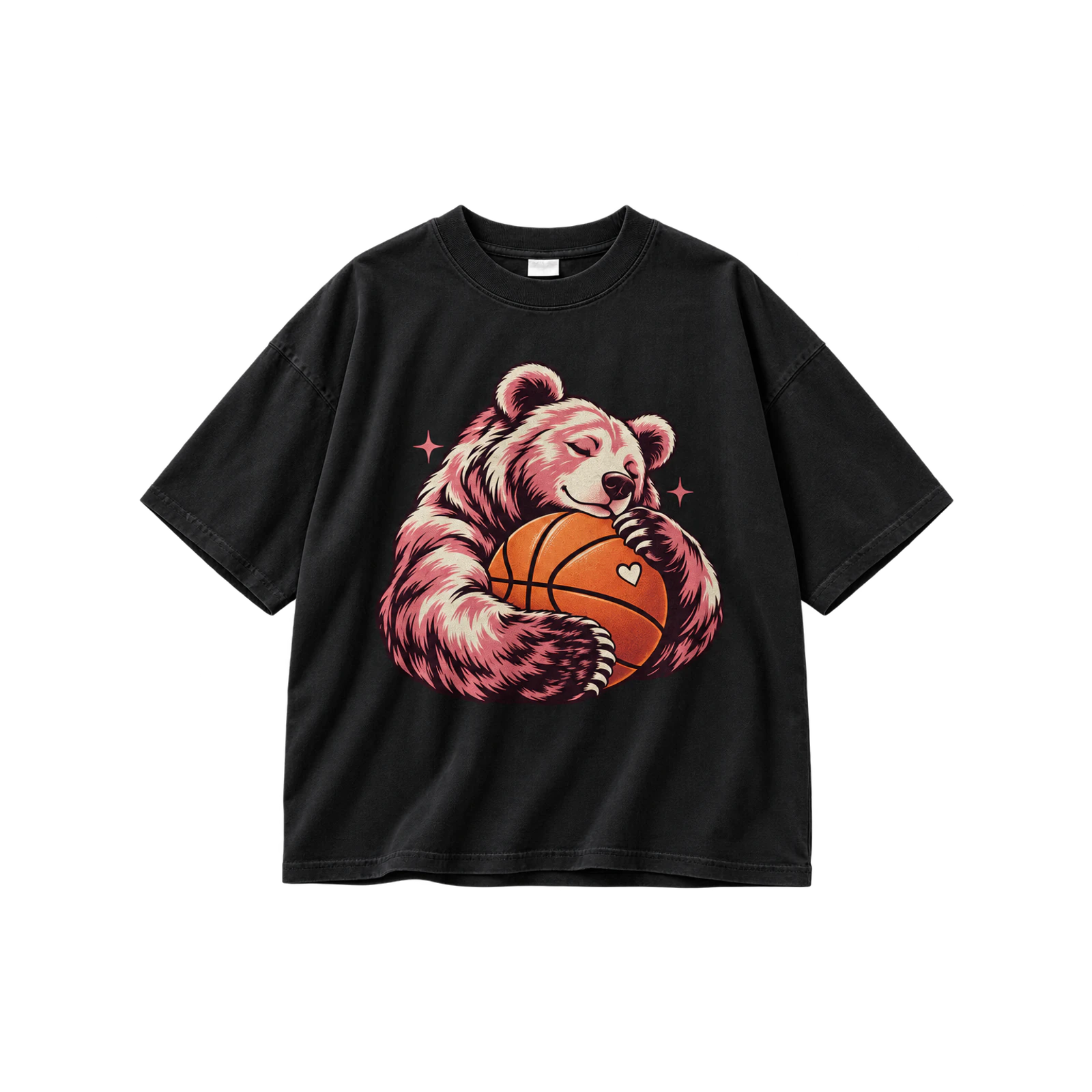
Supporter basketball T-shirt designs for moms combine parent-focused wording with a player number, team name, basketball, heart, bow, or team colors. “Basketball Mom” remains the primary phrase while smaller personalization identifies the player or program being supported. An 8- to 12-inch chest graphic provides strong visibility for game-day wear, while compact versions use fewer elements for a restrained supporter-focused appearance.
Key Features: Basketball Mom wording, player numbers, basketballs, hearts, bows, team colors, personalization, and supporter details.
Best For: Basketball moms, player families, school games, tournaments, Senior Night, Game Day apparel, and personalized gifts.
Popular directions:
- Basketball Mom wordmark: Make the supporter phrase the largest element, place a basketball beside or beneath it, and add the team name in smaller lettering.
- Player-number design: Position the child’s jersey number below the main Basketball Mom wording, then add a surname or team identifier for personalization.
- Team-color graphic: Use official team colors across the wording and basketball, keeping one neutral tone around the player number for stronger contrast.
- Heart and ball: Combine a heart with a basketball or seam pattern, then position the Basketball Mom phrase around the compact supporter symbol.
- Bow supporter design: Place a team-color bow above or beside the basketball, then add the parent wording and player number beneath the graphic.
- Name personalization: Make Basketball Mom the shared design element, then add the player’s surname and number as smaller personalized information for each supporter.
48. Basketball Coach Design
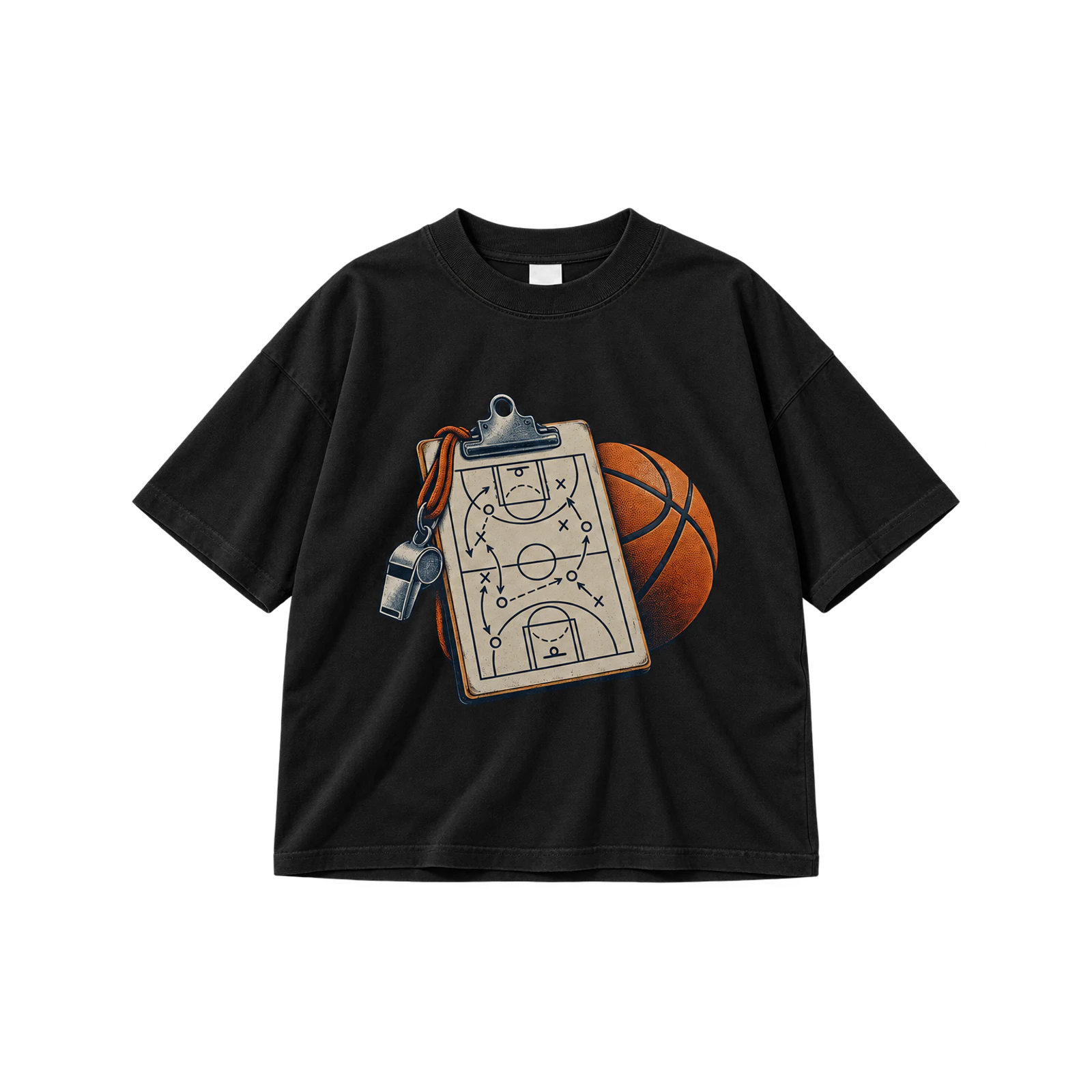
Staff-focused basketball t-shirt designs use clear Coach wording, team names, basketballs, whistles, clipboards, or compact logos to identify the coaching role without unnecessary decoration. A 2- to 4-inch left-chest mark creates a restrained staff appearance, while an 8-inch centered graphic provides stronger visibility. The same visual system extends across assistant coaches and other staff members by changing the role wording while retaining the team identity.
Key Features: Coach wording, team names, basketballs, whistles, clipboards, team logos, role labels, and restrained typography.
Best For: Basketball coaches, assistant coaches, team staff, school programs, basketball camps, tournaments, and practices.
Popular directions:
- Coach chest mark: Place a compact team logo on one chest area, add Coach directly beneath it, and keep the remaining front space visually clean.
- Whistle graphic: Combine a whistle and basketball into one simple illustration, then position the team name above and Coach wording beneath the symbol.
- Staff system: Keep the same logo, typography, and placement across t-shirts, changing only Coach, Assistant Coach, Manager, or Staff for each role.
- Team back print: Use a small Coach identifier on the front, then place a larger school or team wordmark across the upper back.
- Clipboard design: Draw a simplified coaching board with basketball court markings, add one small ball, and position the Coach title beneath the illustration.
- Initial and role: Make the school or club initial dominant, add a small basketball detail, and place Coach in a clean line underneath.
49. Coquette Bow Basketball Design
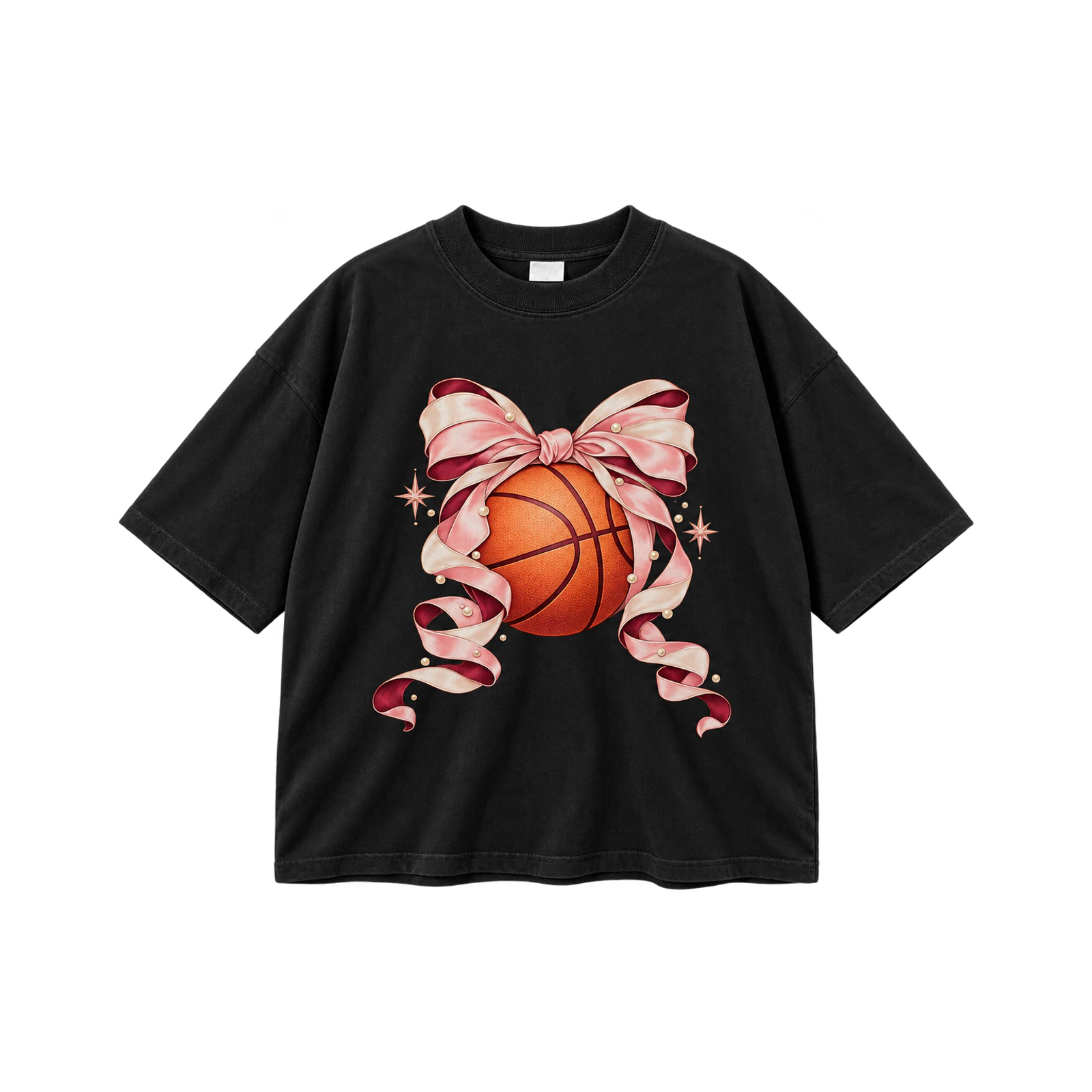
Decorative basketball T-shirt ideas pair a recognizable ball with bows, ribbons, hearts, soft patterns, and team-color accents to create a sport-focused coquette composition. The ribbon wraps around the basketball, sits above it, or frames the central shape while leaving the seams visible. Patterned bows use small basketballs, initials, or school colors, producing an 8- to 12-inch graphic with balanced decorative and athletic identities.
Key Features: Bows, ribbons, basketballs, hearts, soft patterns, team colors, initials, and decorative details.
Best For: Basketball fans, player supporters, youth apparel, team merchandise, fashion-focused sportswear, personalized gifts, and decorative basketball t-shirts.
Popular directions:
- Bow-wrapped basketball: Tie a large ribbon around the basketball, position the knot above or beside the ball, and keep the seam pattern visible underneath.
- Patterned bow: Fill the bow with small basketballs, team initials, or subtle checks, then pair it with a simpler central basketball for contrast.
- Team-color bow: Use official team colors across the ribbon, retain a recognizable basketball beneath it, and add a small school or player identifier.
- Bow above ball: Position one oversized ribbon directly above the basketball, using symmetrical tails to frame the ball without covering its central details.
- Heart-and-bow graphic: Combine small hearts with the ribbon and basketball, keeping the decorative symbols around the outer edges rather than filling the center.
- Name ribbon: Place the player’s surname or team name across a ribbon banner, then position the basketball behind it and add a small number below.
50. Youth Basketball Shirt Design
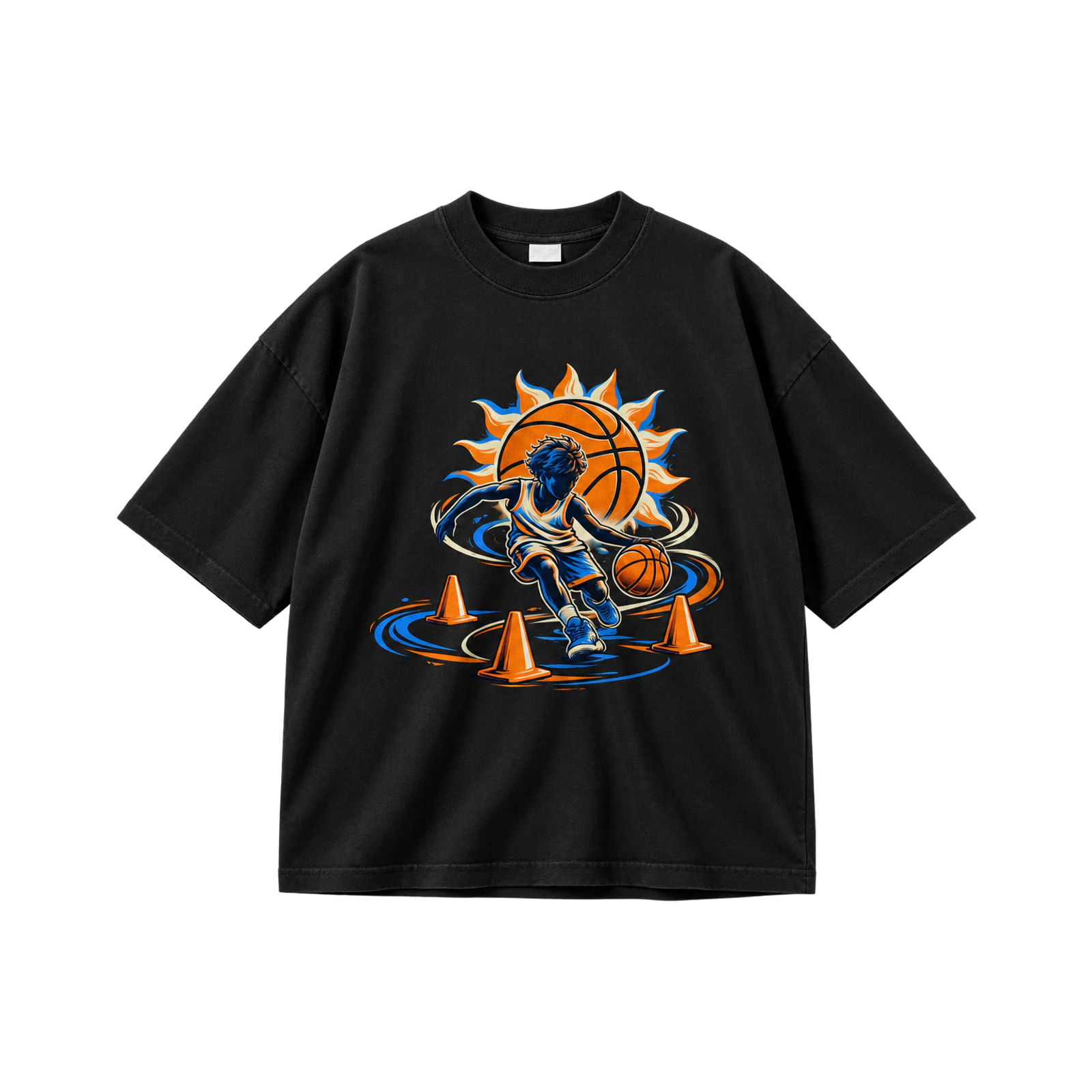
Youth basketball T-shirt ideas use simple basketball imagery, readable team wording, mascots, player numbers, and proportionate artwork that remains clear on smaller garments. The complete composition scales to youth t-shirt dimensions instead of cropping an adult layout, preserving spacing and hierarchy. Younger teams suit friendly character graphics, while older youth players align with varsity typography, team emblems, and number-led designs that retain a clear basketball identity.
Key Features: Basketballs, team names, mascots, player numbers, school colors, readable typography, youth-scaled graphics, and simple layouts.
Best For: Youth basketball teams, school programs, recreational leagues, basketball camps, young players, family supporters, and tournaments.
Popular directions:
- Simple team t-shirt: Make the team name the primary element, place one basketball beneath it, and keep secondary wording large enough for smaller garment sizes.
- Youth mascot: Use a friendly mascot holding or dribbling a basketball, then add the team name in broad readable lettering above the character.
- Player-number version: Place the young player’s jersey number prominently on the back, add the surname above it, and use a small team mark in front.
- School-color graphic: Build the design from official school colors, pair a simple basketball with the team name, and avoid small decorative details that disappear at reduced sizes.
- Cartoon basketball: Give a basketball a friendly face, arms, and sneakers, then add a short team or camp name beneath the character.
- Mini varsity design: Use bold varsity lettering and a readable jersey number, scale the complete composition proportionately, and maintain generous spacing between the primary elements.
What Are Some Basketball T-Shirt Design Tips?
The main basketball T-shirt design tips start with choosing a clear theme, audience, t-shirt color, and team colors. Use high-contrast print colors and readable basketball typography, then determine the design placement, size, and graphic layering. Finally, prepare high-resolution artwork, select the right printing method, and preview the design on a T-shirt mockup. Following these steps creates a clear process from the initial basketball t-shirt concept to the final production-ready design.
10 tips for a good basketball t-shirt design:
- Step 1: Choose a Clear Basketball Theme or Concept
Choose one main basketball theme before adding typography, colors, or supporting graphics. The concept focuses on a team, player, school, tournament, championship, retro basketball style, streetwear aesthetic, or fan apparel. Keep one element visually dominant, such as a player portrait, mascot, basketball, jersey number, or team name, and use secondary elements to reinforce that idea instead of introducing competing themes.
- Step 2: Choose Who the Shirt Is For
Identify who will wear the basketball T-shirt because the audience affects the message, personalization, and overall design style. Players need names and jersey numbers, coaches use compact team or staff identifiers, parents prefer player-focused supporter graphics, and fans wear broader team or Game Day designs. Defining the wearer first makes it easier to select relevant basketball elements and avoid adding details that do not serve the t-shirt’s purpose.
- Step 3: Choose the Shirt and Team Colors
Select the T-shirt color and team palette before finalizing the artwork so every graphic element remains visible against the garment. When designing for an established school, club, or team, use its recognizable colors consistently across the team name, basketball, mascot, number, and supporting graphics. Test the complete palette on the intended t-shirt color because the same artwork appears noticeably different on white, black, navy, gray, or another garment color.
- Step 4: Use High-Contrast Print Colors
Create enough contrast between the garment and important design elements so the basketball graphic, team name, player number, and other information remain easy to distinguish. Light artwork needs sufficient separation from light t-shirts, while dark graphics require the same consideration on darker garments. Check smaller details such as number outlines, mascot features, halftone areas, and secondary text at their actual print size because weak contrast becomes more noticeable when artwork is reduced.
- Step 5: Use Bold and Readable Basketball Typography
Choose typography that keeps team names, player names, numbers, slogans, and event information readable at normal viewing distance. Athletic, varsity, collegiate, slab, and other bold display styles work well for primary basketball wording, while decorative or script lettering is better reserved for short supporting text. Maintain enough spacing between letters and lines, and avoid excessive outlines, shadows, or effects that make important information harder to recognize after printing.
- Step 6: Choose the Design Placement and Size
Match the placement and dimensions to the type of basketball graphic instead of applying one standard size to every design. A 2- to 4-inch area suits chest logos, initials, badges, and embroidered marks. 6 to 10 inches accommodates horizontal graphics such as a basketball heartbeat. 8 to 12 inches works for many standard front designs, and 12 to 14 inches gives player portraits, streetwear graphics, and oversized compositions more room. Back placement is particularly useful for large player numbers, team rosters, and detailed event graphics.
- Step 7: Layer Graphics Without Overcrowding the Design
Arrange multiple basketball elements in a clear visual hierarchy so the viewer can identify the main subject before noticing supporting details. Keep player faces, jersey numbers, team names, mascots, and primary slogans unobstructed, then place textures, stars, paint splatter, court markings, or smaller symbols behind or around them. If removing a secondary element makes the central basketball concept easier to understand, the design will benefit from leaving that element out.
- Step 8: Prepare High-Resolution, Print-Ready Artwork
Prepare the basketball artwork at its intended production dimensions so edges, typography, player details, and small graphic elements remain clean when printed. Use vector files where practical for team logos, numbers, lettering, badges, and simple basketball illustrations, and avoid enlarging low-resolution raster images because scaling produces blurry or pixelated results. Inspect portraits, mascot details, halftone dots, net lines, and small text at the final print size before exporting the production file.
- Step 9: Choose the Right Printing Method
Select a printing method according to the artwork’s colors, detail, size, garment, and production requirements. Screen printing suits bold limited-color team graphics and athletic typography, DTG and DTF work well for detailed portraits, gradients, watercolor effects, neon graphics, and multi-color illustrations, embroidery fits compact logos and simplified badges, puff print adds dimension to thick varsity lettering, and patches suit emblem-style basketball designs. Match the artwork to the production method rather than removing important design details later to accommodate an unsuitable process.
- Step 10: Preview the Final Design on a T-Shirt Mockup

Preview the finished basketball design on a realistic T-shirt mockup before sending the artwork to production so you can evaluate its size, placement, colors, contrast, and relationship with the garment. Use a T-shirt mockup to check whether a chest logo feels proportionate, whether an oversized player graphic extends too close to seams, whether a back number sits at the correct height, and whether important typography remains readable on the selected t-shirt color. A final mockup review helps identify placement and scale problems that may not be obvious when viewing the artwork on a blank digital canvas.
What Mistakes Affect a Basketball T-Shirt Design?
Common basketball T-shirt design mistakes include overcomplicated graphics, poor color contrast, low-resolution artwork, incorrect graphic placement, improper design sizing, hard-to-read typography, spelling and proofreading errors, and a printing method that does not suit the fabric. Identifying and correcting these issues before production helps preserve the readability, visual balance, print quality, and intended appearance of the basketball T-shirt design.
Mistakes that affect a basketball T-shirt design:
- Overcomplicated Graphics
Too many words, icons, textures, sponsor marks, basketballs, stars, splatters, or decorative effects weaken the main focal point. Choose one dominant element, such as a player portrait, team name, or slogan, and arrange supporting elements like jersey numbers, basketball graphics, and team marks around it without overcrowding the composition.
- Poor Color Contrast
Poor contrast between the t-shirt, typography, player numbers, and basketball graphics makes important elements difficult to distinguish. Test the final print colors against the actual garment color, then check smaller details such as lettering, number outlines, halftones, line art, and supporting symbols to ensure they remain clearly visible.
- Low-Resolution or Blurry Artwork
Low-resolution artwork becomes blurry or pixelated when enlarged to the required basketball T-shirt print size. Prepare graphics at their intended dimensions, use vector files for logos, numbers, team names, and typography when practical, and inspect portrait edges, mascot lines, halftone dots, and basketball seams before exporting the final artwork.
- Incorrect Graphic Placement
Incorrect placement makes a basketball graphic appear unbalanced when it sits too low, too close to the collar, near a seam, or visibly off-center. Preview the artwork on a realistic T-shirt mockup and evaluate its position against the collar, chest area, sleeves, side seams, and overall shape of the garment.
- Improper Design Sizing
Improper sizing makes a basketball graphic feel insignificant or overwhelm the available print area. Use 2 to 4 inches for compact team marks, 8 to 12 inches for standard basketball graphics, and 12 to 14 inches for player portraits or oversized streetwear compositions when the proportions of the T-shirt support the larger scale.
- Hard-to-Read Typography
Thin strokes, tight spacing, excessive effects, and highly decorative fonts reduce the readability of team names, player names, jersey numbers, and basketball slogans. Use clear athletic, varsity, collegiate, or bold display lettering for important information, maintain sufficient spacing, and check the complete typography treatment at its intended print size before production.
- Spelling and Proofreading Errors
Spelling and information errors affect team names, player names, jersey numbers, school names, years, slogans, and tournament details. Proofread every text element before exporting the artwork, and give additional attention to roster t-shirts, personalized designs, and senior-night basketball t-shirts where individual garments may contain different names, numbers, or class information.
- Using a Printing Method That Does Not Suit the Fabric
An unsuitable printing method can reduce artwork detail or produce a finish that does not suit the selected garment. Match the design and fabric with the production process, using DTG or DTF for detailed graphics, screen printing for limited-color designs, embroidery for simplified marks, puff print for thick typography, and patches for badge-style designs.

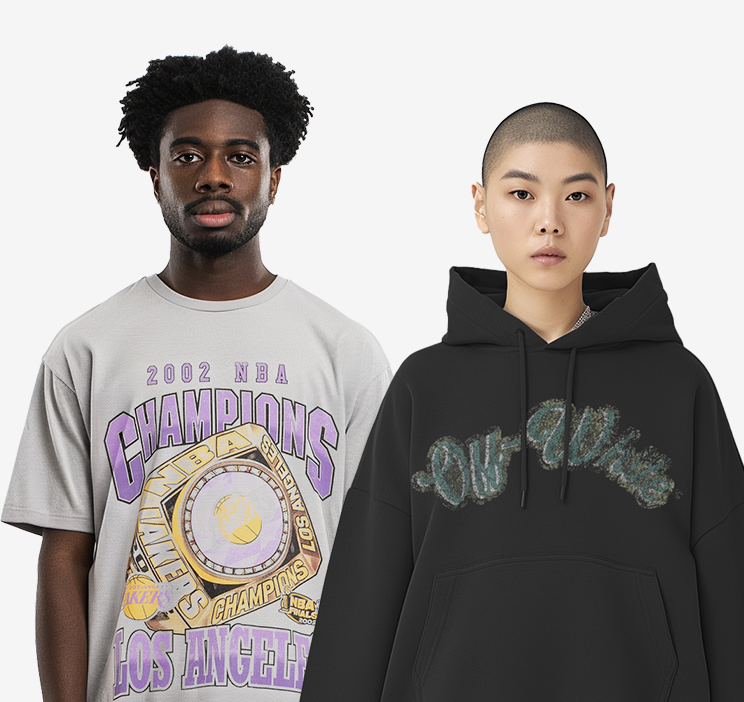
 Trusted By Thousands Of Designers
 Cancel Your Subscription Anytime
 30 Day Money Back Guarantee